
Last Updated: October 22, 2026
Quick Summary
End-to-end logistics is the coordinated management of every step in your supply chain, from the moment goods leave your supplier to when they arrive at your customer’s door, with a single partner who owns visibility and accountability across the entire journey. This eliminates gaps created by fragmented providers and ensures your cargo reaches its destination safely, on time, and on budget.
- End-to-end logistics consolidates supply chain management under one provider, creating visibility and accountability across every stage from origin to final delivery.
- Real-time coordination allows providers to adapt the entire chain within hours when circumstances change, rather than passing problems between multiple vendors.
- AGCO reduced freight costs by approximately 18% through supply chain optimization by integrating logistics management across the entire operation.
- Total cost of ownership includes freight charges, inventory carrying costs, exception and expedite costs, and internal coordination labour, not just carrier rates.
- Measure the complete journey with metrics like on-time delivery rate, order cycle time, cost per shipment, and visibility accuracy, with an 8-12 week baseline before switching providers.
Table of Contents
- What End-to-End Logistics Actually Means
- How End-to-End Logistics Works Across Your Supply Chain
- End-to-End Supply Chain Visibility: Real-Time Tracking and Control
- Logistics Cost Reduction Strategies Through Integration
- Third-Party Logistics Benefits: Why Outsourcing Works
- Measuring Success: Logistics Performance Metrics That Matter
- When End-to-End Logistics May Not Be the Right Fit
- Frequently Asked Questions
What End-to-End Logistics Actually Means
End-to-end logistics is the coordinated management of every step in your supply chain, from the moment goods leave your supplier to when they arrive at your customer’s door.
Fragmented logistics creates gaps. When your supplier handles the first leg, a freight forwarder the middle, and a local distributor the last, nobody sees the full picture: delays compound, costs hide, and responsibility gets lost between handoffs.
At Seatram, we manage that complexity for businesses importing and exporting goods across borders, handling perishables, hazardous cargo, oversized items, and everything in between.
End-to-end logistics consolidates supply chain management under a single provider, creating visibility, accountability, and efficiency across every stage from origin to final delivery.
How End-to-End Logistics Works Across Your Supply Chain
Your shipment flows through a sequence of critical handoffs: export documentation, port operations, customs clearance, transportation, warehousing, and final delivery.
In practice, your freight forwarder begins by understanding your exact requirements, not just weight and destination, but the regulatory constraints, temperature controls, timing windows, and cost thresholds that define success.
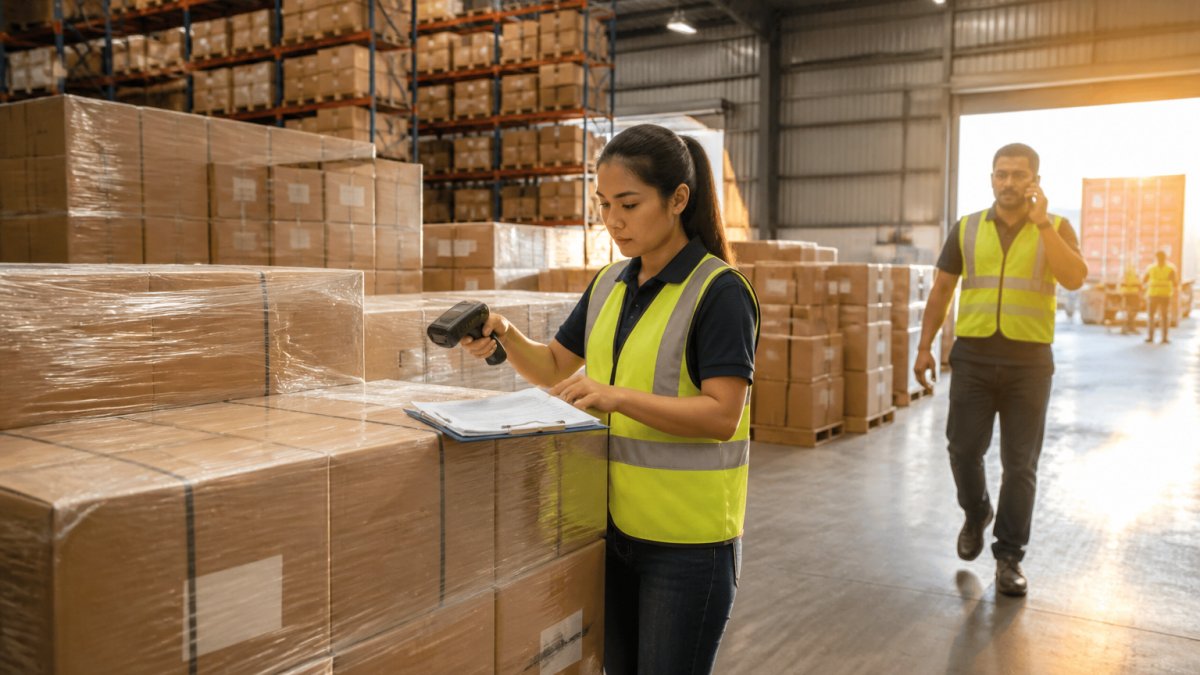
Real-time coordination is the difference. When your shipment clears port faster than expected, the provider adjusts warehouse timing.
Automation of logistics processes accelerates this coordination.
End-to-End Supply Chain Visibility: Real-Time Tracking and Control
Visibility is where end-to-end logistics delivers its most immediate advantage. You’re not checking three tracking systems or waiting for email updates that arrive hours late, you see your shipment’s status in real time across every stage.
This goes beyond “in transit” updates. Modern platforms show where your cargo is, its condition, whether it’s on schedule, and what happens next: temperature monitoring through the cold chain for perishables, compliance documentation status at every checkpoint for hazardous cargo, and alerts before delays occur for time-sensitive shipments.
Supply chain visibility also reveals patterns. Over time, you see which routes perform reliably, which carriers deliver consistently, and where delays typically occur. That data becomes the foundation for optimization, not guesswork.
Request real-time dashboards that show not just current location but predictive arrival windows, exception alerts, and documentation status. This transforms tracking from a status check into a planning tool.
Logistics Cost Reduction Strategies Through Integration
Cost savings emerge from integration, but not always where you’d expect. Consolidating providers eliminates duplicate overhead, but the deeper savings come from eliminating the waste fragmentation creates: expedited shipments to recover from delays, inventory buffers against uncertainty, and administrative labour spent coordinating vendors.
A documented case study illustrates this. AGCO reduced freight costs by approximately 18% through supply chain optimization, demonstrating how integrated logistics management compresses costs across the entire operation. That reduction didn’t come from negotiating lower rates with a single carrier, it came from optimizing the entire flow.
Build a total cost of ownership model, not a freight quote comparison
The most common mistake is comparing carrier rates in isolation. A true comparison measures total cost of ownership (TCO) across four cost pools:
- Freight and carrier charges, linehaul, fuel surcharges, terminal handling, and accessorial fees.
- Inventory carrying cost, typically expressed as an annual percentage of inventory value, covering capital, storage, insurance, obsolescence, and shrinkage. Many practitioners use a carrying-cost rate in the range of 15-25% of average inventory value per year; the exact figure depends on your cost of capital and product risk profile.
- Exception and expedite costs, air freight upgrades, split shipments, demurrage and detention, and re-delivery charges triggered by late or misrouted cargo.
- Internal coordination labour, the hours your team spends chasing status updates, reconciling invoices, and managing multiple vendor relationships.
Add these four pools to get your current baseline. Then compare that total against the all-in cost of an integrated arrangement: the provider’s service fee, any technology or integration setup cost, and the residual internal effort to manage one relationship instead of several.
Where the savings actually come from
Integration compresses cost through mechanisms you can trace:
- Fewer handoffs, fewer failure points. Each vendor transition is a chance for a delay, and each delay triggers expedite charges or buffer stock. Reducing handoffs reduces the frequency of both.
- Predictable lead times reduce safety stock. When arrival windows are reliable, you can lower buffer inventory without raising stockout risk. The saving shows up in carrying cost, not freight.
- Consolidated volume improves rate leverage. A single provider moving your full volume can often negotiate better carrier rates than several small buyers each negotiating a fragment.
- One invoice, one reconciliation. Administrative overhead falls when you stop matching multiple invoices, service agreements, and dispute processes.
Pricing trade-offs to weigh honestly
End-to-end logistics is not automatically cheaper. Setup and integration costs, system connections, data mapping, process redesign, and staff training, are real and often front-loaded. Ongoing service fees may be higher than the sum of the cheapest fragmented quotes, because you are paying for coordination and accountability. The business case rests on the exception, inventory, and labour savings exceeding that premium. Model it before you commit, and ask the provider to show how their fee compares to your measured baseline rather than to a headline carrier rate.
Ask for a line-by-line cost breakdown that separates freight, service fee, technology, and any pass-through charges. A provider confident in its value will show you where the savings come from, not just the total.
The real cost reduction strategy: measure total logistics spend, not just freight charges. Include inventory carrying costs, expedited fees, and internal labour, then compare that total against integrated end-to-end logistics pricing. The gap is typically larger than carrier quotes alone suggest, but only if you count all four pools.
Third-Party Logistics Benefits: Why Outsourcing Works
Third-party logistics providers (3PLs) exist because most businesses can’t justify the infrastructure to manage complex supply chains internally. The question isn’t whether to outsource, but whether to use specialists who manage one piece or end-to-end providers who own the complete process.
Outsourcing to a dedicated 3PL transfers operational risk. You stop managing carrier relationships, customs compliance, warehouse operations, and last-mile delivery, and access existing expertise instead of hiring and training staff.
End-to-end 3PL services eliminate that trap. Your provider manages the complete chain, so accountability is clear. When something goes wrong, you have one partner to contact, not a chain of vendors blaming each other.
Avoid splitting your logistics across multiple 3PLs unless you have the internal capability to coordinate them. The cost savings from using cheaper providers often disappear when you factor in coordination overhead and delay penalties.
Measuring Success: Logistics Performance Metrics That Matter
End-to-end logistics creates accountability because success is measurable. Instead of tracking stage-level metrics (carrier on-time rate, warehouse processing time, delivery completion rate), you measure the complete journey from order placed to delivery completed, something fragmented vendors rarely can calculate.
Define each KPI with a calculation method
Vague metrics produce vague decisions. Define each one precisely:
- On-time delivery rate = shipments delivered within the agreed window ÷ total shipments × 100. Agree the window in writing (for example, delivery by the promised date, not within a multi-day range).
- Order cycle time = average days from order confirmation to delivery completed. Track the median as well as the mean, because a few extreme outliers can distort the average.
- Cost per shipment = total logistics spend (freight + service fees + accessorials + internal labour allocation) ÷ number of shipments. Keep the cost pools consistent month to month so the trend is comparable.
- Inventory carrying cost = average inventory value × your carrying-cost rate. If you reduce safety stock after integration, this is where the saving appears.
- Damage rate = shipments arriving in acceptable condition ÷ total shipments × 100. Define ‘acceptable’ before you start measuring.
- Visibility accuracy = shipments whose predicted arrival window matched actual arrival ÷ total shipments × 100. This is the metric most businesses overlook, and it determines whether you can trust the data for planning.
Set a baseline before you switch
You cannot prove improvement without a before-and-after comparison. Before moving to an integrated provider, record 8-12 weeks of your current performance on each metric above. That baseline becomes the reference point for every review. Without it, any claimed improvement is anecdote.
Use benchmarks with caution
Industry benchmarks exist, but they vary by sector, lane, and cargo type, so treat any published figure as a directional guide rather than a target. A more reliable approach is to compare your post-integration performance against your own baseline, then against the provider’s contractual service commitments. Ask prospective providers what on-time delivery and visibility accuracy they will commit to in the service agreement, and how those commitments are measured and reported.
Review cadence and what to do with the numbers
Track these metrics monthly and review them quarterly with your provider. A simple pattern works well: compare actuals to baseline, flag any metric that has moved in the wrong direction for two consecutive months, and trace the cause to a specific stage in the chain. Because one provider controls the full sequence, the cause is usually identifiable rather than lost between vendors.
Measure the whole journey, not each stage in isolation. Define each KPI with a formula, capture a pre-switch baseline, and hold the provider to contractual service commitments. Visibility accuracy is the metric that tells you whether the rest of your data can be trusted.
When End-to-End Logistics May Not Be the Right Fit
End-to-end logistics is powerful, but not universal. Some business models, shipment types, or operational constraints make fragmented logistics the better choice.
If your shipments are simple, domestic, and low-value, the coordination overhead may exceed the benefit.
If your business has minimal logistics volume, fewer than 10-15 shipments monthly, the fixed costs of setting up end-to-end logistics relationships may not justify the benefit.
And if existing logistics relationships perform well and your business isn’t growing, disrupting them to consolidate carries switching risk that may outweigh the efficiency gains.
End-to-end logistics works because it replaces coordination chaos with systematic control: shipments move faster, costs compress, and visibility becomes reliable.
At Seatram, we manage sea, air, and land freight with the same commitment to safety, timeliness, and budget discipline. Request a Quote to see how end-to-end logistics can simplify your supply chain.
Frequently Asked Questions
What is end-to-end logistics, and how does it differ from traditional logistics?
End-to-end logistics manages your entire supply chain through a single provider, from procurement through warehousing, transportation, and final delivery. Traditional logistics often fragments these functions across multiple vendors, creating coordination gaps and visibility loss. A single provider eliminates handoffs, reduces miscommunication, and ensures consistent service standards throughout the journey.
How does end-to-end supply chain visibility improve my operations?
Real-time tracking across all stages, order placement, warehousing, customs clearance, and delivery, gives you immediate insight into shipment status and potential delays. This visibility enables faster problem-solving, reduces surprises at delivery, and lets you provide accurate updates to your customers. You can also identify bottlenecks and optimise processes based on actual performance data rather than guesswork.
Can end-to-end logistics actually reduce my shipping costs?
Yes. By consolidating shipments, eliminating redundant handling, and optimising routes through a single integrated system, end-to-end providers reduce administrative overhead and transportation inefficiencies. Cost savings vary by current setup, but consolidation and process automation typically deliver measurable reductions.
What are the main risks when switching to end-to-end logistics?
Implementation requires staff retraining on new systems, temporary disruption during the transition, and dependency on a single provider for critical operations. Mitigation involves phased rollout of services, clear service level agreements with defined performance metrics, and ensuring your provider has proven experience with cargo types and routes matching your needs. Verify references from similar-sized businesses in your industry before committing.