
Table of Contents
- Understand the 25-Year Rule and Eligibility Criteria
- Secure ROVER Import Approval Before Shipping
- Calculate Vehicle Import Duty and GST Accurately
- Plan Shipping Logistics and Customs Clearance
- Arrange Freight Liability and Cargo Protection
- Complete Post-Import Compliance and Registration
- Frequently Asked Questions
Last Updated: September 21, 2026
Understand the 25-Year Rule and Eligibility Criteria
A vehicle must be at least 25 years old from its original build date to qualify for concessional entry into Australia under the specialist and enthusiast vehicle scheme, which may exempt it from costly compliance modifications when importing classic cars.
You’ll need the vehicle identification number (VIN) and proof of original manufacture date from the manufacturer or a heritage vehicle assessor, not estimated from appearance.
You may avoid costly modifications under this scheme, but quarantine inspection and biosecurity clearance are still mandatory before the vehicle arrives.
According to Australian Department of Agriculture’s vehicle import guidelines, vehicles over 25 years old qualify for concessional entry, but documentation proving build date is mandatory. Without it, your import stalls at customs clearance.
Keep original factory documentation, service records, or a statutory declaration from the previous owner confirming build date. These documents speed up customs clearance significantly.
Secure ROVER Import Approval Before Shipping
ROVER (Registered Operator Vehicle Entry Register) is your legal permission to import the vehicle. You must obtain approval before shipping, not after arrival.
The approval process takes 2-4 weeks. Contact your state transport authority or an approved customs broker to verify eligibility and ownership.
Your application requires the vehicle’s make, model, year, VIN, engine number, colour, and intended use (personal collection, restoration, or commercial).
Applying for ROVER approval after shipping begins will result in port delays and storage fees. Secure approval in writing before the freight forwarder books the vessel.
Shipping before ROVER approval is confirmed will result in port delays and unexpected storage charges. Always secure approval in writing before the freight forwarder books the vessel.
Calculate Vehicle Import Duty and GST Accurately
Import duty and GST are separate charges. Your customs value is typically the purchase price. GST (10%) is calculated on the customs value plus import duty. Total landed cost includes purchase price, shipping, import duty, and GST.
Work with your freight forwarder or customs broker to calculate the exact total cost before committing to purchase. Seatram’s team can help you understand the full cost breakdown so there are no surprises at customs clearance.
Request a valuation report from an independent assessor to protect against customs disputes over declared value.
Total import cost = vehicle price + shipping + import duty + GST. Calculate this before committing to purchase. A 10% GST error on a $50,000 vehicle costs $5,000.
Plan Shipping Logistics and Customs Clearance
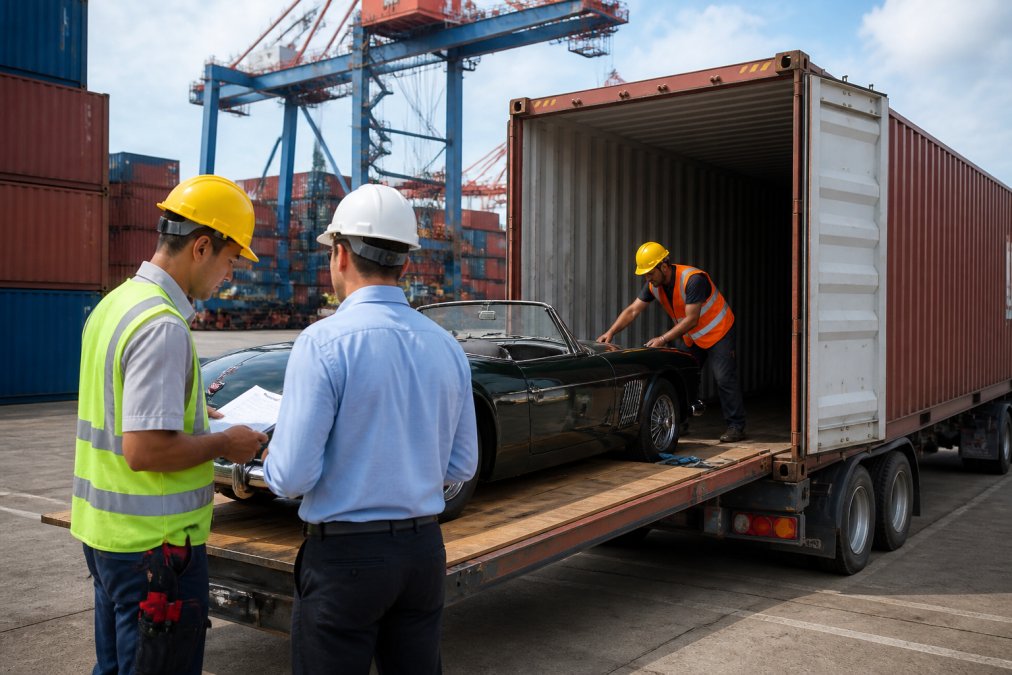
You need a freight forwarder experienced in vehicle logistics, customs documentation, port procedures, and biosecurity requirements when importing classic cars over 25 years old.
Select a Freight Forwarder with Customs Expertise
Choose a forwarder with vehicle import experience who understands biosecurity requirements and ROVER documentation. Ask about their customs broker relationships; in-house expertise accelerates clearance and ensures proactive document preparation.
Seatram is a specialist provider of comprehensive freight forwarding and logistical services. Our experienced team ensures your cargo reaches its destination safely, on time, and on budget. We pride ourselves on identifying the unique requirements of every client to implement customized local or global shipping strategies.
Prepare Documentation and Biosecurity Requirements
You’ll need: bill of lading, shipping manifest, vehicle identification documents (VIN, engine number, origin registration), proof of ownership, ROVER approval, quarantine inspection report, and asbestos clearance certificate or remediation documentation.
Quarantine inspection is mandatory to check for prohibited materials, pests, and contaminants. For classic vehicles, asbestos testing is critical.
Asbestos Testing and Remediation: A Mandatory Pathway
Asbestos was common in vehicles manufactured before the 1980s, appearing in brake pads, clutch linings, gaskets, engine insulation, and heat shields. Quarantine officers conduct visual inspection and may take samples if asbestos-containing materials are suspected.
Quarantine officers conduct visual assessment for asbestos-containing materials (ACM).
Asbestos in classic cars is not optional to address. If detected during quarantine inspection, the vehicle will not be released until remediation is certified. Budget AUD $2,000-$6,000 for professional removal and 3-6 weeks for testing and remediation. Failure to address asbestos will halt your import indefinitely.
Request a pre-import asbestos survey from the vehicle’s current owner or a specialist to identify likely ACM locations and advise on removal before shipment. This reduces timeline and cost. Your freight forwarder should coordinate with quarantine inspectors and licensed contractors. Do not attempt DIY removal; it is illegal and hazardous.
Arrange Freight Liability and Cargo Protection
Secure marine cargo insurance before shipping. Standard ocean freight insurance covers most risks (1-2% of vehicle value), but verify coverage includes the quarantine inspection period and asbestos remediation delays. Clarify liability limits and claims procedures in writing.
Secure marine cargo insurance before the vehicle ships. Confirm coverage includes the quarantine inspection period and any potential asbestos remediation delays. Clarify liability limits and claims procedures in writing.
Arrange Freight Liability and Cargo Protection
Freight liability and cargo protection are not optional. A classic car is valuable. It needs insurance from the moment it leaves the seller’s location until it arrives at yours.
Complete Post-Import Compliance and Registration
Once the vehicle clears customs, compliance work begins. The gap between customs-cleared and road-legal is substantial and often underestimated.
Understanding the Roadworthiness Certificate Inspection
Your vehicle must pass a roadworthiness certificate (RWC) inspection, a detailed compliance audit against current Australian standards. The inspection takes 1-2 hours and costs AUD $200-$400. Each state sets its own criteria, though frameworks are broadly consistent.
State-by-State Variation and Timeline
Roadworthiness requirements vary by state. Confirm your state’s specific requirements before booking; a vehicle that passes in one state may fail in another. Book your inspection as soon as the vehicle arrives (2-4 weeks in busy periods) to allow time for remediation if needed.
Common Compliance Issues and Remediation Costs
Most classic cars require modifications to pass RWC. Common costs: brake upgrades (AUD $200-$3,500), LED/HID headlight conversion (AUD $400-$1,200), seat belt retrofit (AUD $300-$800 per seat), suspension repairs (AUD $200-$1,200), emissions fixes (AUD $200-$15,000+ depending on engine conversion), windscreen/wipers (AUD $100-$800), and tyres (AUD $600-$1,600 for a set).
Total post-import compliance costs typically range from AUD $1,000-$5,000 for minor work (brakes, lights, belts) to AUD $8,000-$20,000+ if major upgrades are needed (engine conversion, full suspension rebuild). Budget conservatively and plan for a 4-8 week timeline from arrival to RWC pass.
Bridging the Gap: Import Clearance to Road-Legal Registration
Once your vehicle passes the RWC inspection, registration is straightforward but not automatic. Here’s the sequence:
- RWC Inspection: Vehicle passes inspection; inspector issues the RWC certificate (valid for 12 months).
- Registration Application: Contact your state’s transport authority or use a registration service (e.g., a local mechanic or automotive broker). Provide:
- RWC certificate
- Proof of ownership (bill of sale or title deed from origin country)
- ROVER import approval documentation
- Proof of identity and address
- Vehicle details (VIN, engine number, colour, make, model, year)
- Registration Fee: Pay the registration fee, which varies by state and vehicle value. Classic cars often qualify for concessional registration rates (lower annual fees) if registered as historic or classic vehicles. Check your state’s criteria; some require the vehicle to be over 30 years old, others over 25.
- Number Plates: Once registration is approved, you’ll receive Australian number plates. These must be fitted before the vehicle is driven on public roads.
- Insurance: Before driving, arrange comprehensive or third-party insurance. Some insurers specialise in classic vehicles and offer agreed-value policies (the insurer agrees on the vehicle’s value upfront, avoiding disputes in a claim).
Registration Concessions: Many states offer reduced registration fees for historic or classic vehicles:
- New South Wales: Historic vehicle registration available for vehicles over 30 years old; annual fee is typically AUD $50-$100 (compared to AUD $500+ for standard vehicles).
- Victoria: Classic vehicle registration for vehicles over 30 years old; similar concessional rates.
- Queensland: Historic vehicle registration available; check current eligibility.
Insurance During Transit and Post-Import
Once the vehicle is road-legal, you’ll need insurance before driving. Classic car insurance differs from standard vehicle insurance:
- Agreed-value policies: The insurer agrees on the vehicle’s value upfront. If the vehicle is damaged, you receive the agreed amount without depreciation disputes.
- Limited-use policies: Some insurers offer lower premiums if the vehicle is used only for shows, club events, or occasional drives (not daily commuting).
- Specialist insurers: Companies specialising in classic vehicles understand the value and rarity of older cars and offer tailored coverage.
Obtain a quote before the vehicle arrives so you understand the cost.
Do not drive your imported classic car on public roads without insurance. It is illegal and leaves you personally liable for any damage or injury. Arrange insurance before the RWC inspection is complete so you’re covered immediately after registration.
Frequently Asked Questions
What is the 25-year rule for importing classic cars?
The 25-year rule allows vehicles manufactured at least 25 years ago to be imported with concessional RAV entry approval, bypassing many modern safety and emissions standards. This applies to vehicles meeting the definition of a specialist and enthusiast vehicle scheme. The vehicle’s original build date, not its current condition, determines eligibility. Vehicles younger than 25 years must meet current Australian Design Rules, which is significantly more costly and complex.
Do I need ROVER import approval before shipping my classic car?
Yes. ROVER (Registrar of Imported Vehicles) import approval is mandatory before your classic car arrives. You must apply before shipping and receive approval in writing. The process requires proof of the vehicle’s age, the vehicle identification number, and confirmation it meets the specialist and enthusiast vehicle scheme criteria. Without this approval, customs will not release your vehicle, and you will face delays and additional costs.
How much vehicle import duty and GST will I pay?
Import duty and GST are calculated on the vehicle’s customs value (typically the purchase price plus freight and insurance). Duty rates vary by vehicle type. GST at 10% applies to the total landed cost. A customs broker or freight forwarder can provide an exact quote based on your vehicle’s valuation. Currency fluctuation impacts the final cost, so lock in exchange rates early if possible.
What happens if my classic car is damaged during shipping?
Freight liability and cargo protection depend on your insurance and the freight forwarder’s terms. Standard carrier liability is limited; you need specialist transit insurance for a classic car’s full value. Arrange comprehensive coverage before shipment that includes port-to-port and door-to-door transit. In case of damage, document everything immediately with photos and notify your insurer and freight forwarder within the required timeframe (typically 48 hours) to preserve your claim.