
Table of Contents
- Understanding the Customs Clearance Process for Automotive Parts
- Essential Automotive Parts Import Documents
- Tariff Classification and HS Codes for Auto Parts
- Calculating Customs Duty on Car Parts
- Biosecurity Requirements for Automotive Parts
- Automotive Parts Customs Clearance Timeline
- Common Delays and How to Avoid Them
- Frequently Asked Questions
Last Updated: October 18, 2026
Understanding the Customs Clearance Process for Automotive Parts
Understanding customs clearance automotive parts means learning the series of steps your shipment must pass before arrival: declaring goods, providing documentation, paying duties, and obtaining entry approval.
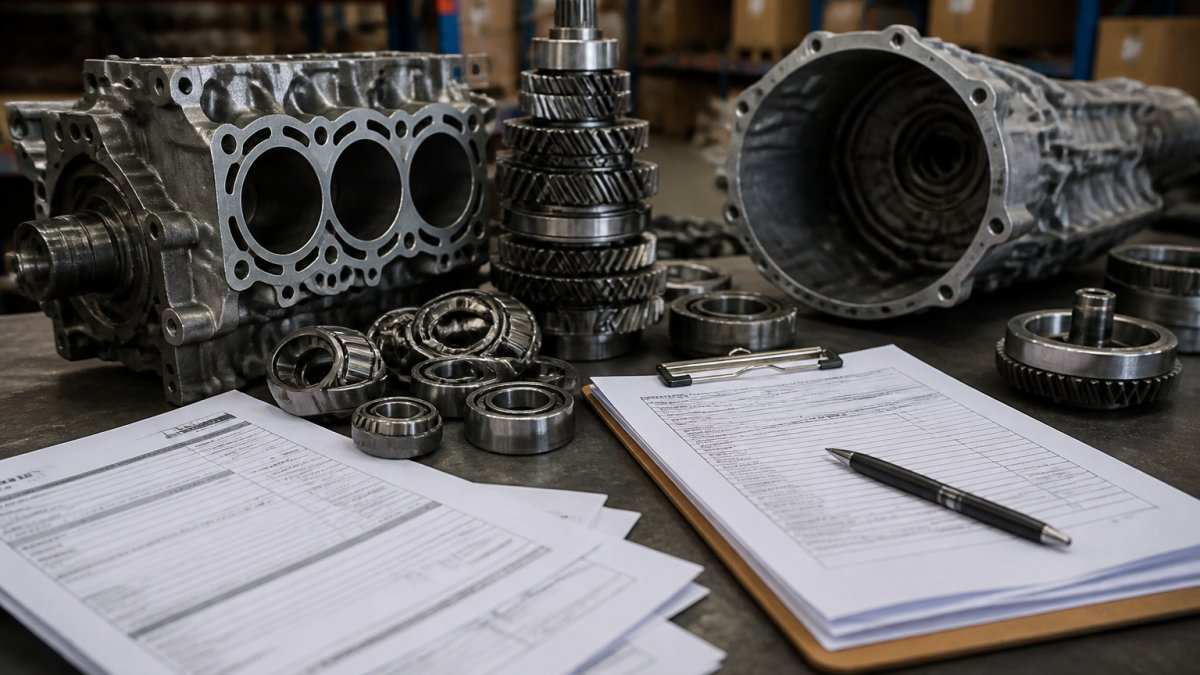
Importing automotive parts triggers a regulated workflow to verify legality, assess duty, and manage biosecurity risks, from lodgement of your declaration to customs release.
Understanding each stage prevents costly delays; most shipments clear within 2-5 business days when paperwork is complete.
The customs clearance process for automotive parts follows a predictable sequence:
- Your freight forwarder submits your import declaration electronically
- Customs reviews documentation and assigns a risk classification
- Your goods may be selected for physical inspection or released immediately
- Biosecurity checks occur for parts with organic components or lubricants
- Duty and taxes are calculated and must be paid before release
- Goods are formally released and available for collection
Essential Automotive Parts Import Documents
You need specific documents to clear automotive parts through customs. Missing or incomplete paperwork is the single biggest cause of delays and holds.
Commercial Invoice shows seller, buyer, item description, quantity, unit price, and total value.
Packing List itemises every part by carton or pallet with quantities and part numbers; a detailed list speeds up physical inspections.
Certificate of Origin documents where each part was manufactured and proves eligibility for reduced tariff rates under preferential trade agreements.
Supporting documents may include:
- Supplier invoices or pro forma invoices
- Purchase orders or contracts
- Quality certificates or test reports (for engine components or electrical parts)
- Manufacturer specifications or datasheets
- Insurance certificates if goods are insured in transit
Documentation errors trigger manual reviews, inspections, and delays that can cost thousands in holding fees.
Tariff Classification and HS Codes for Auto Parts
Every automotive part has an HS code (Harmonised System code) that determines its tariff rate and restrictions. Misclassification can mean incorrect duty, penalties, or goods held pending reclassification.
HS codes are eight digits for Australian customs: the first six are internationally standardised, the last two country-specific.
Common automotive parts fall into these HS code ranges:
- Engine components (pistons, valves, gaskets): 8409
- Transmission and drivetrain parts: 8708
- Electrical components and wiring harnesses: 8544
- Brake components and hydraulic systems: 8708
- Suspension and steering parts: 8708
- Cooling system components: 8409
Similar-looking parts may have different codes based on material, intended use, or whether they’re finished goods or components, an automotive stainless steel bolt may classify differently than a general industrial bolt.
Incorrect HS classification creates three problems: wrong duty rates (triggering audits), restricted items classified as unrestricted (causing seizure), and lost preferential origin benefits.
To classify correctly:
- Check the supplier’s documentation for part specifications
- Cross-reference the Australian Customs Tariff database
- When uncertain, request a binding tariff classification ruling from Customs
- Document your classification reasoning in case of audit
Calculating Customs Duty on Car Parts
Customs duty on automotive parts is a percentage of the customs value, with the rate depending on HS code, origin, and any preferential trade agreement. Duty feeds into the GST base, so a small classification error compounds through the whole landed cost.
How the customs value is built
Customs authorities don’t simply take the invoice total. The customs value is typically the transaction value, the price actually paid or payable, adjusted to include:
- The cost of the goods themselves
- Freight and transport to the port of importation
- Insurance and related charges
- Certain assists, royalties or licence fees where they relate to the imported goods
- Packing and container costs
Some costs can be excluded if separately identified and incurred after importation (e.g. local installation or domestic freight). The declared value should reconcile to your invoice, purchase order and payment records.
The landed-cost formula
A practical way to build the number is:
- Customs value = goods value + international freight + insurance + dutiable adjustments
- Duty = customs value × applicable duty rate
- GST base = customs value + duty + international transport and insurance (where not already included) + any applicable charges
- GST = GST base × 10%
- Landed cost = customs value + duty + GST + brokerage + inspection and biosecurity fees + port and delivery charges
Build the calculation line by line in a spreadsheet and keep the source document for every input. When a customs officer queries a figure, you can point to the invoice, freight invoice or insurance certificate that supports it.
Worked example
Consider a shipment of engine components with a commercial invoice value of AUD 5,000, international freight of AUD 800, and insurance of AUD 120. Assume the applicable duty rate is 5% and no preferential origin applies.
| Line | Calculation | Amount (AUD) |
|---|---|---|
| Goods value | Invoice | 5,000 |
| International freight | Carrier invoice | 800 |
| Insurance | Policy | 120 |
| Customs value | 5,000 + 800 + 120 | 5,920 |
| Duty at 5% | 5,920 × 0.05 | 296 |
| GST base | 5,920 + 296 | 6,216 |
| GST at 10% | 6,216 × 0.10 | 621.60 |
| Brokerage | Fixed fee | 150 |
| Biosecurity inspection | If selected | 0 |
| Total landed cost | Sum | 6,987.60 |
If the same parts qualified for a 0% preferential rate, duty would fall to zero and the GST base would drop to AUD 5,920, reducing GST to AUD 592 and total landed cost to roughly AUD 6,662, a saving of about AUD 325. That is why origin documentation is worth chasing before you ship.
Rates, fees and thresholds change. Always confirm the current duty rate against the Australian Customs Tariff for the specific HS code and origin before you commit to a landed-cost figure. The example above illustrates the method, not a guaranteed rate.
Common calculation mistakes
- Using the invoice total as the customs value without adding freight and insurance where required.
- Applying the duty rate to the wrong base, duty applies to the customs value, not to the GST-inclusive total.
- Forgetting that duty increases the GST base, which inflates the tax payable.
- Ignoring brokerage, inspection and port charges when quoting a landed cost to a customer.
- Assuming a preferential rate applies without a valid certificate of origin or origin declaration.
Biosecurity Requirements for Automotive Parts
Australia’s biosecurity rules apply to automotive parts containing organic materials, used oils, or components that may harbour pests or disease.
Used automotive parts face stricter inspection than new parts.
Parts that trigger biosecurity checks include:
- Used engines or engine blocks with oil residue
- Transmission fluid reservoirs or hydraulic systems with residual fluid
- Parts with rubber seals or gaskets containing organic materials
- Cooling systems with antifreeze or coolant residue
- Air filters, cabin filters, or fuel filters
- Wiring harnesses with fabric or organic insulation
New parts generally clear biosecurity without inspection if clean and intact, though parts from countries with known agricultural pests may still be flagged.
To avoid biosecurity holds:
- Declare the condition of parts accurately (new vs. used)
- Request cleaning certificates from suppliers for used parts
- Package parts in clean, undamaged containers
- Provide origin documentation if parts are from high-risk countries
- Budget 1-2 additional business days for inspection if parts are used
Biosecurity inspection fees apply if your shipment is physically inspected. Fees vary but typically range from AUD 100 to AUD 500 depending on shipment size and inspection complexity.
Automotive Parts Customs Clearance Timeline
The timeline for customs clearance automotive parts depends on documentation completeness, inspection requirements, and customs workload.
Standard clearance takes 2-5 business days from lodgement:
- Day 1: Customs receives and processes your import declaration
- Day 2-3: Risk assessment and automated checks; most shipments approved without inspection
- Day 3-4: Physical inspection (if selected) or biosecurity check (if required)
- Day 4-5: Duty payment and final release approval
- Day 5+: Goods available for collection or delivery
Expedited clearance is possible with complete documentation and low-risk goods, some shipments clear within 24 hours. Delays occur when:
- Documentation is incomplete or inconsistent
- Goods are selected for physical inspection
- Biosecurity inspection is required
- Duty classification is questioned
- Goods require additional testing or certification
Peak periods (end of month, seasonal peaks) may extend clearance by 1-2 days; off-peak periods are faster.
To minimise clearance time:
- Ensure all documents are complete and accurate before shipment
- Provide detailed item descriptions and HS codes
- Declare part condition honestly (new vs. used)
- Submit documentation electronically as early as possible
- Use a freight forwarder experienced with automotive parts
Common Delays and How to Avoid Them
Most clearance delays are avoidable, but when one happens the response matters more than the cause. Here are the common triggers and how to resolve a hold.
The five most common triggers
**1.
2. Valuation queries. If the declared value looks low against comparable goods, customs may request evidence, payment records, contracts, or supplier correspondence.
3. Classification disputes. An HS code that doesn’t match the goods description can trigger reclassification, changing the duty rate and requiring a formal amendment.
4. Biosecurity flags. Used parts, residual oil or fluid, and organic materials attract inspection; missing cleaning certificates extend the hold.
5. Missing origin evidence. A preferential duty claim without a valid certificate of origin or origin declaration is disallowed, and duty is reassessed at the general rate.
What to do when customs raises a query
The response sequence is broadly the same regardless of trigger:
- Read the notice carefully. Identify exactly which line item, document or figure is in question. Do not send a blanket response.
- Assign an owner. Your broker or forwarder should be the single point of contact with customs so responses are consistent.
- Gather the supporting evidence. Pull the invoice, payment record, freight invoice, product specification or supplier statement that answers the specific query.
- Respond in writing and on time. Most customs authorities set a response window; missing it can lead to goods being held longer or returned.
- Amend the declaration if needed. If the query reveals an error, lodge a correction rather than arguing the original figure.
- Record the outcome. Note what was queried and how it was resolved so the same issue does not recur on the next shipment.
The fastest way out of a hold is a specific, evidence-backed response to the exact question asked. Vague explanations and resubmitted documents without commentary usually add another review cycle.
Handling specific scenarios
Document mismatch. Prepare a short reconciliation note explaining the difference, for example, a packing list showing 50 units against an invoice showing 45 because five were backordered.
Valuation question. Provide the commercial invoice, proof of payment, and any contract or order confirmation.
Classification query. Supply product specifications, material composition, and the reasoning behind your chosen code.
Biosecurity hold. Arrange the inspection, provide cleaning certificates or treatment records, and budget for the inspection fee and the extra days. Used parts should always be shipped with condition documentation.
Missing origin evidence. If the certificate is obtainable, request it from the supplier urgently.
Preventing the next delay
- Run a pre-lodgement check that reconciles invoice, packing list and declaration line by line.
- Keep a classification file for each part number with the reasoning and supporting specifications.
- Collect origin certificates at the point of order, not at the point of clearance.
- For used parts, obtain cleaning certificates and condition reports before shipment.
- Use a forwarder or broker who has handled automotive parts before and can flag part-specific risks early.
Frequently Asked Questions
What documents do I need to import automotive parts?
You’ll need a commercial invoice, packing list, bill of lading or airway bill, country of origin certificate, and import declaration. For specific parts, you may also need certificates of compliance, test reports, or manufacturer documentation. Your customs broker can advise on additional requirements based on the part type and origin country. Having complete documentation upfront prevents clearance delays.
How long does automotive parts customs clearance typically take?
Standard clearance takes 2-5 business days after your shipment arrives, assuming all documentation is correct and no biosecurity issues arise. Complex shipments or those requiring inspection may take 7-10 business days. Delays occur when HS code classification is disputed, origin documentation is missing, or biosecurity inspection identifies concerns. Planning ahead and working with a customs broker reduces clearance time significantly.
Do automotive parts need to meet biosecurity requirements?
Yes. Automotive parts must be clean and free from soil, plant material, and animal products. Parts with rubber seals, hoses, or organic components face stricter inspection. If biosecurity officers identify contamination, your shipment may be held for cleaning or treatment, adding 3-5 days to clearance. Declaration of part condition and material composition on your import documents helps expedite biosecurity checks.
How are customs duties and GST calculated on imported car parts?
Customs duty depends on the HS code classification and the tariff rate, typically ranging from 0-10% for automotive parts. GST (10%) is calculated on the customs value plus the duty amount. Your customs value is based on the invoice price, freight, and insurance. Using an incorrect HS code can result in overpayment or underpayment penalties. A customs broker can verify your classification and calculate the exact duty and GST before clearance.