Table of Contents
- What End-to-End Supply Chain Solutions Actually Mean
- Key Components That Make Up a Complete Supply Chain
- How to Automate Customs Clearance Documentation
- Supply Chain Risk Mitigation Strategies That Work
- Integrated Freight Forwarding Services: From Sourcing to Delivery
- Real-Time Visibility and Data Analytics Across Your Supply Chain
- Implementing End-to-End Solutions: A Roadmap for Your Business
- Frequently Asked Questions
Last Updated: September 23, 2026
What End-to-End Supply Chain Solutions Actually Mean
An end-to-end supply chain connects every step from sourcing raw materials to delivering finished products to customers. It’s one integrated system instead of separate, disconnected processes.
Most businesses treat supply chain as disconnected handoffs: procurement buys materials, manufacturing makes products, logistics ships them. Each team works independently, information gets lost, delays pile up, and costs spiral.
True end-to-end supply chain integration eliminates those gaps. Every stage flows into the next with real-time data, unified visibility, and early problem detection.
Businesses implementing genuine end-to-end solutions report faster delivery times, fewer delays, and lower costs by connecting procurement, production, logistics, and customer delivery into one coordinated workflow.
The real value isn’t in any single tool or process, it’s in visibility across all of them. When your sourcing team knows what logistics needs three weeks ahead, and your logistics team knows exactly what’s arriving, everything runs smoother.
Key Components That Make Up a Complete Supply Chain
A functioning end-to-end supply chain has five core moving parts that depend on each other and must communicate seamlessly.
Procurement and raw material sourcing starts the chain. In an integrated system, procurement data (supplier details, lead times, quality metrics, cost) flows automatically to production planning and inventory management, preventing unexpected stockouts when supplier lead times extend.
Production and manufacturing transforms materials into products. In an end-to-end model, production systems receive real-time inventory and supplier updates, allowing schedule adjustments before shortages hit the factory floor. Production output data feeds immediately back to inventory and logistics systems.
Inventory management keeps stock levels balanced. Integrated inventory systems receive data from procurement, production, and logistics, creating a live picture of stock levels across all locations and reducing both excess stock and emergency expedited orders.
Logistics and distribution moves products from factory to customer. In an end-to-end system, logistics receives production schedules in advance for capacity planning and feeds shipment status back to customers and internal teams, eliminating the “black hole” period and informing future production planning.
Post-sale services and returns complete the cycle. Integrated systems capture return reasons and quality issues at the point of service, feeding this data to procurement and production teams in real time for faster corrective action.
How data flows between components. Real integration happens through standardised data formats and APIs (application programming interfaces). Most modern platforms use EDI (Electronic Data Interchange) or API-based connections to move information between procurement systems, ERP platforms, warehouse management systems, and transportation management systems. Without this plumbing, you have separate systems requiring manual data re-entry and reconciliation.
When a customer places an order, data should flow automatically from order management to inventory, production, procurement, and logistics. Manual intervention at any step multiplies delays and errors; integrated systems eliminate those handoffs.
Businesses with siloed systems typically spend 15-20% of supply chain costs on data management and error correction; integrated systems reduce this overhead substantially.
When evaluating an end-to-end platform, ask specifically how it connects to your existing systems (ERP, procurement tools, carrier networks). “Integration-ready” is not the same as “integrated.” You need to understand the actual data flow, not just the vendor’s claim that it works with other systems.
How to Automate Customs Clearance Documentation
Customs paperwork is where many international shipments stall. Automation removes manual work and catches errors before they cause delays.
Start by digitizing your documentation. Use cloud-based systems to store and organize customs records, creating a single source of truth for all shipment information.
Map your shipment data to customs forms automatically. Modern platforms populate customs forms without manual entry, cutting data-entry errors by half.
Set up pre-clearance workflows. Submit documentation before shipment arrives at the port so customs can approve in advance, clearing cargo faster upon arrival.
Use document templates for common shipment types. Create reusable templates for regular product categories; setup takes an hour, each future shipment takes minutes.
Integrate with your freight forwarder’s systems. Connecting your internal systems to your logistics provider eliminates data re-entry. Connecting your internal systems to your logistics provider eliminates data re-entry.
Automation removes busywork and reduces delays, cutting customs clearance time from days to hours.
Incomplete or inaccurate customs documentation creates delays that cost money and damage customer trust. Automation catches errors automatically, use it.
Supply Chain Risk Mitigation Strategies That Work
Supply chains are vulnerable to supplier failures, logistics disruptions, demand shifts, and material scarcity. Risk mitigation means identifying what could go wrong and building buffers before it happens.
Diversify your supplier base. Identify your highest-risk materials and find at least two qualified suppliers for each. The extra cost is insurance against catastrophic disruption.
Build strategic inventory reserves. Keep extra stock of critical materials to protect against supply tightness; the amount depends on reorder speed and demand variability.
Monitor supplier performance continuously. Track on-time delivery, quality metrics, and financial health to activate backups before problems hit production.
Create contingency logistics routes. Maintain secondary shipping options to avoid disruption if your primary route fails.
Forecast demand with real data. Use historical sales data, market trends, and customer feedback to improve accuracy and reduce both inventory costs and missed sales.
Establish communication protocols with key partners. Pre-agreed communication channels and decision-making authority prevent delays when problems emerge.
The goal is reducing the impact when disruptions happen.
Integrated Freight Forwarding Services: From Sourcing to Delivery
Integrated freight forwarding means one provider handles customs, transportation, and warehousing instead of coordinating with separate companies, simplifying operations and improving coordination.
Single point of contact. One logistics partner manages your entire shipment, eliminating coordination delays and speeding decisions.
Unified tracking and visibility. One system shows shipment status from pickup through delivery, eliminating the “in transit” black hole.
Coordinated timing. One provider optimizes handoffs between stages, preventing cargo from sitting idle between steps.
Cost efficiency. Integrated providers negotiate better rates with carriers and ports, passing savings to you instead of multiple independent markups.
Customised solutions. An integrated provider tailors solutions to your requirements, temperature control for perishables, special handling for hazardous cargo, specific equipment for oversized items, instead of forcing standard packages.
Seatram provides integrated service handling sea, air, and land freight with customs clearance, real-time tracking, and customised solutions.
Real-Time Visibility and Data Analytics Across Your Supply Chain
Real-time visibility into your supply chain transforms decision-making.
Track shipments in real time. Modern GPS and sensor technology provide continuous location updates, preventing surprises and enabling planning around delays.
Monitor equipment and conditions. Track temperature, humidity, and handling for sensitive cargo, getting immediate alerts if conditions drift outside acceptable ranges.
Analyse performance data. Collect metrics on delivery times, cost per shipment, on-time performance, and quality issues to identify bottlenecks and negotiate better terms.
Predict problems before they happen. Historical data reveals patterns, consistent delays on certain routes or declining supplier quality, enabling proactive planning.
Share visibility with customers. Real-time tracking reduces support questions and increases satisfaction, demonstrating professionalism.
Integrate data from multiple sources. Integrating internal systems, supplier systems, carrier systems, and customer systems creates one unified view instead of fragments.
Data analytics turns raw information into actionable insights, enabling faster response times, lower costs, and better customer satisfaction.
Real-time visibility isn’t a luxury, it’s the foundation of modern supply chain management. Without it, you’re making decisions on outdated information.
Implementing End-to-End Solutions: A Roadmap for Your Business
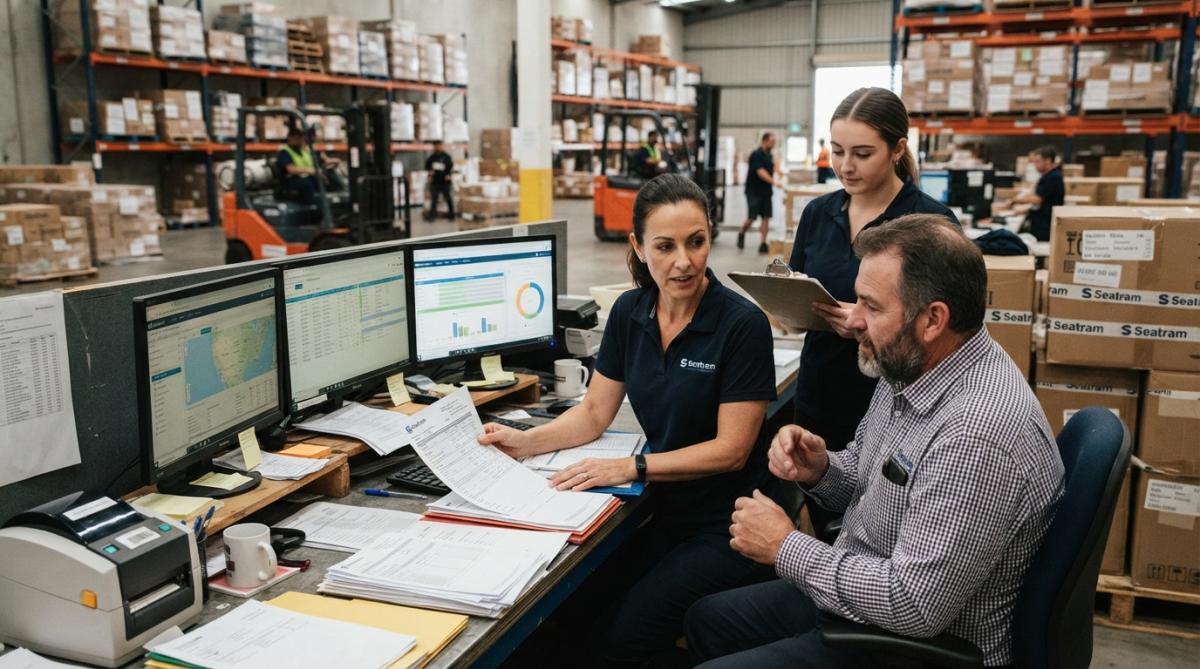
Moving to integrated end-to-end supply chain solutions requires phased implementation and strong change management. The technical roadmap is only half the story; how you bring your people along determines success.
Phase 1: Audit your current state and build internal alignment (3-5 weeks). Map every step from sourcing to delivery, identifying information loss, bottlenecks, and current costs. Involve stakeholders from all departments, when people help diagnose the problem, they’re more invested in the solution. Address concerns about job losses or loss of control directly.
Phase 2: Secure executive sponsorship and communicate the vision (2-3 weeks). Secure a clear executive sponsor with authority over multiple departments to communicate specific benefits: “this system will reduce order-to-delivery time from 14 days to 9 days and cut data-entry errors by 60%.” Vague messaging like “we’re modernising” fails.
Phase 3: Choose your core platform and plan integration points (2-3 weeks). Select a system handling procurement, inventory, logistics, and customer delivery that integrates with your existing tools. Map which systems will connect and how. Involve IT early to avoid integration nightmares later.
Phase 4: Pilot with your highest-priority flow (4-8 weeks). Choose one product line, supplier relationship, or customer segment and run the new system in parallel for 2-3 weeks. Early wins create advocates for the next phase.
Phase 5: Invest heavily in training and role clarity (3-4 weeks, overlapping with pilot). Most implementations stumble here. Invest in proper training explaining why changes matter and how they improve jobs. Be transparent about role changes. Assign “super-users” from each department to support peers.
Phase 6: Expand to other shipment types and integrate supplier/carrier systems (4-6 weeks). Once the pilot runs smoothly, expand to other product lines or customer segments.
The most common implementation failure: rushing to go live before your team is ready. A delayed launch with full adoption beats an on-time launch with 40% of your team still using workarounds. Prioritise readiness over speed.
Frequently Asked Questions
What is the difference between traditional logistics and end-to-end supply chain solutions?
Traditional logistics focuses on moving goods from point A to point B. End-to-end supply chain solutions integrate every stage: procurement, production, inventory management, distribution, and post-sale services. This integration creates real-time visibility, reduces delays, cuts costs, and improves customer experience. You manage everything through one platform instead of juggling multiple providers and systems.
How do end-to-end solutions improve customs clearance efficiency?
Integrated solutions automate documentation, pre-clear shipments, and coordinate with customs authorities before cargo arrives. This reduces hold times and compliance errors. Automated systems track regulatory requirements, generate required forms, and flag issues early. Many businesses see customs clearance times drop from days to hours when using streamlined end-to-end platforms that handle documentation automation.
What are the primary benefits of integrated supply chain solutions for small to mid-sized businesses?
Smaller businesses gain access to enterprise-level visibility and efficiency without the cost of building internal teams. Benefits include faster customs processing and dedicated support and customised service tailored to your specific needs rather than generic one-size-fits-all solutions.
How can businesses reduce supply chain risks through end-to-end management?
End-to-end management provides visibility into every stage, allowing you to identify bottlenecks and vulnerabilities early. Predictive analytics help forecast disruptions, automated alerts notify you of delays, and integrated processes reduce human error. Diversified supplier networks and real-time tracking mean you can respond quickly to problems before they impact delivery or costs.