
Last Updated: November 7, 2026
Quick Summary
To ship dangerous goods internationally, first confirm the cargo is classified as dangerous goods using its Safety Data Sheet, then identify its UN number and proper shipping name. Pack and label it to the matching packing group, complete the declaration form, and verify carrier acceptance for every route and transit point before booking.
- Check the Safety Data Sheet, Section 14, for the UN number and hazard class.
- Match packaging to the substance’s packing group and confirm its UN mark authorises your goods.
- Photograph every labelled face of the package before it leaves your site.
- Get carrier acceptance in writing for your UN number, route and every transit point.
- Re-verify acceptance close to the shipping date, since policies and country rules change.
Table of Contents
- Step 1: Confirm Your Goods Are Dangerous Goods
- Step 2: Find the UN Number and Proper Shipping Name
- Step 3: Pack and Label to Dangerous Goods Packaging Requirements
- Step 4: Prepare the Dangerous Goods Declaration Form
- Step 5: Check Carrier Acceptance and Destination Rules
- Shipping Dangerous Goods by Air: Rules, Rejections and Troubleshooting
- Booking Your Dangerous Goods Shipment with Seatram
- Frequently Asked Questions
Shipping dangerous goods overseas is one of the most tightly regulated tasks in freight, and the rules are unforgiving. This guide walks you through the process of shipping dangerous goods in the order you need to tackle it. Delays in dangerous goods shipments often come from paperwork and packaging issues. Following a clear sequence from the start helps avoid them.
Step 1: Confirm Your Goods Are Dangerous Goods
The first question is simple: does your cargo count as dangerous goods at all? Get this wrong and everything after it is built on a false footing. Start here before you book anything.
What Counts as Dangerous Goods or Hazardous Materials
Dangerous goods, also called hazardous materials or hazmat, are substances or articles that can pose a risk to people, property, or the environment during transport.
A quick check you can run today:
- Does the item have flammable, toxic, corrosive, or reactive properties?
- Does the manufacturer label carry hazard symbols or warnings?
- Is it a battery, aerosol, or liquid with a flashpoint?
If you answer yes to any of these, treat the shipment as dangerous goods until you confirm otherwise. Guessing wrong is the most expensive mistake in this process, because carriers can refuse, return, or dispose of undeclared cargo.
Using a Safety Data Sheet to Identify Hazards
A Safety Data Sheet (SDS) is the document that describes a product’s hazards, handling needs, and transport classification. It is the most reliable source you have. Ask your supplier for the current SDS for every product you plan to ship, and read the transport section carefully.
Look for these fields:
- Section 14 (transport information) on most SDS formats
- The UN number and proper shipping name
- The hazard class and any packing group
Use the SDS to confirm classification, and do not rely on memory or old paperwork, because formulations change.
Step 2: Find the UN Number and Proper Shipping Name
Once you know the goods are dangerous, you need two identifiers that every shipping document will use.
The UN number is a four-digit code, such as UN1203 for petrol. The proper shipping name is the official name that goes with it.
Keep these points in mind:
- The UN number and proper shipping name come from the dangerous goods regulations, not from your product label
- Many products share a proper shipping name with a generic description, so match carefully
- Using the wrong identifier can cause a rejection even when the goods themselves are packed correctly
Write both down and copy them exactly onto every document later.
Step 3: Pack and Label to Dangerous Goods Packaging Requirements
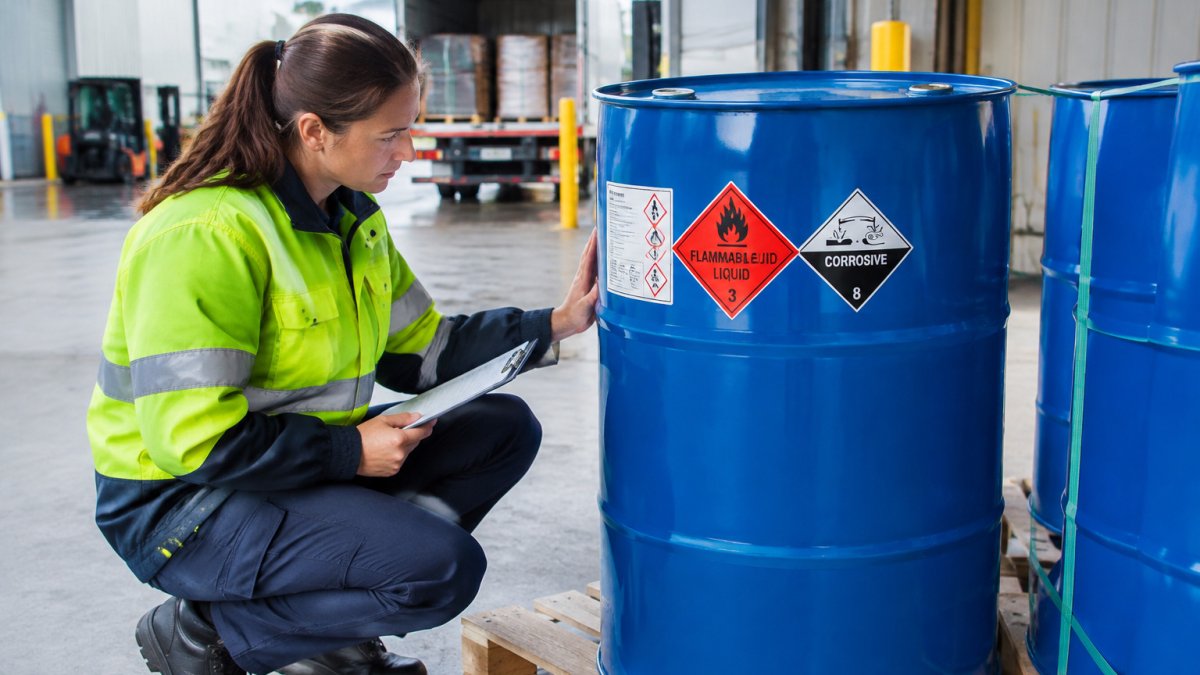
Packaging is where most shipments fail inspection. The container must be approved for the goods, sealed correctly, and marked clearly, but “approved” is a specific legal concept, not a judgement call, and the marks on the box are how a handler or inspector verifies it in seconds.
Match the packaging to the packing group
Dangerous goods are assigned a packing group that reflects the degree of danger: Packing Group I (great danger), II (medium danger) or III (minor danger). The packing group drives how strong the packaging must be and which UN packaging code is permitted. A common pattern is a shipper buying “UN-approved” boxes or drums without checking that the specific code is authorised for their UN number and packing group, the packaging is genuine, but it is the wrong authorisation for the goods.
Read the UN packaging code
Approved packaging carries a UN specification mark, a string of characters that encodes the test standard it passed. The mark typically shows the UN symbol, the packaging type code (for example a fibreboard box or a steel drum), the packing group it is approved for, and a manufacturer reference. Read it against the SDS and the applicable dangerous goods regulations rather than assuming any UN mark will do.
Limited quantities and excepted quantities
Small volumes sometimes qualify for reduced requirements. Limited quantity (LQ) provisions allow smaller inner packaging with a reduced set of marks and, in many cases, no full dangerous goods declaration. Excepted quantity (EQ) provisions go further for very small amounts. Eligibility depends on the substance’s UN number, the packing group, the inner and outer package sizes, and the mode of transport, and carriers can impose their own stricter limits.
Labels, marks and orientation
Work through these checks before the package leaves your site:
- Confirm the packaging is approved for your UN number and packing group, and that the UN specification mark matches
- Use inner packaging that is compatible with the substance, and check closure torque or sealing method
- Leave the correct headspace and secure all closures so expansion or vibration cannot open them
Watch out: a label that is correct in isolation but hidden under stretch wrap or overlapping another label is treated as missing, and that alone can trigger rejection.
Photograph and record the finished package
Photograph the finished package from every labelled face before it leaves your site, and keep the images with the SDS and packing record. If a carrier or inspector later questions the condition at dispatch, the photographs are your evidence. They also make it far easier to correct a rejection, because you can see exactly which mark or label was applied.
When to use a packing specialist
Occasional shippers often underestimate how much of this step is documentation as well as physical packing. If you ship dangerous goods rarely, a packing specialist or a forwarder with dangerous goods capability can confirm the packaging authorisation and label set before dispatch, which is usually cheaper than a rejected consignment sitting at a depot.
The table below summarises the main packaging checks before a dangerous goods shipment leaves your site.
| Check | What to verify | Why it matters |
|---|---|---|
| Packing group | Match packaging to the substance’s packing group (I, II or III) | Sets required packaging strength and permitted UN code |
| UN specification mark | Confirm the mark authorises your UN number and packing group | Wrong authorisation makes packaging non-compliant |
| Closures and headspace | Seal correctly and leave headspace for expansion | Prevents opening from expansion or vibration |
| Hazard labels | Apply on correct faces, not obscured by tape or wrap | Hidden labels are treated as missing |
| Orientation arrows | Mark combination packagings containing liquids | Required for liquid combination packages |
| Photographs | Image every labelled face before dispatch | Evidence if condition at dispatch is questioned |
Step 4: Prepare the Dangerous Goods Declaration Form
The dangerous goods declaration form is the document that formally tells the carrier what is inside. It is also the form authorities check first.
A complete declaration usually includes:
- Shipper and consignee details
- UN number, proper shipping name, class, and packing group
- Quantity and type of packaging
Fill it in from the SDS and your packing record, not from memory. Have the form signed by a person who understands what they are certifying. Errors here, even small ones, can stop a shipment at the port or airport.
Step 5: Check Carrier Acceptance and Destination Rules
Even correctly packed and declared goods can be refused if the carrier does not accept them on your route. This is the step most guides gloss over, and it is where a shipment that passed every earlier check can still stall. Acceptance is not a single yes-or-no answer, it is a set of conditions that vary by carrier, by mode, by route and by date.
Why acceptance varies so much
Airlines, shipping lines and road operators each publish their own dangerous goods acceptance policy, and those policies can be stricter than the international regulations.
Transit points matter as much as the destination. A stopover or transhipment airport or port applies its own rules, and a restriction at an intermediate point can stop cargo even when both the origin and destination would accept it.
A verification workflow you can run before booking
Work through these checks in order, and record the date and source for each answer:
- Confirm the UN number, proper shipping name, class and packing group from the SDS, acceptance is always checked against these identifiers, not the product name.
- Ask the carrier, or your forwarder, whether that UN number is accepted on the specific route, including every transit point.
- Confirm the mode restrictions: passenger versus cargo aircraft, full container versus less-than-container load, and any quantity limits per package or per consignment.
- Check the destination country’s import restrictions, since some countries prohibit certain classes outright or require an import permit.
- Check the carrier’s own documentation and labelling requirements, which can exceed the international minimum.
- Re-verify close to the shipping date, because policies and country restrictions change and a confirmation from months ago is not reliable.
Watch out: a verbal “we accept that” from a booking agent is not the same as a written acceptance against the UN number and route, get it in writing and keep it with the declaration.
Destination-by-destination checks
Rules and carrier availability vary by country and route, and there is no single global list that stays current. Build a short verification checklist for each destination you ship to regularly: the classes and UN numbers accepted, any import permit or prior-notification requirement, the documents the destination authority expects, and the carrier options that actually serve that route with dangerous goods.
Limited quantity and small-shipper pathways
If your volumes are small, ask about limited quantity options before assuming full dangerous goods handling is the only path. LQ shipments often face fewer carrier restrictions and simpler documentation, but eligibility depends on the substance, the package size and the carrier’s policy. For occasional shippers, the practical choice is often between preparing the shipment yourself with verified carrier acceptance or using a forwarder that already holds the route confirmations, the trade-off is cost against the time and risk of running every check in-house.
Build delay into the plan
Acceptance checks take time, and a rejection at this stage is expensive because the goods are already packed and declared. Start the carrier and destination verification early, keep written confirmations, and re-verify before dispatch.
Shipping Dangerous Goods by Air: Rules, Rejections and Troubleshooting
Air freight has the strictest acceptance rules, and rejections are common. Most refusals come from a short list of causes:
- Packaging not approved for the UN number or packing group
- Missing or incorrect hazard labels
- A declaration form with mismatched details
When a shipment is rejected, do not repack in a hurry. Use real-time shipment tracking to see where the cargo is and catch problems early. Identify which document or label failed, correct it against the SDS, and recheck the carrier’s current requirements before rebooking. Expect some delay, and build it into your schedule.
Booking Your Dangerous Goods Shipment with Seatram
Once your paperwork and packaging are ready, you can book. Seatram provides freight forwarding and logistics services, and you can request a quote to discuss your shipment requirements. If you want to see how the process works, read our guide to book international freight online. For current pricing, request a quote, since pricing depends on quantity, dates, and delivery requirements.
Frequently Asked Questions
How do I ship dangerous goods internationally?
Start by confirming whether your goods are classified as dangerous goods, then obtain the Safety Data Sheet and identify the UN number and proper shipping name. Pack the goods in approved packaging, apply the required hazard and orientation labels, and prepare a dangerous goods declaration. Confirm with your freight forwarder that the carrier, route and destination country will accept the shipment before booking.
What items are classified as dangerous goods for shipping?
Dangerous goods include substances and articles that pose risks such as flammability, toxicity, corrosiveness or the release of gases, and also items like lithium batteries and certain aerosols. Classification depends on the properties of the product and is set out in the relevant international transport regulations. The Safety Data Sheet is the primary source for hazard information. If you are unsure, ask your freight forwarder to help classify the product before you prepare the shipment.
Do dangerous goods shipping rules vary by destination country?
Yes. While international transport rules set a common framework, individual countries and airlines may add their own restrictions, prohibit certain goods, or limit quantities on particular routes. Always verify the requirements for both the origin and destination, and check whether any transit points impose additional conditions. Pricing and timing depend on quantity, dates and delivery requirements, so request a quote for current details.
How long does it take to arrange an international dangerous goods shipment?
Lead times depend on how quickly your classification, Safety Data Sheet, packaging and documentation can be completed, as well as carrier acceptance for your route and dates. Preparing documents before booking reduces the risk of delays and rejections at the airport or port. Dangerous goods often require more lead time than standard cargo, so plan ahead of your required delivery date.
