
Last Updated: October 23, 2026
Quick Summary
To calculate air freight cost per kg in 2026, multiply the chargeable weight by the rate per kg for your weight break, then add surcharges. Chargeable weight is the greater of actual weight and volumetric weight, calculated as length × width × height in cm ÷ 6,000.
- One cubic metre converts to 166.67 kg for volumetric charging under the standard 6,000 divisor.
- Express services typically carry a 60% to 100% premium over standard on the same route.
- Fuel surcharge usually runs roughly 15% to 30% of base freight.
- Add a surcharge buffer of 15% to 25% on top of base freight when estimating.
- Every quote carries a minimum charge, typically AUD 150 to AUD 350 per shipment.
Table of Contents
- How Air Freight Cost per kg Is Calculated in 2026
- Air Freight Chargeable Weight Calculation: Actual vs Volumetric Weight
- Worked Examples: Turning Dimensions into a Rate per kg
- Air Cargo Pricing and Surcharges: What Sits Beyond the Base Rate
- How to Build an Air Freight Cost Estimate Before You Request Quotes
- Using an Air Freight Cost Calculator Without Being Misled
- Comparing Carrier Quotes on an Apples-to-Apples Basis
- Reducing Chargeable Weight and Total Freight Cost
- Frequently Asked Questions
How Air Freight Cost per kg Is Calculated in 2026
Air freight cost is not charged on the weight you see on the scale. It is charged on the greater of actual weight and volumetric weight, multiplied by a rate per kilogram. That single rule explains why two identical cartons can cost wildly different amounts to fly.
Below, we break down how to calculate the air freight cost per kg in 2026 so you can estimate before a forwarder sends you a number.
The Three Numbers Behind Every Quote
Every air freight quote rests on three inputs:
- Chargeable weight in kilograms, which is the higher of actual and volumetric weight
- Rate per kg at the applicable weight break
- Surcharges added on top of the base rate
Get those three right and you can predict a quote within a few percent.
Air Freight Chargeable Weight Calculation: Actual vs Volumetric Weight
Air freight chargeable weight calculation compares a shipment’s actual gross weight against its volumetric weight and bills on whichever is higher. Light, bulky cargo pays for the space it takes up, not the kilograms it registers.
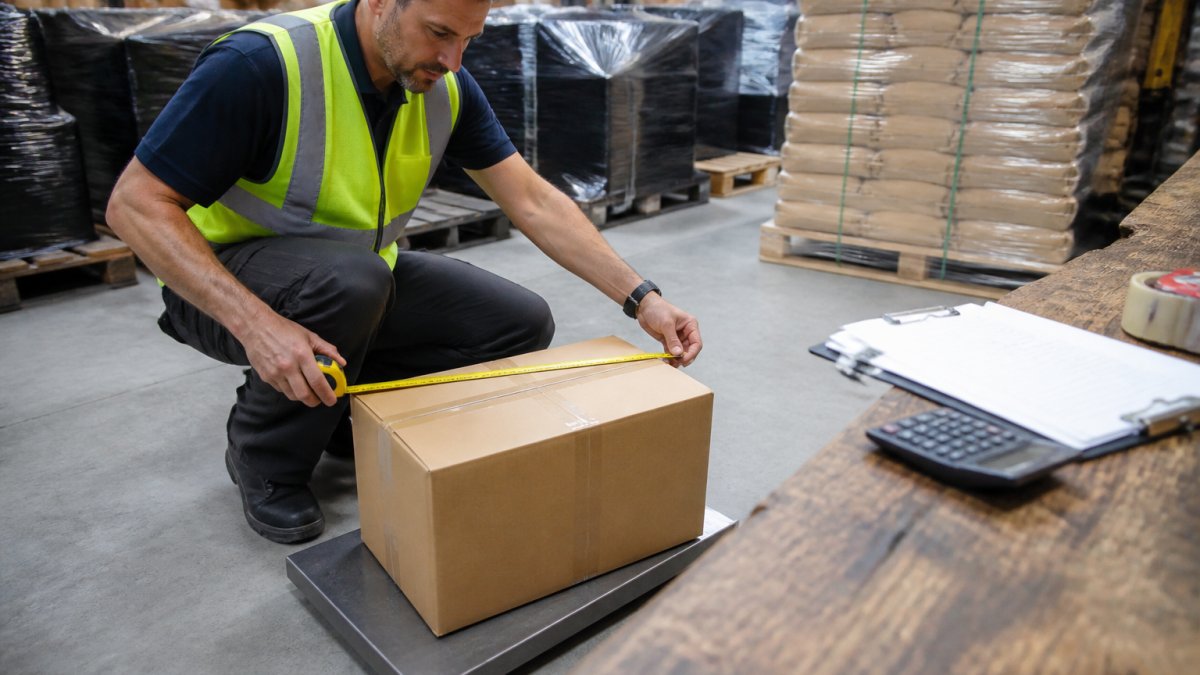
Airlines and forwarders use this rule because aircraft cargo holds are limited by volume as much as by payload.
The Volumetric Formula and the 1 CBM = 166.67 kg Rule
The volumetric formula is simple:
Length (cm) × Width (cm) × Height (cm) ÷ 6,000 = volumetric weight in kg
The 6,000 divisor comes from the standard conversion of 1 cubic metre to 166.67 kg. Some carriers use 5,000 for express services, producing a higher volumetric weight, so the same carton can cost more on an express product. Always confirm which divisor applies before comparing quotes.
Worked Examples: Turning Dimensions into a Rate per kg
The examples below carry chargeable weight through to a dollar figure.
Example 1: Dense Cargo
A carton measures 60 × 40 × 40 cm and weighs 45 kg actual.
- Volumetric weight: 60 × 40 × 40 ÷ 6,000 = 16 kg
- Chargeable weight: 45 kg, because actual weight is higher
- At an indicative standard rate of AUD 5.20 per kg for a 45 kg shipment: 45 × AUD 5.20 = AUD 234.00 base freight
Example 2: Light, Bulky Cargo
A carton measures 120 × 80 × 80 cm and weighs 30 kg actual.
- Volumetric weight: 120 × 80 × 80 ÷ 6,000 = 128 kg
- Chargeable weight: 128 kg, because volumetric weight is higher
- At an indicative standard rate of AUD 3.90 per kg for a 128 kg shipment (the 100 kg break): 128 × AUD 3.90 = AUD 499.20 base freight
Example 2 pays for 128 kg of space while carrying 30 kg of goods.
| Scenario | Actual Weight | Volumetric Weight | Chargeable Weight | Indicative Rate (AUD/kg) | Base Freight (AUD) |
|---|---|---|---|---|---|
| Dense parts | 45 kg | 16 kg | 45 kg | 5.20 | 234.00 |
| Bulky packaging | 30 kg | 128 kg | 128 kg | 3.90 | 499.20 |
| Balanced freight | 60 kg | 62 kg | 62 kg | 4.80 | 297.60 |
2026 Rate Benchmarks by Route and Service Level
The table below gives indicative standard-service ranges by origin region into Australia, plus the express premium. Treat these as planning bands, not quotes: they move with fuel, capacity and season.
| Origin Region | Standard Service (AUD/kg) | Express Service (AUD/kg) |
|---|---|---|
| Southeast Asia | 3.50 – 6.00 | 6.50 – 11.00 |
| North Asia | 4.00 – 7.00 | 7.00 – 12.00 |
| Europe | 5.50 – 9.00 | 9.00 – 15.00 |
| North America | 5.00 – 8.50 | 8.50 – 14.00 |
Three patterns matter. Express services typically carry a 60% to 100% premium over standard on the same route, partly due to the 5,000 divisor inflating volumetric weight. Rates fall as shipment size rises, so the same route can quote at the top of the band for a 20 kg shipment and the bottom for a 500 kg shipment. Bands also widen on longer routes as fuel and capacity surcharges move.
Shave 5 cm off each dimension of a bulky carton and the volumetric weight can drop by double digits. On Example 2 above, trimming the carton to 115 × 75 × 75 cm cuts volumetric weight to about 108 kg. At the AUD 3.90 rate, that is a saving of roughly AUD 78 on a single carton, a 16% reduction in billable kilos for a few centimetres of cardboard.
Converting Between Metric and Imperial
If your supplier measures in inches, convert first: one inch equals 2.54 cm, so a carton measuring 48 × 32 × 32 inches becomes 121.9 × 81.3 × 81.3 cm. Run the metric formula, then divide by 6,000. Do not mix units; a carton measured in inches but divided by 6,000 understates volumetric weight by a factor of about 16, the most common cause of a quote far higher than the estimate.
Air Cargo Pricing and Surcharges: What Sits Beyond the Base Rate
Air cargo pricing and surcharges are where most estimates fall apart: a quote that looks competitive on the base rate can land 30% to 50% higher once accessorial charges are added. The defence is knowing what each line is and roughly what it adds.
The Base Rate and Weight Breaks
Airlines publish rates in weight breaks, and the per-kilogram rate falls as the shipment weight rises. A typical structure uses these bands:
- M (minimum), a flat minimum charge for very small shipments
- N (normal), the rate for shipments below the first break
- 45 kg, 100 kg, 300 kg, 500 kg and 1,000 kg breaks, each with a lower rate per kg
ASEAN’s training material on calculating air freight shows the mechanism: an example M rate of AUD 5.05/kg drops to AUD 3.35/kg at the Q100 kg break. The lesson is that per-kilogram rates fall as shipment weight rises, so consolidating two small shipments into one larger one often beats splitting them. Always ask which break your total chargeable weight falls into, and whether the next break up would be cheaper overall, sometimes declaring a slightly higher weight to reach a lower break reduces the total charge.
The Surcharges That Sit on Top
On top of the base rate you will typically see the following lines. The ranges below are indicative; your forwarder‘s live tariff will differ by route and month.
| Charge | How It Is Assessed | Indicative 2026 Range |
|---|---|---|
| Fuel surcharge | Percentage of the base freight rate, adjusted monthly against oil prices | Roughly 15% to 30% of base freight |
| Security surcharge | Per kilogram or per shipment, for screening and handling | A few cents to about AUD 0.20 per kg |
| Terminal handling (origin and destination) | Per shipment or per kilogram, charged at each airport | AUD 50 to AUD 250 per shipment, each end |
| Documentation and customs entry | Per shipment, plus per additional line item | AUD 75 to AUD 200 per entry |
| Pickup and delivery | Per shipment, by distance and access | Quoted per job; can exceed the base freight on short hauls |
| Dangerous goods or special handling | Per shipment, plus per kg for some classes | AUD 100 to AUD 400 per shipment |
Two mechanisms matter more than the numbers. The fuel surcharge is usually a percentage of the base freight, so a higher base rate means a higher fuel line. And terminal handling is charged at both origin and destination, so a quote listing only one end is incomplete.
A Worked Landed-Cost Build-Up
Take a 120 kg chargeable shipment from a major Asian hub to Australia on a standard service, with an indicative base rate of AUD 4.50 per kg:
- Base freight: 120 kg × AUD 4.50 = AUD 540.00
- Fuel surcharge at 22% of base: AUD 118.80
- Security surcharge at AUD 0.12 per kg: AUD 14.40
That is an effective rate of about AUD 10.36 per chargeable kg, more than double the headline AUD 4.50 base rate. Budget against this number, not the base rate.
Never quote a customer from a forwarder’s base rate alone. Fuel and security surcharges move monthly, and terminal charges vary by airport. A base rate quoted in January can be 20% under the final invoice by March. Ask for the surcharge basis in writing and confirm the validity period of the quote.
Minimum Charges and Why Small Shipments Cost More per kg
Every quote carries a minimum charge, typically AUD 150 to AUD 350 per shipment depending on route and service. For a 10 kg shipment, the minimum can dominate the invoice, pushing the effective rate per kg far above the published rate, which is why small, frequent shipments are expensive and consolidation pays.
Ask any forwarder for a full line-by-line breakdown with the surcharge basis and validity stated. A single-number quote cannot be compared to anything.
How to Build an Air Freight Cost Estimate Before You Request Quotes
Build your own air freight cost estimate before you talk to a forwarder. It takes fifteen minutes and strengthens your negotiating position.
- Measure every carton in centimetres, including pallets and any overhang
- Weigh every carton on a calibrated scale
- Calculate volumetric weight for each using the 6,000 divisor
- Take the higher figure per carton as chargeable weight
- Add up total chargeable weight across the shipment
- Apply the rate for the weight break your total falls into
- Add a surcharge buffer of 15% to 25% on top of the base freight
Step seven is the one people skip. It is also the one that saves the budget.
Using an Air Freight Cost Calculator Without Being Misled
An air freight cost calculator applies the chargeable-weight formula and a rate per kg to produce an indicative figure. It is useful for ballpark planning and useless for budgeting if you do not know its assumptions.
Check three things before trusting any calculator:
- Which divisor does it use? 6,000 or 5,000 changes the answer materially
- Does it include surcharges? Most free tools show freight only
- Is the rate current? A rate loaded two years ago is fiction
Treat calculator output as a floor, not a final number. Then ask a forwarder to confirm against live rates for your route and service level.
Comparing Carrier Quotes on an Apples-to-Apples Basis
Comparing carrier quotes properly means normalising every line before judging price. Two quotes that look 30% apart often land within 5% once aligned.
| Check | What to Confirm | Why It Matters |
|---|---|---|
| Divisor used | 6,000 or 5,000 | Changes chargeable weight |
| Weight break | M, N, 45 kg, 100 kg, 300 kg | Rate per kg drops at higher breaks |
| Surcharges | Fuel, security, terminal listed separately | Hidden cost sits here |
| Service level | Standard, express, deferred | Express costs more per kg |
| Incoterms | Who pays which leg | Shifts cost between parties |
| Transit time | Door-to-door, not airport-to-airport | Door-to-door is the real number |
Ask each provider to quote on the same Incoterm, service level and door-to-door scope. Anything else is not a comparison.
Reducing Chargeable Weight and Total Freight Cost
Cutting chargeable weight is the most reliable way to cut air freight cost. The levers are physical, not commercial, and most shippers ignore them.
- Right-size cartons. Oversized boxes for light goods inflate volumetric weight fast
- Reduce void fill. Air pillows and foam take up billable space
- Consolidate shipments. Larger totals unlock lower weight breaks
The per-kg rate is the number everyone argues about. Chargeable weight is the number that actually moves your invoice. Fix the carton before you haggle on the rate.
For mixed urgent and non-urgent cargo, splitting modes often wins: fly the critical items, send the rest by sea, and pay air rates only for what genuinely needs to arrive fast.
Air freight budgeting rewards preparation over negotiation. Measure your cartons, apply the 6,000 divisor, compare chargeable weight against actual weight, and build a surcharge buffer into every estimate. That discipline turns a quote from a surprise into a confirmation.
Frequently Asked Questions
Is air freight charged by actual weight or volumetric weight?
Carriers charge on whichever is greater: the actual gross weight on the scale or the volumetric weight worked out from the carton’s dimensions. Volumetric weight is calculated by multiplying length, width and height in centimetres, dividing by 6,000, and comparing the result to the weighed figure. A light but bulky shipment, such as foam packaging or flat-packed furniture, will usually bill on volumetric weight. Dense cargo like metal components bills on actual weight. Always confirm which divisor your forwarder applies, because the air freight cost can shift substantially depending on that single number.
Why is 1 CBM treated as 166.67 kg in air freight?
The conversion comes from the standard air freight ratio of 6,000 cubic centimetres per kilogram. One cubic metre equals 1,000,000 cubic centimetres, and dividing that by 6,000 gives 166.67 kg. Some carriers and consolidations use a 5,000 divisor instead, which pushes the equivalent to 200 kg per cubic metre and raises the chargeable weight for the same carton. That difference matters when you are comparing quotes, so ask which volumetric divisor sits behind the rate per kg before you sign off on a booking.
What charges are included in an air freight quote?
A quote typically combines the base rate per kg multiplied by chargeable weight, plus a fuel surcharge, a security surcharge, terminal handling, and an air waybill fee. Beyond those, expect customs clearance, biosecurity inspection charges where applicable, and delivery to the final address. The per-kg figure alone rarely reflects the landed cost. Ask for a line-by-line breakdown that separates origin charges, freight, destination charges and any duties or taxes, so you can compare providers on the same basis rather than on headline rate alone.
How can I estimate air freight costs before requesting a quote?
Weigh each carton, measure its dimensions in centimetres, and calculate volumetric weight using the divisor your forwarder confirms. Take the higher of the two figures per carton, add them together, then multiply by an indicative rate per kg for that lane. Add a buffer for surcharges, which commonly sit outside the base rate. The result is a planning figure, not a booking price. A forwarder can validate it against current lane rates and flag accessorial charges specific to your cargo, such as dangerous goods handling or temperature control.
