
Last Updated: October 23, 2026
Quick Summary
To manage cold chain logistics for perishables, map every handover point and set a commodity-specific temperature and humidity target for each stage, then pre-cool, package and load for airflow, monitor temperatures continuously and follow a written excursion plan. Keep every link unbroken from harvest to delivery, because one break can spoil a whole shipment.
- Pre-cool produce to its target temperature within hours of harvest and never load warm product next to pre-cooled stock.
- Leave at least 10-15 cm between pallets and the trailer wall so return air can flow.
- Place loggers at the warmest and coldest points, not just the centre of the load.
- Define excursion thresholds in three tiers: advisory, actionable and critical, agreed with your buyer.
- Track temperature compliance rate, excursion count per 100 shipments and spoilage rate as core KPIs.
Table of Contents
- Step 1: Map Your Cold Chain Stages and Set Temperature Targets
- Step 2: Pre-Cool and Prepare Perishable Goods Before Transport
- Step 3: Apply Cold Chain Packaging for Food and Load for Airflow
- Step 4: Secure Temperature-Controlled Storage and Refrigerated Transportation
- Step 5: Set Up Cold Chain Temperature Monitoring and Data Logging
- Step 6: Build a Temperature Excursion Management and Contingency Plan
- Step 7: Measure Performance with Cold Chain KPIs and Best Practices
- Conclusion
- Frequently Asked Questions
Step 1: Map Your Cold Chain Stages and Set Temperature Targets
Cold chain logistics is the management of temperature-sensitive products from harvest or production through storage, transport and final delivery, keeping every link unbroken. Get one link wrong and a whole shipment can spoil.
So start with a map. Write down every handover point: farm or factory, packhouse, cold storage warehouse, port, vessel or aircraft, customs, delivery.
From Harvest to Delivery: The Unbroken Cold Chain
An unbroken cold chain means the product never leaves its target range between harvest and delivery. Every transfer is a risk point. Loading docks, customs holds and cross-docking are where breaks happen most.
Your map should name who is responsible at each step. That is your chain of custody.
Commodity-Specific Temperature and Humidity Guidance
Different perishables need different conditions. A single setting for everything is a common and expensive mistake. Use this as a starting point, then confirm with your buyer or supplier:
| Commodity | Typical target range | Watch for |
|---|---|---|
| Leafy greens | 0-2°C, high humidity | Wilting, condensation |
| Berries | 0-2°C, moderate humidity | Mould, bruising |
| Citrus | 4-10°C | Chilling injury below range |
| Meat and poultry | -1 to 2°C | Temperature spikes at handover |
| Frozen seafood | -18°C or colder | Thaw and refreeze cycles |
Step 2: Pre-Cool and Prepare Perishable Goods Before Transport
Pre-cooling removes field heat before a product enters the cold chain. Skip it and your refrigeration unit has to do that work in transit, which is slower and less even. Research on postharvest losses published in ScienceDirect (2026) describes cold chain logistics as central to preventing quality loss across local and international markets.
Practical steps:
- Cool produce to its target temperature within hours of harvest
- Use forced-air or hydro-cooling suited to the commodity
- Never load warm product next to pre-cooled stock
Step 3: Apply Cold Chain Packaging for Food and Load for Airflow
Cold chain packaging for food protects product and holds temperature when refrigeration is weakest. The packaging and the load layout work as one system, and getting either wrong undermines the refrigeration unit’s ability to keep product in range.
Understand the Heat Transfer Problem
Cold air must circulate around every pallet to remove heat that enters through the trailer walls, the floor and the doors. If cartons are stacked tight to the pallet edge or pushed against the trailer wall, you block the return air path and create warm pockets that a single logger at the centre will never detect.
Pallet Spacing and Loading Sequence
- Leave a gap of at least 10-15 cm between pallets and the trailer wall, and between pallets themselves, so return air can flow.
- Keep cartons on pallets, not directly on the trailer deck, to allow air movement underneath.
- Load the coldest items nearest the refrigeration unit and the least sensitive items at the rear doors, where warm air enters every time the doors open.
Load the coldest items nearest the refrigeration unit and the least sensitive items at the rear doors. The rear is where warm air enters every time the doors open.
Match Packaging to Transit Time, Not Just Product
Insulated liners, thermal blankets and vacuum insulation panels slow heat ingress, but their performance depends on the transit duration and the ambient conditions. A packaging specification that works for a four-hour road leg may fail on a multi-day sea or air leg. Ask your packaging supplier for performance data at the expected ambient temperature and transit time, and test the specification on a real lane before committing a season’s volume to it.
Precondition Packaging and Product
Packaging that has been stored in a warm warehouse carries heat into the load. Precondition insulated liners and blankets in the cold store before use, and confirm that product has reached its target temperature before packaging. Record the pull-down time for each batch so you can spot batches that were packed warm.
Verify Airflow After Loading
Walk the load before the doors close. Check that pallets are not leaning against the wall, that the return air path is clear and that the unit is set to the correct range. A two-minute check at the dock is cheaper than a rejected load at the other end.
Step 4: Secure Temperature-Controlled Storage and Refrigerated Transportation
Temperature-controlled storage and refrigerated transportation are the backbone of cold chain management best practices. A cold storage warehouse must hold its range through door openings, defrost cycles and power interruptions.
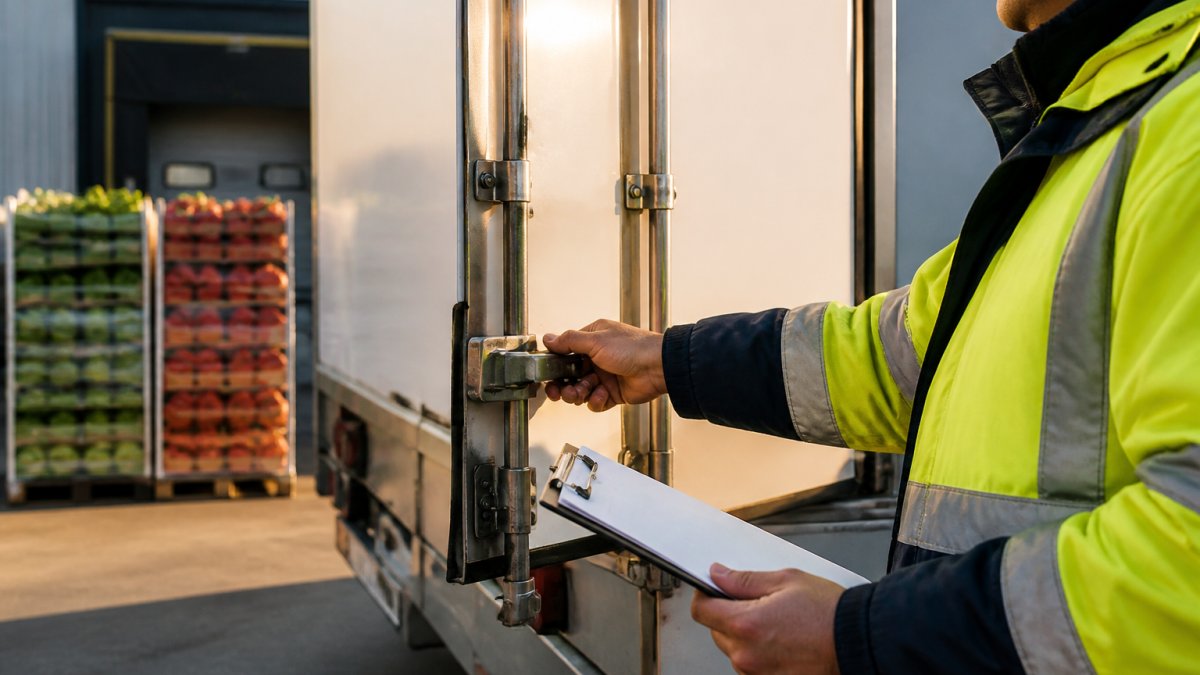
Refrigerated transport comes in several forms:
- Refrigerated sea containers for long ocean legs
- Temperature-controlled air freight for high-value or short shelf-life goods
- Refrigerated road transport for the final delivery leg
Check equipment before loading. Pre-cool the trailer. Confirm the unit holds temperature with the doors closed. Geotab’s 2025 guide lists temperature-controlled storage, specialised packaging, refrigerated transport and real-time monitoring as the four core cold chain practices.
Step 5: Set Up Cold Chain Temperature Monitoring and Data Logging
Cold chain temperature monitoring uses sensors and data loggers to record conditions continuously from loading to delivery. A temperature logger gives you a defensible record if a buyer disputes quality.
Lineage’s 2026 Cold Chain Insights Survey reports that companies are prioritising real-time visibility and AI-informed decision-making. Tive (2026) describes end-to-end visibility as a way to build a more proactive cold chain.
Set your monitoring up properly:
- Place loggers at the warmest and coldest points, not just the centre
- Set alert thresholds inside your target range, not at the limit
- Log at fixed intervals and keep the data with the shipment record
Step 6: Build a Temperature Excursion Management and Contingency Plan
Temperature excursion management is the set of documented actions you take when a shipment leaves its target range. Speed and evidence decide whether you save the load, protect the customer relationship and defend the decision later. Most operators have a monitoring system but no written response plan, which is why small breaches become large claims.
Define Excursion Thresholds Before You Ship
An excursion is not simply any reading outside the target range. Define it by commodity, duration and magnitude. A common pattern is to set three tiers:
- Advisory: a reading drifts outside the target range but stays within a narrow tolerance band for less than a defined window, such as 30 minutes. Log it and notify the shift supervisor.
- Actionable: the reading exceeds the tolerance band or persists beyond the window. Trigger the response team and begin corrective action.
- Critical: the reading suggests the product may be unsafe or unsaleable, for example frozen goods showing evidence of thaw and refreeze, or chilled meat held above 5°C for an extended period. Quarantine immediately.
Set the thresholds with your buyer or food safety adviser, because the acceptable tolerance depends on the commodity, the packaging and the remaining shelf life. Record the agreed thresholds in the shipment plan so everyone works from the same definition.
Name Roles and Escalation Paths
A plan that names no one is not a plan. At minimum, assign:
- A first responder who receives the alert and confirms it is real, not a sensor fault.
- A decision-maker who authorises re-icing, diversion, expediting or quarantine, and who understands the commercial and food safety consequences.
- A customer contact who informs the buyer early, with data, before the buyer discovers the problem at receiving.
Escalation should be time-bound. If the first responder cannot resolve an actionable excursion within a set period, the decision-maker is notified automatically. Critical excursions notify the decision-maker and customer contact immediately.
Choose the Corrective Action
The right response depends on where the break occurred and how much shelf life remains:
- Re-ice or recharge where the load is still within tolerance and the refrigeration unit can recover.
- Divert to the nearest cold storage facility if the remaining transit leg cannot hold temperature.
- Expedite the delivery or transfer to a faster mode if the product is high value and time-critical.
Do not default to shipping the load and hoping. A documented assessment that considers time out of range, product temperature at the point of discovery, packaging performance and remaining shelf life is what separates a defensible decision from a guess.
Document Everything
For every excursion, record the time the alert was raised, the readings before and after, the suspected cause, the action taken, who authorised it, the product temperature at assessment and the final disposition. Keep the record with the shipment file and the temperature logger data. If a buyer disputes quality or a regulator audits your food safety system, this record is your evidence.
Quarantining a load and shipping it anyway without a documented assessment is the fastest way to lose a customer and a contract. If you cannot prove the product stayed safe, do not release it.
Review After Every Event
Treat each excursion as a free lesson. Ask whether the threshold was right, whether the alert reached the right person in time, whether the corrective action worked and whether the packaging or loading contributed. Feed the answers back into the plan and into supplier and carrier reviews. Over time, the pattern of excursions tells you where your chain is genuinely fragile, which is more useful than any single incident report.
Step 7: Measure Performance with Cold Chain KPIs and Best Practices
Cold chain KPIs turn good intentions into numbers you can manage. Without them, you are guessing.
Cold Chain KPIs to Track
| KPI | What it tells you | Target direction |
|---|---|---|
| Temperature compliance rate | Share of shipments within range | Up |
| Excursion count per 100 shipments | Frequency of breaks | Down |
| Spoilage and product loss rate | Cost of failure | Down |
| On-time delivery in full | Reliability of the chain | Up |
| Energy use per pallet stored | Sustainability and cost | Down |
Olimp Warehousing (2026) lists predictive analytics, digital traceability and sustainability among the emerging cold chain themes. Cost and sustainability pull against each other here. Running a tighter temperature range costs more energy, so match the range to the commodity rather than over-cooling everything.
The cheapest cold chain improvement is usually better loading discipline, not new equipment. Fix airflow and handovers before you spend on hardware.
Conclusion
Managing perishables is unforgiving: one broken link undoes every good decision before it. Seatram handles the hard parts for you, with tailored end-to-end supply chain solutions, wharf-to-wharf and door-to-door options, and one platform to manage all shipments. Request a quote from Seatram and keep your perishables moving safely, on time and on budget.
Frequently Asked Questions
What is cold chain logistics for perishable goods?
Cold chain logistics is the temperature-controlled movement and storage of perishable products from harvest or production through to delivery. It covers pre-cooling, refrigerated storage, refrigerated transport, handling and temperature monitoring. The goal is an unbroken cold chain that preserves freshness, extends shelf life and reduces food waste. A 2026 study in ScienceDirect notes cold chain logistics supports the safe movement of perishables across local, regional and international markets by preventing quality loss. Businesses shipping perishables should map every stage and set temperature targets for each commodity.
How do you maintain the cold chain during transport?
Maintain the cold chain by pre-cooling products before loading, using insulated or refrigerated transport, and packing with adequate airflow so cold air circulates. Place temperature loggers inside the load and check data at handover points. Avoid opening doors unnecessarily and keep the chain of custody documented. For temperature excursion management, have a written response plan: isolate the load, review logger data, assess product quality and decide whether to release, divert or reject. Real-time monitoring and visibility tools help catch deviations early, as Tive noted in 2026.
What temperature should perishable goods be transported at?
Temperature depends on the commodity. Chilled meat, dairy and fresh produce typically require 0°C to 4°C, while frozen goods need -18°C or colder. Tropical fruit may need 10°C to 13°C to avoid chilling injury. Humidity also matters: leafy greens and berries benefit from high humidity, while garlic and onions need dry conditions. Confirm exact setpoints with your buyer and supplier, and record them in your cold chain management best practices. A 2026 systematic review in the International Journal of Logistics Research and Applications identifies shelf-life prediction as key to minimising waste.
How can businesses choose a cold chain logistics provider?
Look for a provider with proven refrigerated transport, temperature monitoring and data logging, plus documented excursion response procedures. Ask for commodity-specific experience, references from similar food businesses, and clarity on what is included in rates versus surcharges. Check their chain of custody and traceability processes. Seatram provides tailored end-to-end freight forwarding with real-time tracking. Request a quote and ask how they handle temperature excursion management and contingency planning for disruptions.
