
Table of Contents
- International Shipping for Furniture Retailers: What Changes in 2026
- Sea Freight, Air Freight and Courier: Choosing Your Method
- How to Reduce Damaged Cargo Arrivals Step by Step
- Customs clearance for furniture retailers: Documents, Duties and Biosecurity
- Incoterms for Retailers: Who Pays, Who Owns the Risk
- Calculating Costs: Cubic Volume, Weight-Based Pricing and Landed Cost
- Insurance, Liability and Reverse Logistics: The Parts Most Guides Skip
- Frequently Asked Questions
Last Updated: September 13, 2026
International Shipping for Furniture Retailers: What Changes in 2026
International shipping for furniture retailers means moving bulky, high-value goods across borders by sea freight, air freight or courier while managing customs clearance, damage risk and landed cost. This Seatram guide breaks down where most retailers lose money: freight forwarding is more document-driven, not less, and biosecurity enforcement on timber has tightened. Below, we show how to plan container loads, control damage and calculate true landed cost before you book.
Sea Freight, Air Freight and Courier: Choosing Your Method
Sea freight is the default for furniture because cubic volume, not weight, drives cost. Air freight suits urgent restocks or high-margin accessories; courier suits samples and single pieces under roughly one cubic metre.
| Method | Best For | Transit Time | Cost Profile |
|---|---|---|---|
| Sea freight (FCL) | Full container loads, bulk orders | Slowest | Lowest per unit |
| Sea freight (LCL) | Part loads, mixed SKUs | Slower | Moderate, volume-rated |
| Air freight | Urgent restocks, small runs | Fast | Highest per kg |
| Courier | Samples, single items | Fastest | High per unit |
Full Container Load (FCL) vs Less Than Container Load (LCL)
FCL means you book and seal the entire container; LCL means your pallets share space with other shippers’ cargo, adding handling and consolidation risk. For fragile, high-value furniture, FCL is almost always better, you just pay for space you may not fill.
If your LCL shipment sits at a consolidation warehouse waiting for other cargo, your goods get handled more times. Every extra touch is a damage opportunity. Ask your logistics provider how many handling points your LCL cargo passes through before it reaches the port of entry.
How to Reduce Damaged Cargo Arrivals Step by Step
Damage reduction is a process, not a product. Retailers with the lowest claim rates treat packing, loading and documentation as one continuous system. The biggest determinant of whether a claim is paid is not how well you packed, but whether you can prove how well you packed.
- Inspect and photograph every item at the factory before packing, with a timestamp and a visible SKU
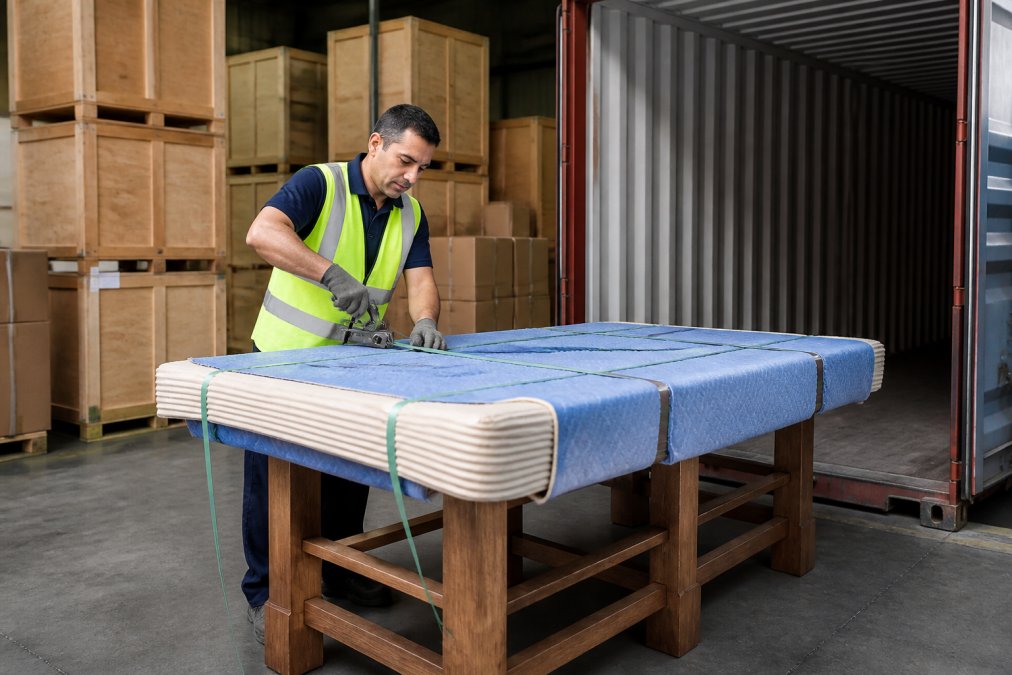
- Wrap surfaces in foam or bubble film, then add edge guards to corners and rails
- Crate fragile and over-dimensional pieces to a timber standard that meets ISPM 15
- Palletize and strap loads so nothing shifts in transit, and use load bars or airbags to fill voids
- Load with weight distributed low and heavy items braced against the container walls
- Photograph the sealed container and record the seal number on the bill of lading
- Note any visible damage on the delivery docket before signing, and photograph the docket
Retailers who win damage disputes keep a photo file running from factory floor to final delivery, with the container seal number visible in loading photos. Without that chain, a carrier or insurer can argue the damage pre-existed the shipment and the claim stalls.
Packing and Crating Standards for Fragile Items
Crating is the single biggest lever on damage claims. A cardboard carton is not sufficient protection for a glass-topped table or mirrored cabinet. Timber crates need bracing that stops movement in all directions, and any timber must meet biosecurity requirements before it leaves origin.
ISPM 15 governs solid timber packaging, crates, pallets, dunnage and blocking. It requires timber to be heat-treated to a specified core temperature or fumigated with methyl bromide, then stamped with the compliant mark showing country code, producer registration number and treatment code (HT or MB). The mark must come from an accredited provider, not the supplier.
For furniture retailers, the practical implications are specific:
- Confirm the stamp before the container is sealed. Once the container is on the water, you cannot fix a missing or non-compliant stamp without a delay measured in weeks.
- Check the treatment code matches the destination’s requirements. Some markets restrict methyl bromide fumigation and prefer heat treatment, so a crate that is compliant for one destination may be refused at another.
- Keep the treatment certificate on file. If the border authority queries the packaging, the certificate is what releases the cargo.
- Do not mix compliant and non-compliant timber. A single unstamped pallet can trigger inspection of the entire container.
According to the Department of Agriculture, Fisheries and Forestry on importing timber and wood packaging, timber packaging must meet specific treatment and marking requirements before it can be cleared, and non-compliant packaging is treated as a biosecurity risk at the border.
Untreated timber crates can be refused entry, fumigated at your cost, or returned, a delay of weeks and a bill you didn’t budget for. Treatment cost is minor next to the storage, re-export or destruction charges after a refusal.
Packaging for High-Value and Over-Dimensional Pieces
Beyond the timber standard, low-claim retailers match packaging to each item’s failure mode:
- Glass and mirrors: foam wrap, then a rigid board facing, then a timber crate with the glass face never in direct contact with the crate wall
- Solid timber and stone: corner protection and a moisture barrier, because stone and timber can stain or warp in humid container conditions
- Upholstered pieces: a breathable cover rather than sealed plastic, which traps moisture and can cause mould over a long sea transit
- Flat-packed items: edge protection on every panel and a reinforced carton, because flat-pack failures almost always start at a corner
For over-dimensional pieces that cannot be crated, use a flat-rack or open-top container with the item braced to the floor. It costs more per unit but avoids a crate too large to handle safely at either port.
Customs clearance for furniture retailers: Documents, Duties and Biosecurity
Customs clearance for furniture retailers means lodging accurate export and import documentation so cargo is assessed, duty-calculated and released without holds. The paperwork matters more than most retailers expect.
You typically need a commercial invoice, packing list, bill of lading or air waybill, and a shipping manifest. Duties and taxes are calculated on declared value, freight and insurance, so undervaluing an invoice creates a far bigger problem than it solves. A customs broker lodges documents and answers queries, where delays usually start.
ISPM 15 and Timber Biosecurity Requirements
ISPM 15 requires solid timber packaging, crates, pallets and dunnage, to be heat-treated or fumigated and stamped with a compliant mark. Non-compliant timber is a biosecurity risk at the border. If your supplier uses timber packaging, confirm the stamp before the container is sealed, not after it arrives.
According to the Department of Agriculture, Fisheries and Forestry on importing timber and wood packaging, timber packaging must meet specific treatment and marking requirements before it can be cleared.
Incoterms for Retailers: Who Pays, Who Owns the Risk
Incoterms define where your responsibility ends and your supplier’s begins. Get this wrong and you can be liable for cargo you don’t yet own, or pay duty twice because the agreed term didn’t match the commercial invoice.
The practical split most furniture retailers use:
- FOB (Free On Board): you take control once goods are loaded at origin port
- CIF (Cost, Insurance, Freight): supplier arranges freight and insurance to destination port
- DAP (Delivered At Place): supplier delivers to your named address, duty unpaid
- DDP (Delivered Duty Paid): supplier handles everything including duties
For first-time importers, FOB gives you the most control over freight and insurance. DDP is simpler but hides your true landed cost. the International Chamber of Commerce’s Incoterms 2020 rules set out the current definitions.
DDP vs DAP: The Distinction That Costs Retailers Money
The DDP-versus-DAP gap matters more for furniture than almost any other category, because the duty and tax bill on a container is large.
Under DAP, the supplier delivers to your named place but the buyer is importer of record, you handle customs clearance, duty, taxes and biosecurity inspection charges. The supplier’s responsibility ends when goods are available at the named place, not when cleared.
Under DDP, the supplier is importer of record and pays duty and taxes; goods arrive cleared. Simpler for a small trial order, but DDP hides true landed cost inside the supplier’s price, making like-for-like comparison hard, and puts customs compliance risk on a party you don’t control.
A common pattern: a retailer agrees DDP for a first order, then finds on the second that duty is absorbed into the unit price with no visibility of the actual rate. Moving to FOB later means negotiating blind on the duty component.
If you are comparing suppliers, ask each one to quote on the same Incoterm. A DDP quote and an FOB quote are not comparable, and the difference is usually larger than the freight itself. For a first order, FOB plus your own broker gives you the clearest picture of landed cost.
Risk Transfer, Insurance and the Incoterm You Chose
The Incoterm sets when risk passes from supplier to buyer, which is not always when cost passes. Under CIF, the supplier arranges insurance, but cover is typically minimum-level and risk passes to you once goods are on board. If the container is lost mid-voyage, you claim on a policy the supplier arranged, for a value the supplier chose.
For furniture retailers, the practical rule is:
- Insure to full commercial value, not the invoice value declared for duty, and confirm the policy names you as the insured or the loss payee
- Check the cover is door-to-door, not port-to-port, because most furniture damage happens in inland handling at either end
- Match the Incoterm to your insurance, so there is no gap between when risk passes and when cover starts
Reverse Logistics: The Incoterm Question Nobody Asks
Returns are where Incoterms get awkward. If a customer returns a bulky item and you ship it back to the supplier, the original Incoterm doesn’t govern the return, you’re now the exporter, and must decide who is importer of record at the other end.
A common pattern: a retailer ships in on DDP, then finds returning the item means acting as exporter, arranging freight and paying duty on re-import if the supplier can’t reclaim it. Plan the return path before the outbound shipment, including whether the item can be resold locally, and for high-value pieces a local repair or resale partner is often cheaper than a cross-border return.
Calculating Costs: Cubic Volume, Weight-Based Pricing and Landed Cost
Furniture is priced on cubic volume more often than weight, because a sofa occupies far more space than it weighs. Sea freight quotes are per cubic metre for LCL and per container for FCL; air freight is weight-based with a volumetric conversion. Landed cost is the number that matters, and it includes more than the freight quote.
Landed cost components:
- Freight charges and any fuel surcharges
- Origin and destination port fees
- Customs duties and taxes
- Customs broker fees
- Transit insurance
- Inland delivery to your warehouse
A shipping quote is not a landed cost. Always ask your logistics provider to itemise what’s included and what’s billed separately, so you’re comparing total cost rather than headline rate.
Insurance, Liability and Reverse Logistics: The Parts Most Guides Skip
Transit insurance covers cargo against loss and damage, separate from the carrier’s liability, which is limited and rarely covers full value. Insure to full commercial value, not the invoice value declared for duty.
Reverse logistics is where furniture retailing gets hard. Bulky returns are expensive to move back across borders, and many retailers write them off. Planning returns before you ship, including local resale, is cheaper than managing them after the fact.
Sustainability is the other gap. Consolidating LCL into FCL, choosing sea over air where timelines allow, and working with a logistics provider that reports emissions all reduce your carbon footprint per unit. the Clean Energy Regulator’s guidance on emissions reporting is a useful reference if you’re being asked for supply chain emissions data by retail partners.
Frequently Asked Questions
What is the cheapest way to ship furniture internationally?
Sea freight is almost always the lowest-cost option for furniture shipping. If you can fill a full container load (FCL), your rate per cubic metre drops sharply because you are not paying for shared space. Less than container load (LCL) suits smaller volumes but adds consolidation handling, which raises the per-unit cost and the damage risk. Air freight only makes sense for urgent, high-value, compact pieces. Ask your logistics provider for both FCL and LCL quotes before deciding.
How do furniture retailers calculate international shipping costs?
Costs are built from cubic volume first, then actual weight, because furniture is bulky but relatively light. Carriers charge whichever is greater using a volumetric conversion. On top of that you add terminal handling, customs clearance, duties and taxes, biosecurity inspection fees, and delivery to the final address. Request a written shipping quote that itemises what is included and what is not, so fuel surcharges and port fees do not appear as surprises later.
What are the primary customs requirements for exporting furniture?
You need a commercial invoice, packing list, bill of lading or air waybill, and the correct Harmonised System (HS) code for each furniture line. Australian exports may also require an Export Declaration through the Integrated Cargo System where value thresholds apply. Timber items must meet ISPM 15 treatment and marking rules. A licensed customs broker can prepare and lodge export documentation, which reduces the chance of holds at the port of entry.
Are there specific biosecurity regulations for exporting timber furniture?
Yes. Solid wood packaging, pallets and crates must be heat treated or fumigated and stamped under ISPM 15 before they travel. Untreated timber can be refused, quarantined or re-exported at your cost. Some destination markets also require fumigation certificates for the furniture itself, not just the packaging. Confirm the destination country’s plant health requirements before you pack, because re-treating a container after it has been sealed is expensive and slow.
What is the difference between FCL and LCL shipping for furniture retailers?
FCL means you book an entire container, so your goods are loaded once and sealed until they reach the destination port. LCL means your shipment shares container space with other cargo, which involves extra handling at a consolidation warehouse. LCL is cheaper for small volumes but adds transit time and more touch points where damage can occur. Once your volume passes roughly 15 cubic metres, FCL usually becomes the better value.
How can retailers minimise the risk of damaged cargo during international shipping?
Start with crating and packaging compliance: corner protection, moisture barriers, strapping and correctly rated pallets. Specify that the container is loaded to prevent movement, and photograph the load before the doors close. Choose transit insurance rather than relying on carrier liability, which is capped well below the value of most furniture consignments. Finally, track lead times and avoid tight handovers, because rushed handling at either port is where most damage happens.
Furniture retailing across borders rewards preparation over reaction. Seatram handles the parts that trip most importers up: tailored end-to-end supply chain solutions, customs brokerage and biosecurity clearance, and both wharf-to-wharf and door-to-door options on one platform. Get started with Seatram and move your cargo safely, on time and on budget. Request a quote today.