
Last Updated: October 23, 2026
Quick Summary
Logistics solutions for oversized cargo start with a full load assessment of exact dimensions, weight, and centre of gravity before any quote is given. From there, we survey the route, confirm feasibility, lodge permits and escorts, then match specialised equipment and transport mode to the load.
- Oversized cargo breaks standard limits on size, weight, or shape and needs permits, equipment, and planning.
- Route surveys check bridge heights, overhead lines, road width, gradients, and turning ability.
- Lodge permit applications as soon as the route is confirmed to avoid idle loads.
- Shortlist transport modes by feasibility first, then compare total landed cost.
- Budget fixed, line-haul, accessory, time-related costs plus a contingency percentage.
Table of Contents
- What Counts as Oversized Cargo in Freight Logistics
- Oversized Load Route Planning: Survey, Feasibility and Road Exposure
- Oversized Cargo Permits and Escorts: Compliance Without Delays
- Heavy Lift Cargo Services and Specialised Transport Equipment
- Choosing Transport Modes: Road, Rail, Sea, Air and Coastal Shipping
- What Drives an Oversized Freight Quote (and How to Budget)
- Cargo Handling, Contingency Planning and Delivery Coordination
- Conclusion
- Frequently Asked Questions
What Counts as Oversized Cargo in Freight Logistics
Oversized cargo is freight that breaks standard shipping limits on size, weight, or shape. It needs special permits, equipment, and planning before it moves. At Seatram, we treat every oversized job as its own project rather than a standard booking.
The first step is always a load assessment. Get this wrong and every quote after it is guesswork.
Over-Dimensional, Overweight and Out-of-Gauge Explained
These three terms overlap, but they are not the same:
- Over-dimensional cargo exceeds standard length, width, or height limits.
- Overweight freight sits above legal mass limits for a vehicle or route.
- Out-of-gauge cargo cannot fit inside a standard container or trailer envelope.
A single load can be all three at once. That changes the equipment, the route, and the permits.
Why Load Assessment Comes Before Any Quote
A common mistake is requesting a freight quote before the load is properly assessed. Without accurate dimensions, weight, and centre of gravity, any price you get is a guess.
We ask for exact measurements, lifting points, and packing details first. Only then can we confirm route feasibility and equipment.
Skipping a load assessment often leads to re-quoting mid-project, missed permits, or a load that cannot legally move on the planned route. The delay costs more than the assessment would have.
Oversized Load Route Planning: Survey, Feasibility and Road Exposure
Oversized load route planning starts with a route survey, not a map. The survey checks bridges, overhead lines, road width, and turning circles along the whole journey.
Route feasibility comes next. We test whether the load can physically pass each constraint, and whether the road can carry the weight.
Road exposure matters too. Longer routes mean more risk, more escorts, and more chances of a delay.
Key checks in a route survey:
- Bridge height and load ratings
- Overhead power and signal lines
- Road width and gradient
Oversized Cargo Permits and Escorts: Compliance Without Delays
Oversized cargo permits and escorts are the difference between a smooth move and a stranded load. Permits come from the relevant road authorities, and the requirements change by state, route, and load size.
Escort vehicles may be required for certain dimensions or weights. Some routes also need pilot vehicles and travel time restrictions.
Filing early is the simplest way to avoid delays. Permit approvals can take time, and a late application stalls the whole project.
Lodge permit applications as soon as the route is confirmed. Building a buffer into the schedule is far cheaper than paying for a load sitting idle while paperwork clears.
Heavy Lift Cargo Services and Specialised Transport Equipment
Heavy lift cargo services cover loads that standard equipment cannot handle. That means cranes, low-loader trailers, and multi-axle configurations built for the weight and shape.
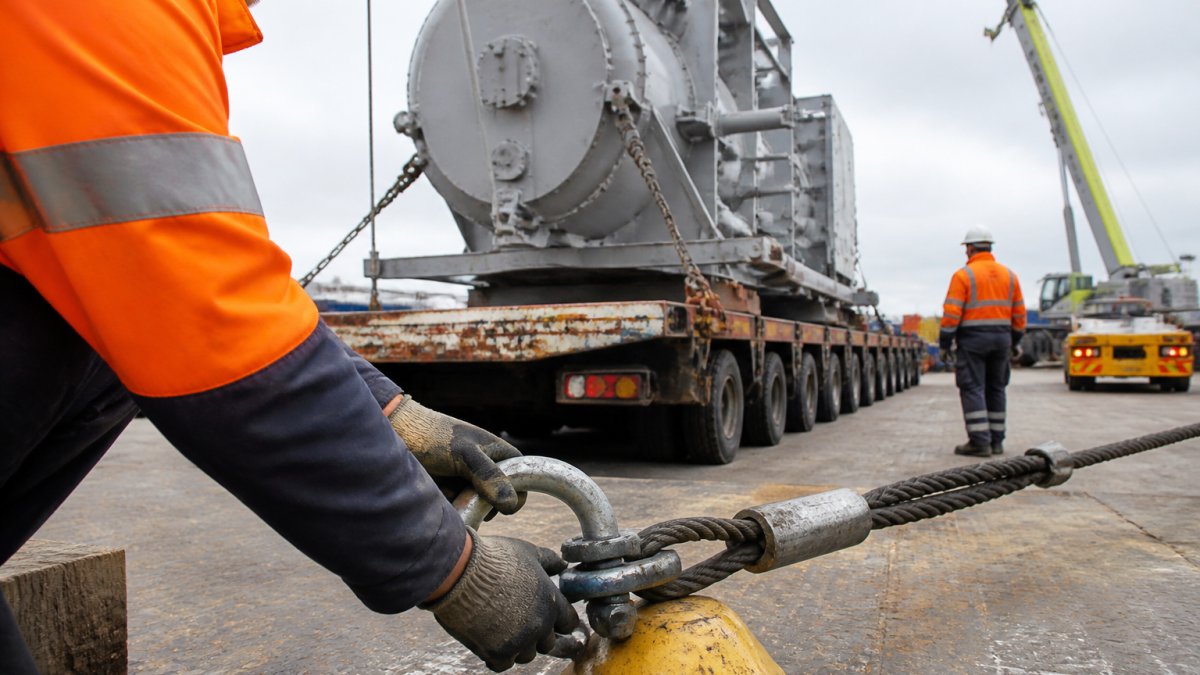
Specialised transport equipment is chosen per load. A low-loader trailer suits tall machinery. A multi-axle platform spreads weight across more wheels.
Equipment choice affects cost, route options, and safety. Matching it to the load early avoids expensive changes later.
Choosing Transport Modes: Road, Rail, Sea, Air and Coastal Shipping
No single mode fits every oversized load. The right choice depends on dimensions, weight, distance, urgency, route access, risk, and budget. Most practitioners find that the decision is driven by two questions first: can the load physically move on this mode, and what does each feasible option cost in time and money?
A Practical Mode-Selection Framework
Work through these criteria in order. The first criterion that rules a mode out removes it from the shortlist.
- Dimensions and weight envelope. Check the load against each mode’s practical limits. Road is constrained by bridge heights, lane widths, and axle mass limits. Rail is constrained by tunnel and bridge clearances and wagon deck capacity. Sea is constrained by hatch openings, deck space, and crane capacity at both ports. Air is constrained by aircraft door size, floor loading, and the maximum payload of the freighter type available.
- Route access. Confirm the load can reach the departure point and leave the arrival point. A rail terminal or port is only useful if the load can get there by road under permit.
- Urgency and transit time. Air is fastest but has the tightest size and weight caps. Road is usually next fastest for domestic moves. Rail and coastal shipping trade speed for capacity. Sea freight is slowest but handles the largest project cargo.
- Handling and transfer count. Every mode change adds a lift, a staging point, and a risk of damage or delay. A direct road move with one loading and one unloading is simpler than a road-rail-road-sea sequence.
- Risk and weather exposure. Long coastal or sea legs add weather risk. Rail adds fixed-terminal dependency. Road adds traffic and route-closure risk.
- Cost per tonne-kilometre versus total landed cost. The cheapest line-haul rate is not the cheapest shipment once permits, escorts, handling, staging, and demurrage are added.
Mode Comparison for Oversized Cargo
| Mode | Best For | Main Trade-off | Typical Use Case |
|---|---|---|---|
| Road transport | Short to medium distance, door-to-door, loads within permitable dimensions | Route and permit limits; escorts and travel restrictions | Machinery moving between a port and an inland site |
| Rail transport | Long inland hauls, heavy loads, routes with rail access at both ends | Fixed rail terminals; limited clearance envelope | Mining equipment moving to a remote inland hub |
| Sea freight | International and large project cargo, very heavy or very long units | Longer transit times; port crane and hatch constraints | Turbines or modular plant shipped between ports |
| Air freight | Urgent, high-value, relatively compact freight | Size and weight caps; high cost per kilogram | Critical spares for a project with a hard deadline |
| Coastal shipping | Long domestic hauls between ports, heavy units | Port scheduling; weather exposure | Structural steel moving between coastal terminals |
Worked Example: Choosing Between Road and Coastal Shipping
Suppose a 42-metre, 180-tonne unit needs to move between two coastal terminals roughly 1,800 kilometres apart. Road is feasible only with a multi-axle configuration, multiple permits, and escorts, and the route survey may reveal bridge or turning constraints. Coastal shipping avoids the road exposure but adds port handling at both ends and depends on vessel scheduling. The decision usually comes down to whether the schedule can absorb the sea transit and port windows, or whether the site needs the unit sooner and can justify the road cost.
When Multimodal Wins
Multimodal transport often wins on large project cargo. A load might move by road to a port, by sea, then by road again. The planning work is in the handovers: confirming crane capacity at each transfer point, booking staging space, and aligning vessel, rail, and road windows so the load does not sit idle. We plan each leg against the same schedule so the handovers line up.
Shortlist modes by feasibility first, then compare total landed cost. Comparing rates before you have ruled out modes on dimensions or route access leads to quotes you cannot use.
What Drives an Oversized Freight Quote (and How to Budget)
An oversized freight quote is driven by the load, the route, and the equipment, not a flat rate. Two loads of the same weight can price very differently if one needs a wider route, more escorts, or a larger crane. Understanding the drivers lets you budget realistically and compare quotes on a like-for-like basis.
The Main Cost Drivers
- Dimensions and weight. Length, width, height, and mass determine the equipment class, the number of axles, and whether the load fits within standard permitable limits or needs a special permit. Over-dimensional loads often attract higher rates than overweight loads of similar mass because of route and escort requirements.
- Permits. Each road authority along the route may charge its own permit fee, and the fee structure changes with load size, route, and travel conditions. Multiple jurisdictions mean multiple applications and multiple fees.
- Transit time and schedule pressure. Urgent moves may require premium equipment availability, out-of-hours travel, or air freight, all of which carry a premium.
How to Build a Budget
A practical budget separates fixed and variable costs.
- Fixed project costs. Load assessment, engineering, route survey, and permit applications. These are usually incurred early and are largely independent of transit time.
- Line-haul cost. The base transport rate for the chosen mode and equipment. This is the number most quotes lead with, but it is rarely the whole cost.
- Accessory costs. Permits, escorts, pilot vehicles, crane hire, rigging, and temporary works. These scale with route complexity and load size.
- Time-related costs. Staging, storage, demurrage, and standby charges if the schedule slips.
- Contingency. A buffer for route changes, permit delays, or weather. Most practitioners set this as a percentage of the total rather than a fixed figure.
Comparing Quotes Like for Like
Ask each provider what is included. A quote that excludes permits, escorts, or crane time is not comparable to an all-in quote. Check whether the rate assumes a specific travel window, whether standby charges apply, and whether the equipment configuration matches the load assessment. The cheapest headline rate often excludes the cost lines that grow once the move starts.
The cheapest quote is rarely the safest or the most complete. Ask what is included for permits, escorts, handling, and standby before comparing prices, and budget a contingency for route and schedule changes.
Cargo Handling, Contingency Planning and Delivery Coordination
Cargo handling covers loading, securing, and unloading the load. Each step needs the right equipment and a clear plan.
Contingency planning prepares for what goes wrong: a closed road, a delayed permit, or a weather hold. A backup route and a buffer in the schedule protect the delivery date.
Delivery coordination ties it together. Staging, storage, and final delivery are scheduled so the load arrives when the site is ready.
A simple end-to-end checklist:
- Complete the load assessment
- Survey the route and confirm feasibility
- Lodge permits and book escorts
Conclusion
Moving oversized cargo well comes down to planning before the load leaves. Get the assessment, route, and permits right, and the rest follows.
Seatram handles this end to end. Our team builds tailored freight solutions across sea, air, and land, with door-to-door or wharf-to-wharf options and one platform to track every shipment.
Request a quote from Seatram and let us plan your next oversized move.
Frequently Asked Questions
What is considered oversized cargo in freight logistics?
Oversized cargo is any load that exceeds standard vehicle or container limits in dimension, weight or shape. That covers over-dimensional freight that is too wide, tall or long for a normal trailer, overweight freight beyond standard axle limits, and out-of-gauge cargo such as mining equipment or industrial machinery that cannot be packed conventionally. Because the thresholds differ between road, rail and sea modes, a load assessment with exact cargo dimensions and cargo weight is the first step before any logistics solutions for oversized cargo can be planned.
How do you plan a route for an oversized load?
Oversized load route planning starts with a route survey to check bridge heights, pavement strength, turning circles, overhead lines and road exposure along the proposed path. From there, a route feasibility review confirms whether the load can physically pass and whether escorts or temporary works are needed. Alternatives are compared before locking in a delivery schedule, and the final route is documented for permit applications. Doing this early avoids the common mistake of securing a permit for a route the load cannot actually travel.
What information is needed to get an oversized freight quote?
A freight quote for oversized cargo needs exact cargo dimensions (length, width, height), cargo weight, the pickup and delivery locations, preferred dates and any handling constraints such as lifting points or fragile components. Photos and drawings help. Ask what is included: fuel surcharges, port fees, escort costs, crane hire and storage are often quoted separately. Getting these itemised up front is the simplest way to compare providers fairly and avoid surprise charges after the shipment is booked.
How do you choose a logistics provider for heavy or over-dimensional freight?
Look for a provider that runs a formal load assessment, documents route feasibility, manages permits and escorts in-house, and can explain how it handles contingency planning when a route is blocked or a crane slot is lost. Ask for references from similar project cargo work, check how shipment tracking actually reports progress, and confirm who is liable if customs paperwork delays clearance. A provider that answers these questions specifically, rather than generically, is usually the safer choice for heavy haulage and heavy lift cargo services.
