
Table of Contents
- What Counts as Over Dimensional Cargo and Why It Needs Specialist Handling
- NHVR Permit Requirements for Over-Dimensional Loads
- Heavy Vehicle Pilot Vehicle Guidelines
- Risk Assessment for Heavy Haulage
- Route Planning, Feasibility and Specialised Equipment
- Insurance, Liability and Post-Transport Inspection
- Common Mistakes in Over Dimensional Cargo Logistics
- Conclusion
- Frequently Asked Questions
Last Updated: September 15, 2026
What Counts as Over Dimensional Cargo and Why It Needs Specialist Handling
Over dimensional cargo is any load that exceeds the standard legal limits for height, width, length or mass on a public road, which means it cannot travel under normal freight arrangements. In practice, managing over dimensional cargo logistics means coordinating permits, escorts, route surveys and specialised trailers around a single indivisible load.
The distinction matters because general freight networks are built for pallets and containers, not for a 60-tonne transformer. Seatram handles these movements as project cargo, where the planning starts weeks before the truck does.
Over Dimensional Cargo vs Standard Freight
Standard freight moves inside a fixed dimensional envelope: a container, a pallet footprint, a rigid truck and dog combination. Over dimensional cargo breaks that envelope by definition.
The practical differences stack up quickly:
|
Factor |
Standard Freight |
Over Dimensional Cargo |
|---|---|---|
|
Permits |
Not required |
Required per state and route |
|
Escorts |
Not required |
Pilot and often police escorts |
|
Route |
Any approved road |
Surveyed and assessed route |
|
Equipment |
Standard trailers |
Low-bed, hydraulic modular trailers |
|
Transit time |
Scheduled |
Variable, weather and permit dependent |
NHVR Permit Requirements for Over-Dimensional Loads
The National Heavy Vehicle Regulator (NHVR) issues permits for vehicles and loads that exceed the Heavy Vehicle National Law mass, dimension or loading requirements. Operators apply through the NHVR Portal, and the permit must be carried for the journey.
A common mistake is assuming one permit covers the whole trip. It often does not. Cross-border movements can require separate state approvals, and conditions vary by road manager.
What You Need Before You Apply
Gather these before you lodge anything:
- Accurate mass and dimension certificates for the load
- A route survey confirming clearances and roadway constraints
- Registered vehicle details and configuration drawings
- Evidence of public liability and cargo insurance
- Contact details for the receiving site and any road managers
Incomplete applications are the single biggest cause of permit delays. Check the NHVR permit application guidance before you start.
Heavy Vehicle Pilot Vehicle Guidelines
A pilot vehicle warns other road users and helps the driver negotiate the route. Whether you need one, and how many, depends on the load’s dimensions and the road class.
The National Heavy Vehicle Regulator sets the requirements in the NHVR pilot and escort vehicle rules. As a rule of thumb, wider and longer loads attract more escorts, and some routes require a police escort regardless.
Pilot drivers need the right accreditation, a fitted warning sign, flashing lights and a UHF radio to communicate with the heavy vehicle driver. Skipping accreditation is a compliance breach, not a shortcut.
Risk Assessment for Heavy Haulage
Risk assessment for heavy haulage is the process of identifying every hazard between origin and destination, then documenting controls before the load moves. It is not a formality. It is the document that protects your cargo, your crew and your schedule.
Building a Practical Risk Register
- Clearance height conflicts with bridges, signage and overhead lines
- Axle load distribution exceeding pavement or bridge limits
- Load securement failure under braking or cornering
- Escort or permit gaps on multi-state routes
- Weather and road closure risk on the surveyed route
Route Planning, Feasibility and Specialised Equipment
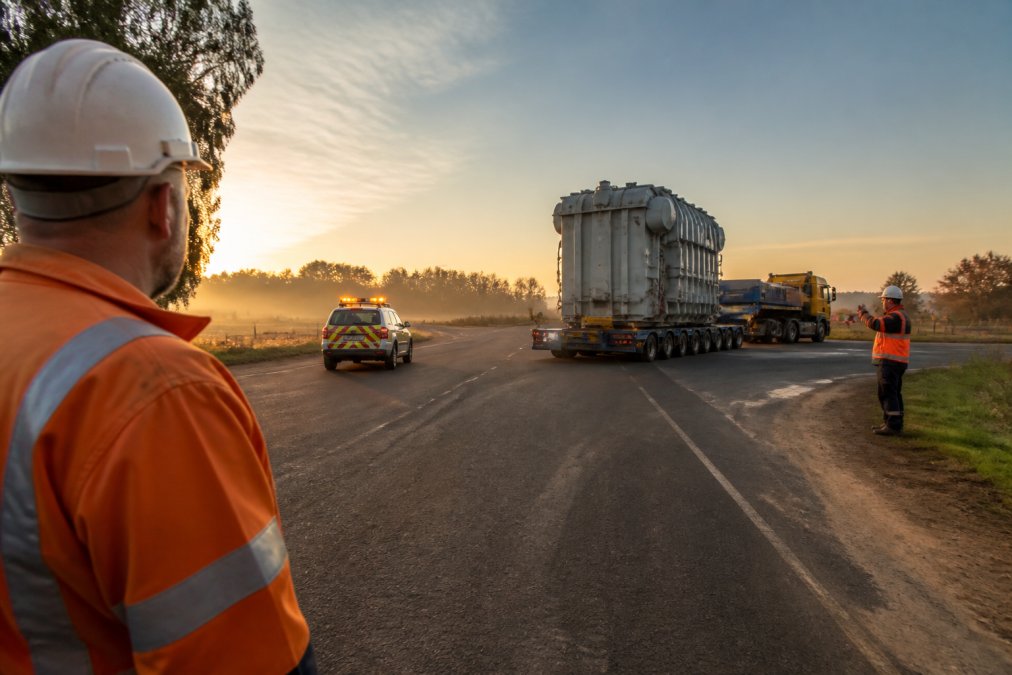
Route planning starts with a transport feasibility study: can this load physically get from A to B, and what does it take?
The Feasibility Study, Step by Step
- Load data capture. Mass, dimensions, centre of gravity, lifting points, and any indivisibility certification. If the load can be broken down, it usually should be, the cheapest oversized move is the one you avoid.
- Desk-top route options. Identify two or three candidate corridors using road manager mapping, bridge restriction registers and height clearance data. Never rely on a single route.
- Physical route survey. Drive the route and measure. Record overhead line heights, tree canopy, roundabout geometry, pavement width, median crossings, and any pinch point where the load cannot pass a stationary vehicle.
- Structural assessment. Where axle loads or all-up mass exceed posted limits, the road manager may require a bridge or pavement assessment before approval. This is often the longest lead-time item.
- Equipment selection. Match the trailer configuration to the load’s mass and geometry, not to what happens to be available.
- Permit lodgement and condition review. Conditions can dictate travel windows, escort numbers and no-go times.
Matching Equipment to the Load
- Low-bed and drop-deck trailers lower the deck to gain height clearance. They suit tall, heavy indivisible items where overhead structures are the binding constraint.
- Extendable trailers handle long loads such as wind turbine blades and precast beams, with deck length adjusted to the load rather than the load trimmed to the deck.
- Hydraulic modular trailers (SPMTs) distribute mass across many axle lines. They are the standard answer when the load exceeds what a conventional trailer can legally carry, and they allow steering geometry to be adjusted for tight corners.
- Platform and bolster trailers suit concentrated point loads where the load bears on defined support points.
- Heavy lift cranes and gantries handle the transfer at each end, and the crane pad, not the crane, is often the constraint on an industrial site.
Why the Survey Has a Shelf Life
A route survey is a snapshot.
Insurance, Liability and Post-Transport Inspection
Insurance and liability in over dimensional cargo logistics are rarely straightforward.
Where Standard Cover Falls Short
- Valuation basis. High-value indivisible assets such as transformers, turbines and switchgear are often better insured on an agreed-value or reinstatement basis rather than a per-kilogram limit, which can leave a large shortfall.
- Transit versus storage. Cover needs to follow the asset through every stage: factory gate, wharf, storage laydown, road movement, and final positioning on site. Gaps commonly appear at the handover points between these stages.
- Loading and unloading. Many policies exclude or restrict cover during loading and unloading unless specifically extended. For heavy haulage, that is exactly when the highest-risk lift occurs.
- Delay and consequential loss. Physical damage cover does not respond to a delayed project. If a late delivery triggers contractual penalties, that exposure sits elsewhere and needs to be identified early.
- Subcontractor and equipment exposure. Pilot vehicles, crane contractors and modular trailer operators each carry their own cover. The contract should make clear whose policy responds and at what limit.
Allocating Liability Across the Chain
- Who is the principal contractor for the movement, and who holds the master policy?
- What are the liability limits, and are they adequate against the asset’s value?
- Who bears risk during each transition, wharf to trailer, trailer to site, site to foundation?
- What notice periods and documentation are required to make a claim?
Post-Transport Inspection: A Working Checklist
- Condition baseline. Compare the arrival condition against the pre-loading photographic record and any factory inspection report.
- Structural integrity. Inspect for stress marks, deformation, cracking at lifting points, and movement of any internal components.
- Securement evidence. Check for chafe marks, strap witness marks and any sign the load shifted during transit.
- Environmental exposure. Look for water ingress, condensation or corrosion, particularly on electrical assets.
- Ancillary items. Confirm all loose components, shipping brackets and documentation travelled with the load.
- Sign-off. Record findings on a signed condition report, with photographs at each inspection point and the names of those present.
The Sustainability Angle
Heavy haulage is carbon-intensive by nature, and that is increasingly a factor in project tenders.
Common Mistakes in Over Dimensional Cargo Logistics
- Applying for permits too late, forcing a rushed route
- Underestimating clearance height after the load settles on the trailer
- Using a freight forwarder without heavy haulage experience
- Ignoring axle load distribution until the weighbridge
- Leaving load securement to the driver alone
Conclusion
Managing over dimensional cargo logistics is unforgiving of gaps: one missing permit or one unassessed bridge stops the whole movement.
Frequently Asked Questions
What is classified as over-dimensional cargo in Australia?
A load is over-dimensional when it exceeds standard legal limits: generally wider than 2.5 metres, higher than 4.3 metres, longer than 19 metres for a combination, or heavier than the mass limits on the route. Loads that cannot be broken down, known as indivisible loads, need an NHVR permit before they move. State and territory rules can vary slightly, so always confirm against the corridor you plan to use.
What permits are required for transporting over-dimensional loads?
Most oversize transport in Australia needs a permit or notice issued through the National Heavy Vehicle Regulator. Which instrument applies depends on the dimensional envelope, the mass, and the roads you use. Some loads travel under a gazette notice with set conditions; others need a specific permit. You will typically need axle load distribution, a route survey, and escort arrangements confirmed before approval.
How do you ensure safety when managing over dimensional cargo logistics?
Safety starts with a documented risk assessment for heavy haulage covering clearance height, roadway constraints, load securement, and traffic management. Pilot and escort vehicles manage other road users, while hydraulic modular trailers or low-bed trailers keep weight distribution within limits. Post-transport inspection of the load and securing gear closes the loop, so damage or fatigue is caught before the next job.
What is the role of a pilot vehicle in over-dimensional transport?
A pilot vehicle travels ahead of or behind the load to warn other drivers, check clearances, and manage traffic through tight sections. Under heavy vehicle pilot vehicle guidelines, pilots must hold the right accreditation, display correct signage, and communicate with the driver by radio. The number of pilots and their positions depend on the width, length, and route, and they are a permit condition rather than an optional extra.