
Last Updated: October 23, 2026
Quick Summary
Freight tracking software delivers benefits by replacing check calls with live location data, recalculating ETAs against traffic, port congestion and weather, and raising automated exception alerts so delays are caught early. It also improves route planning and fleet utilisation, unifies sea, air, rail and road visibility, and feeds transport management software to drive measurable ROI.
- Treat a road-leg position as unknown when the last update is more than a few hours old.
- Set notifications to fire on key node arrivals and ETA slips beyond an agreed threshold.
- Ask each carrier which events report automatically, which need manual entry, and how often each updates.
- Report five KPIs monthly against a baseline captured before go-live.
- Build the ROI case in four lines with visible assumptions, run at low, mid and high.
Table of Contents
- 1. Real-Time Shipment Tracking Ends the ‘In Transit’ Black Hole
- 2. Accurate ETA Updates That Customers Actually Trust
- 3. Exception Alerts and Proactive Issue Management Cut Delays
- 4. Route Planning and Fleet Utilisation Lower Operating Costs
- 5. A Container Tracking System for Sea, Air and Land Freight
- 6. Choosing Shipment Visibility Software: Integrations, Data Quality and Governance
- 7. From Transport Management Software to Measurable ROI
- Frequently Asked Questions
1. Real-Time Shipment Tracking Ends the ‘In Transit’ Black Hole
If you have ever watched a container sit on “in transit” for three weeks with no further detail, you already understand the problem. Real-time freight tracking software closes that gap by replacing a single vague status with continuous location data, timestamps and event history.
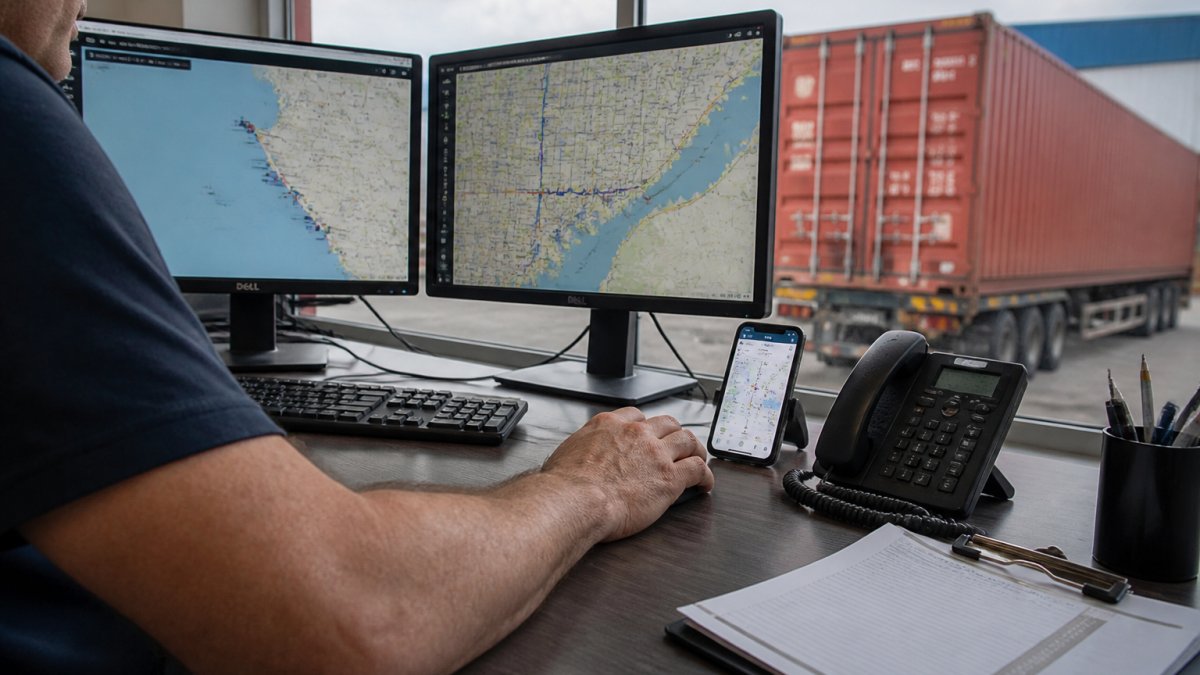
(/tag/road-freight-tracking/) legs, and carriers that report late all create blind spots. A good system flags staleness rather than pretending a position is current.
The most common failure is trusting a stale timestamp. If the last update is more than a few hours old on a road leg, treat the position as unknown and confirm with the carrier before promising anything to a customer.
2. Accurate ETA Updates That Customers Actually Trust
An estimated time of arrival is only useful if it moves when reality moves.
The practical win sits in customer communication. Automated delivery notifications, sent at meaningful milestones rather than every minor event, cut inbound “where is my order” enquiries and give your account team something accurate to say.
A common mistake is over-notifying. Customers want the exception, not the itinerary.
Set notifications to fire on arrival at key nodes and on any ETA slip beyond an agreed threshold. Everything else stays in the dashboard for your team.
3. Exception Alerts and Proactive Issue Management Cut Delays
Exception alerts are automated flags raised when a shipment deviates from plan: a missed connection, a customs hold, a temperature excursion, a delay beyond tolerance. They turn reactive firefighting into proactive issue management, because someone knows before the customer does.
The value is in the response window. A port delay caught on day one gives you options: rebook, reroute, or warn the receiver. The same delay discovered on day five leaves you apologising.
Start sensitive, then calibrate.
4. Route Planning and Fleet Utilisation Lower Operating Costs
Better route planning and fleet utilisation are where tracking data starts paying for itself.
The cost levers are unglamorous but reliable: reduced fuel consumption from fewer wasted kilometres, fewer empty return legs, tighter dispatch scheduling, and lower detention and demurrage exposure because you see problems coming.
Tracking alone does not optimise anything. Someone has to review the data and change the plan.
5. A Container Tracking System for Sea, Air and Land Freight
A container tracking system should give one view across every mode you use, but the honest starting point is that each mode leaks visibility in a different place. Sea freight, air freight, rail and road legs fail differently, and stitching them into a single shipment record is the whole point of shipment visibility software. Most competitors stop at “multi-modal visibility”; the useful detail is where each mode breaks and what a realistic data expectation looks like.
Mode-specific visibility gaps
- Sea (FCL and LCL): vessel position via AIS is relatively easy, but container-level status is harder. Port and terminal events, gate-in, gate-out, load, discharge, customs hold, are the usual blind spot, and they are exactly the events that drive demurrage and detention exposure. LCL adds a consolidation layer, so the container may move before or after your cargo does.
- Air: milestone data from carriers and ground handlers is generally strong, but dwell time between flights and the clearance window is where surprises hide. A shipment can be “arrived” for days before it is released.
- Rail and intermodal: handoffs between rail operators and drayage carriers are the weak link. The container is often physically moving while the status feed says nothing, because no single party owns the handoff event.
- Road (FTL and LTL): the most granular data, and the most dependent on driver and carrier reporting discipline. Telematics and electronic logging device feeds help on owned or contracted fleets; subcontracted LTL legs are where status goes quiet.
Stakeholder views in one place
Different parties need different slices of the same shipment, and a centralised tracking layer is what stops three separate email threads forming:
- Shippers want exception-first views: which consignments are off plan, what it will cost, and who owns the fix. They rarely need a live map of every truck.
- Freight forwarders and brokers work shipment-by-shipment across many customers and need milestone completeness and document status as much as position.
- Carriers need clear, explicit expectations, which events to report, how often, and in what format, because carrier visibility improves when the reporting contract is unambiguous.
- Consignees want a reliable ETA and a notification when it changes, not a dashboard login. Give them a tracked link rather than a seat in the platform.
Design the tracking layer around events and exceptions, not around a map. A map is the demo; milestone completeness and stale-data flags are what operations actually run on.
What to ask before you commit
Ask each carrier which events they report automatically, which require manual entry, and how often each updates. Ask whether the platform flags stale data per mode rather than averaging update frequency across the network. And ask how handoffs between parties are represented, because the gap between two carriers is where most visibility programmes quietly fail.
6. Choosing Shipment Visibility Software: Integrations, Data Quality and Governance
Pick software by integration depth first, dashboard second. A tracking tool is only as good as the carrier feeds and transport management software it connects to. Ask which carriers report automatically, which need manual entry, and how often each updates.
Data quality decides whether the system is trusted. Duplicate shipment records, mismatched references and missing milestones will quietly undermine adoption.
Use this checklist when evaluating providers:
- Carrier integrations cover your top lanes and modes
- Update frequency is stated per carrier, not averaged
- Stale data is flagged, not silently displayed
- Access roles separate customer, operations and finance views
- Data retention and export terms are documented
- Onboarding includes reference-matching and cleanup
7. From Transport Management Software to Measurable ROI
Tracking earns its keep when it feeds the systems that act on it. Connected to transport management software, live data drives dispatch, billing and customer updates from one source. Disconnected, it is an expensive map. The gap in most benefit-focused articles is that they assert savings without showing the arithmetic. Here is a defensible way to build the case, line by line, with assumptions you can defend in a budget meeting.
The five KPIs to report monthly
| KPI | What it tells you | Where the data comes from |
|---|---|---|
| On-time delivery rate | Whether promises are kept | Milestone timestamps vs planned ETA |
| Exception response time | How fast issues get owned | Alert raised vs first action logged |
| ETA accuracy | Whether customers can plan | Predicted vs actual arrival |
| Cost per shipment | Whether routing is improving | Freight, fuel and handling per consignment |
| Check calls per shipment | Manual effort removed | Call log vs automated updates |
Report these monthly against a pre-implementation baseline. Without a baseline captured before go-live, every later saving is an argument rather than a measurement.
A benefit-by-benefit ROI model
Build the case in four lines rather than one big number. Each line needs three things: a volume driver, a unit assumption, and a source for that assumption. Where you cannot measure a line yet, say so and revisit it quarterly rather than inventing a figure.
Line 2, Avoided detention, demurrage and spoilage.
Count the chargeable events in the prior twelve months and the average charge per event.
Line 3, Reduced expedited freight spend.
Identify shipments that were upgraded to air or expedited road because a delay was discovered late. Better planning converts some of those into planned, cheaper movements.
Line 4, Retained revenue from customers who stop chasing you.
This is the softest line and should be treated as such.
Add the four lines, subtract the software subscription, integration effort and internal onboarding time, and you have a figure you can defend. Run it at low, mid and high assumptions so the conclusion does not hinge on a single guess.
Present the model as a spreadsheet with every assumption visible and editable. Reviewers trust a model they can change more than a single headline saving.
Where the model usually disappoints
Two failure modes are common. First, savings are claimed but never realised because nobody changed the process, tracking alone does not optimise anything, and someone has to review the data and change the plan. Second, the baseline is reconstructed after go-live from memory, which makes every number contestable. Capture the before-state first, then let the model do its work.
Frequently Asked Questions
How does real-time freight tracking software work?
It pulls location and status data from several sources, including carrier GPS feeds, port and terminal milestones, container sensors and driver apps, then matches each event to the right consignment in one dashboard. Trimble’s Transportation Pulse Report 2026 found 39% of carriers surveyed already use AI for real-time tracking. For a forwarder, that means fewer manual check calls and earlier warning when a vessel, truck or flight slips. The software does not create visibility on its own: data quality and carrier integrations decide how much you actually see.
What are the main real time freight tracking software benefits for a small importer?
The practical gains are fewer surprise delays, more accurate ETA updates to your customers, lower detention and demurrage exposure, and less staff time spent chasing status. For a business moving 15 to 20 international shipments a month, the biggest win is usually exception alerts: you hear about a missed connection or customs hold before the customer does. Pricing for tracking platforms varies with shipment volume and integration scope, so ask for a quote based on your actual monthly consignments rather than a headline rate.
What is the difference between freight tracking and container tracking?
Freight tracking follows the whole consignment from pickup to delivery, including the paperwork, handoffs and final delivery leg. A container tracking system follows the physical box: its location, port moves, terminal milestones and empty return. Most importers need both views joined together, because a container can sit at a terminal while the freight inside is already cleared for delivery. Ask any provider how they reconcile container events with shipment milestones, and whether you see one timeline or two disconnected screens.
Which features should freight tracking software include?
Look for live location and milestone data across sea, air and road, configurable exception alerts, ETA updates you can share with customers, and integration with your transport management software and accounting tools. Check how the platform handles carrier data gaps and who cleans the data. Also confirm security and access controls, audit logs and data retention, because shipment data reveals supplier relationships and volumes. A short trial on your own lanes, measured against your current on-time delivery rate, tells you more than a feature list.
Freight visibility is not a dashboard problem, it is a discipline problem, and the right platform makes the discipline easier to keep. Seatram provides tailored end-to-end supply chain solutions across sea, air and land freight, with one platform to manage all shipments and responsive, efficient shipping processes behind it. If you want tracking that shows where cargo actually is, request a quote and we will map it against your lanes.
