
Table of Contents
- What Makes Cold Chain Shipping Responsive and Efficient
- Cold Chain Transport Planning: Building the Route Before You Ship
- Cold Chain Shipping Best Practices for Packaging and Handling
- Cold Chain Monitoring Systems: Real-Time Visibility Across the Journey
- Cold Chain Risk Management: Playbooks for Disruptions and Excursions
- Measuring Efficiency: KPIs, Cost Control and Emissions Trade-Offs
- Choosing the Right Freight Partner for Cold Chain Logistics
- Conclusion: Turning Cold Chain Plans Into Reliable Deliveries
- Frequently Asked Questions
Last Updated: October 6, 2026
What Makes Cold Chain Shipping Responsive and Efficient
Responsive cold chain logistics comes down to control. Every temperature-sensitive shipment passes through handovers, each a chance for the chain to break.
Cold chain logistics is the planning, moving and storing of goods that must stay within a set temperature range from origin to delivery.
Three habits separate reliable cold chain operations from fragile ones:
- Plan the temperature range before you book freight. Know the product’s safe window first.
- Monitor in real time, not at the end. A logger read on arrival tells you what already went wrong.
- Have a playbook for failure. Excursions happen. Response speed decides the loss.
Below: transport planning, packaging, monitoring, risk playbooks and the numbers that prove it works.
Cold Chain Transport Planning: Building the Route Before You Ship
Cold chain transport planning starts with the product, not the route. Work backwards from the temperature range the goods must hold, then design the journey around it. Booking the cheapest lane first costs more in spoiled cargo than it saves in freight.
Build the plan in this order:
- Confirm the product’s required temperature range and tolerance.
- Map every handover point, including ports, depots and customs holds.
- Match the mode to the urgency: sea for volume, air for speed, road for the last leg.
- Set a maximum time outside controlled conditions for each leg.
- Book refrigerated transport and cold storage capacity before confirming the shipment.
The Department of Agriculture, Fisheries and Forestry on export cold chain requirements sets out the conditions many perishable exports must meet, so check those rules before you lock in a plan.
Cold Chain Shipping Best Practices for Packaging and Handling
Cold chain shipping best practices for packaging come down to matching the cooling method to the journey length. A gel pack that holds temperature for 24 hours will fail on a five-day sea leg.
|
Journey Length |
Cooling Method |
Best For |
|---|---|---|
|
Under 24 hours |
Gel packs |
Local delivery, short road legs |
|
1-3 days |
Dry ice or high-performance packs |
Air freight, regional road |
|
3+ days |
Refrigerated containers |
Sea freight, long-haul |
|
Ultra-low temp |
Liquid nitrogen |
Specialised pharmaceutical cargo |
Handling matters too. Every time a pallet sits on a dock, it loses temperature. Train staff to move cold containers straight from vehicle to cold storage, with no waiting time between.
- Pre-chill packaging before loading
- Keep insulated containers sealed until the last moment
- Minimise dock time at every handover
Cold Chain Monitoring Systems: Real-Time Visibility Across the Journey
Cold chain monitoring systems track temperature, humidity and location across the journey.
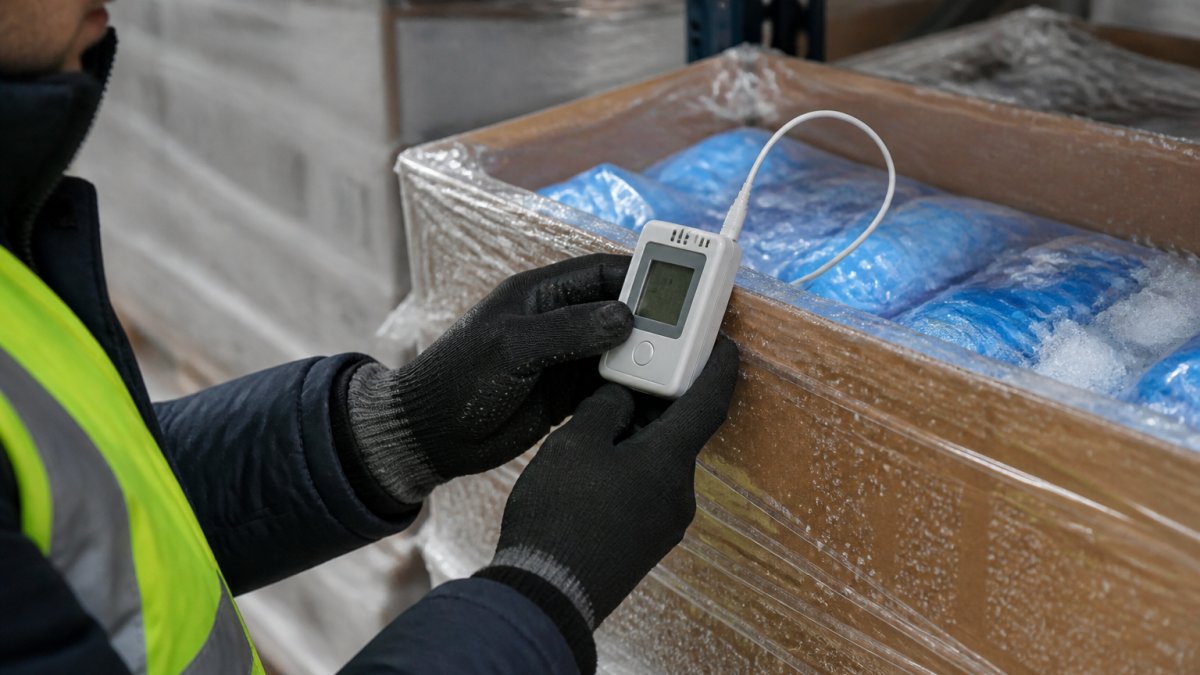
Modern tracking goes beyond a single logger read on arrival: sensors inside the packaging, GPS on the vehicle, and a platform that flags problems as they happen.
What to look for in a monitoring system:
- Live alerts when temperature drifts outside the set range
- Location tracking so you know exactly where a shipment is
- Humidity control data, not just temperature
The Therapeutic Goods Administration on cold chain requirements for medicines is a useful reference for anyone moving pharmaceutical products, where monitoring records form part of the compliance picture.
Cold Chain Risk Management: Playbooks for Disruptions and Excursions
Cold chain risk management is the plan you run when something goes wrong. Most cold chain failures come not from bad equipment but from a slow response to a problem visible hours earlier.
A temperature excursion is any moment the goods drift outside their required range. The faster you act, the more you save, but speed only helps if the response is pre-decided.
Build the playbook around four scenarios
Write a short playbook for each of the four disruptions that account for most cold chain losses:
1. Refrigeration unit failure in transit. The vehicle’s cooling stops; the load stays within range only for a window set by the packaging’s thermal mass and ambient temperature.
- Trigger: sensor reads a rising trend, not just a breach.
- Immediate action: driver diverts to the nearest pre-identified cold storage facility on the route.
- Escalation: operations controller contacts the customer within 30 minutes with the diversion plan and revised ETA.
2. Route closure or extended delay. Road closures, port congestion, or a biosecurity hold push the journey past the packaging’s rated hold time.
- Trigger: projected arrival time exceeds the packaging’s validated hold duration.
- Immediate action: switch to a pre-approved alternate route or a cross-dock transfer to a fresh refrigerated vehicle.
- Escalation: notify the receiver and, for export cargo, the relevant biosecurity authority if the hold affects clearance.
3. Temperature excursion detected mid-journey. Goods have already drifted outside range.
- Trigger: alert fires when temperature crosses the lower or upper limit for a defined duration (for example, more than 30 minutes outside range).
- Immediate action: stop the clock, record the exact time, the peak deviation, and the duration out of range.
- Assessment: compare the excursion against the product’s stability data or the manufacturer’s permitted excursion allowance. Many pharmaceutical products have a documented short-term excursion tolerance; perishables often do not.
4. Power failure at a cold storage facility. A site-level outage threatens stored inventory.
- Trigger: facility monitoring loses power or the backup generator fails to start.
- Immediate action: activate the site’s contingency plan, backup generator, standby refrigeration, or transfer to an alternate facility.
- Escalation: notify all customers with stock at the site within a defined window.
Set escalation thresholds before you need them
A playbook only works if everyone knows when to escalate and to whom. Define thresholds in advance:
- Green: conditions within range, no action.
- Amber: a trend toward the limit or a delay that threatens the hold time, notify the operations controller.
- Red: an actual breach or a confirmed equipment failure, notify the customer and the quality contact immediately, and activate the relevant scenario playbook.
Record every event, even resolved ambers: repeated amber alerts on one lane warn that its packaging or routing needs redesign.
Document for the customer and for compliance
Every excursion needs a written record: what happened, when it was detected, what was done, who decided the goods were safe, and the evidence behind that decision. It supports the customer’s quality system and any insurance claim or regulatory response; for pharmaceutical cargo it is part of the compliance picture under therapeutic goods requirements. A playbook turns a crisis into a manageable event; without one, every excursion becomes a full-scale emergency.
Measuring Efficiency: KPIs, Cost Control and Emissions Trade-Offs
Measuring efficiency in cold chain logistics means tracking a small set of numbers that show where money and product are leaking. Each metric needs a definition, a data source and a target.
The core KPIs, defined
Temperature-excursion rate. Shipments that breach their required range divided by total shipments, as a percentage.
Spoilage rate. The value or volume of goods written off due to temperature failure, divided by total goods shipped.
On-time delivery (OTD). The percentage of shipments delivered within the agreed window.
Energy consumption per shipment. Kilowatt-hours consumed in cold storage and refrigeration per shipment, or per pallet-day.
What good looks like
Targets vary by product and lane, but mature operators commonly hit: excursion rate below 1% of shipments, spoilage below 0.5% by value, and OTD above 98% against the temperature-validated window. Treat these as directional benchmarks, ultra-low-temperature pharmaceuticals need tighter tolerances than chilled produce.
The efficiency trade-off, explained
The central tension in cold chain efficiency is that speed, temperature reliability, and cost pull against each other:
- Expedited transport (air freight, dedicated vehicles) cuts transit time and therefore spoilage risk, but raises freight cost and emissions per unit substantially.
- Slower sea freight lowers freight cost and emissions per unit, but demands longer-lasting cooling systems, more coolant, and more robust packaging, which shifts cost from transport to packaging and raises the consequence of any delay.
- Over-specifying packaging (more coolant, thicker insulation) reduces excursion risk but adds weight, volume, and cost, and can increase emissions from the extra mass being transported.
The right balance is not the cheapest freight rate or fastest lane but the combination that minimises cost per delivered unit while keeping the excursion rate inside the product’s tolerance. That calculation changes by lane, season and product, which is why measuring all five KPIs together matters more than optimising any one.
Emissions and refrigerants
Cold chain equipment is a heavy energy user, and the emissions picture has two parts: the energy consumed to run refrigeration, and the refrigerant gases themselves. Many common refrigerants have high global warming potential, so a leak or an end-of-life disposal matters as much as the electricity drawn. If your business reports on transport emissions, the Clean Energy Regulator on emissions reporting is worth reviewing, and your refrigerant handling obligations sit alongside that reporting.
Practical levers that reduce emissions without sacrificing reliability:
- Right-size refrigeration to the load rather than running oversized units.
- Improve door discipline and loading dock seals to cut energy waste.
- Consolidate part-loads where temperature compatibility allows.
Choosing the Right Freight Partner for Cold Chain Logistics
Choosing a freight partner for cold chain logistics comes down to three things: proven cold chain capability, honest pricing and tracking that works.
Questions worth asking any provider before you sign:
- Can you show live temperature and location data on demand?
- What is included in your rate, and what sits outside it?
- Who is liable if a shipment spoils in transit?
This is where a specialist provider earns its place. At Seatram, we build tailored, end-to-end supply chain solutions for cold and perishable cargo, with wharf-to-wharf and door-to-door options. Clients stay because shipments arrive safely, on time and on budget, and because they can track every one on a single platform.
Conclusion: Turning Cold Chain Plans Into Reliable Deliveries
Cold chain logistics rewards preparation and punishes guesswork. Plan the temperature range first, package for the journey, monitor in real time, and keep a playbook ready for when something drifts.
That is a lot to manage alone. Seatram handles it end to end, from tailored supply chain planning to real-time tracking and dedicated customer service, so your perishable and pharmaceutical cargo arrives in the condition it left in.
Frequently Asked Questions
What are the 4 Ps of logistics and how do they apply to cold chain shipping?
The 4 Ps are product, place, price and promotion. In cold chain logistics, product means understanding each item’s temperature range and shelf life. Place covers cold storage and temperature-controlled warehouses positioned close to your customers. Price includes refrigeration units, refrigerants and expedited transport costs. Promotion covers how you communicate delivery windows and quality assurance to buyers. Getting all four right keeps perishable products moving without spoilage.
What is the difference between an efficient and a responsive supply chain?
An efficient supply chain focuses on lowering transport costs and maximising load utilisation across predictable routes. A responsive supply chain prioritises speed, flexibility and real-time monitoring so it can react to temperature excursions, port delays or sudden demand shifts. Cold chain logistics needs both: efficient base routing for regular shipments, plus responsive contingency playbooks when something goes wrong. The balance shifts depending on whether you ship pharmaceuticals, seafood or chilled produce.
How can businesses prevent temperature excursions during transport?
Start with validated insulated containers and the right refrigerant, whether that is dry ice, gel packs or liquid nitrogen, matched to the journey length. Pre-cool the cargo and the vehicle before loading. Use cold chain monitoring systems with real-time alerts so you know about a deviation before the shipment arrives. Brief drivers and handlers on door-opening discipline. If an excursion does occur, document the temperature range and duration so you can assess product quality and file any insurance claim quickly.
How can real-time monitoring improve cold chain logistics performance?
Real-time monitoring turns a black box into a live view. Sensors report temperature, humidity and location every few minutes, so your team can reroute a shipment, add refrigerant or escalate to a cold storage facility before spoilage happens. The data also feeds operational KPIs such as excursion rate, mean kinetic temperature and on-time delivery. Over time, that record supports quality assurance audits and helps you negotiate better freight rates because you can prove your lanes perform.