
Last Updated: November 23, 2026
Quick Summary
To ship perishables internationally, plan backwards from the product’s shelf life, value and required temperature. Then choose packaging, coolant, transport mode and the export and destination paperwork that protect the cargo through transit and customs.
- Map each product’s shelf life, value and temperature band before choosing a shipping mode.
- Match gel packs, dry ice or insulation to the temperature band you need.
- Check destination import permits, certificates and labelling rules for your exact product.
- Compare landed cost per sellable unit, not headline freight rates, when choosing sea or air.
- Keep an unbroken cold chain and record temperatures at dispatch and on arrival.
Table of Contents
- Map Your Product’s Shelf Life, Value and Temperature Band First
- How to Package Perishable Food for Shipping
- International Perishable Shipping Requirements to Check Before You Book
- Temperature Control and Transit Time: Choosing Sea or Air Freight
- Shipping Frozen Food Internationally: Cold-Chain Steps That Matter
- International Food Shipping Customs Documents You Need
- Booking Your Perishable Shipment with Seatram
- Frequently Asked Questions
Learning to ship perishables internationally is a different job from shipping ordinary cargo. For a closely related guide, see handling time-sensitive cargo requirements before you commit to a plan.
The short answer is that you plan backwards. Start with the product’s shelf life, value and required temperature, then choose the packaging, transport mode and paperwork that protect it.
Demand for cold-chain freight is generally rising, and competition for reliable capacity rises with it. Businesses that plan carefully have an edge.
Map Your Product’s Shelf Life, Value and Temperature Band First
Before you book anything to ship perishables internationally, write down three numbers for each product: how long it lasts, what it is worth, and the temperature it must stay within. These three figures decide almost every later choice.
Shelf life tells you how much transit time you can afford. Value tells you how much you can spend protecting the cargo.
Shippers should map each product’s shelf life, value and temperature band before choosing between sea freight and air freight, because those three figures drive cost more than the distance does.
Watch out: A cheaper route that adds ten days can cost more than the air freight it replaced if the goods expire in transit.
How to Package Perishable Food for Shipping
Packaging is your first line of defence. Its job is to hold the product, slow the rise in temperature, and stop moisture or contamination getting in.
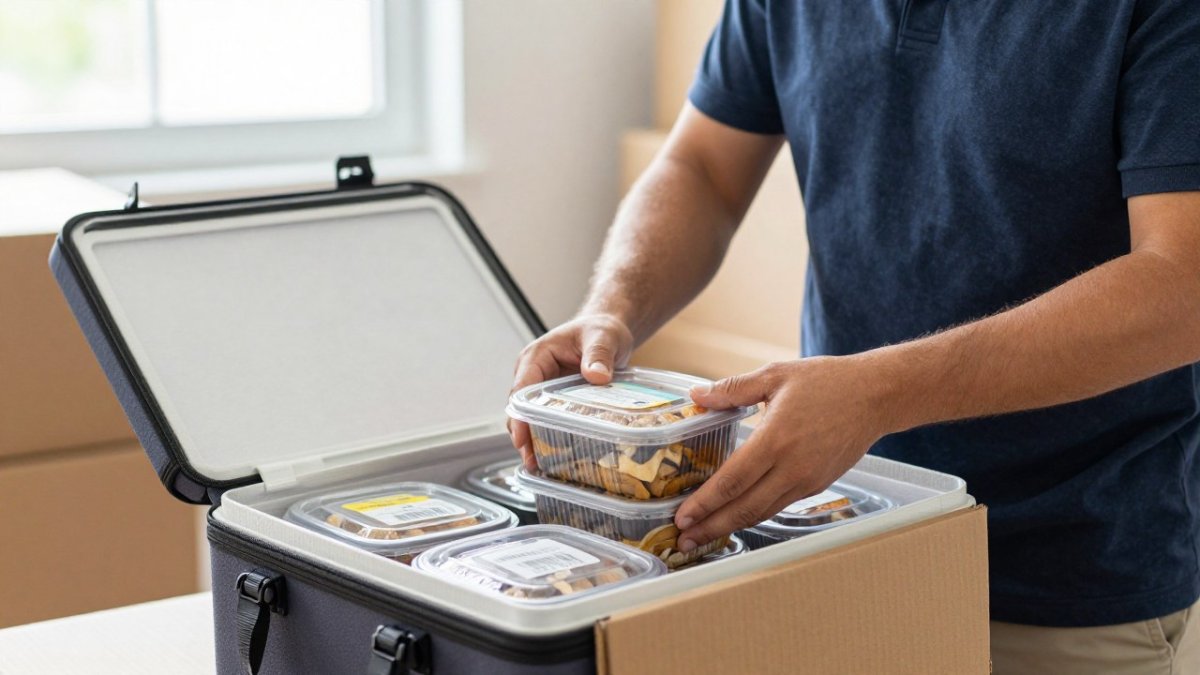
Use a food-safe inner packaging layer, sealed tightly. Place it inside a rigid outer carton, usually corrugated, so the box survives stacking and handling. Keep the goods well away from the carton walls, where heat gets in fastest.
Choosing insulation, gel packs and dry ice
Match the coolant to the temperature band you mapped earlier:
- Gel packs: suited to chilled goods held near 2 to 8 degrees Celsius for short transits.
- Dry ice: needed for frozen goods. It is classed as a hazardous material, so it must be declared and labelled correctly.
- Insulation: expanded polystyrene or vacuum-insulated panels slow heat transfer. Thicker insulation buys more time.
Pack coolant so it stays in contact with the product and nothing leaks onto it. Test the packing set-up with a trial run before a real shipment.
International Perishable Shipping Requirements to Check Before You Book
Every destination sets its own rules on what food can enter, how it must be labelled and what certificates it needs. The rules are not harmonised, so a checklist that works for one market can be wrong for the next. Check the requirements for your exact product and destination before you commit to a booking, because a shipment held at the border can spoil while you argue paperwork.
The Australian regulatory layer you cannot skip
If you are exporting from Australia, the requirements start at home. The Department of Agriculture, Fisheries and Forestry (DAFF) administers export certification for food and agricultural products, and many destinations will not accept a consignment without the certificate DAFF issues. Depending on the product, you may need:
- An export permit or registration for the commodity
- A health certificate or export certificate issued through DAFF
- A phytosanitary certificate for plant-based products
- A certificate of origin, often required for tariff preference under a free trade agreement
Food safety obligations also apply domestically under the Food Standards Code administered by Food Standards Australia New Zealand (FSANZ), and exporters of certain products must meet the export control rules that sit alongside it. Confirm with DAFF which certificates apply to your commodity and destination before you book freight, because certificate processing takes time and cannot be rushed at the port.
Destination-side requirements to confirm
On the receiving end, common requirements include:
- An import permit issued by the destination’s agriculture or food safety authority
- Health or phytosanitary certificates matching the destination’s prescribed format
- Labelling in the destination language, including allergen and ingredient declarations
- Restrictions or outright bans on specific animal or plant products, often driven by biosecurity risk
Biosecurity restrictions are the most common cause of rejected perishable cargo. Many markets restrict or ban particular meat, dairy, egg, honey, fresh fruit and plant products outright, and the list changes with disease outbreaks. A product that cleared last season may be restricted this season.
How to check without guessing
Do not rely on a generic checklist. Confirm the rules for your exact product and destination through the destination’s own agriculture or food safety authority, and ask your freight forwarder to verify the current requirements in writing.
Watch out: An outdated checklist is one of the most common causes of rejected cargo. Rules change with outbreaks and trade negotiations, so re-check every shipment rather than reusing last year’s paperwork.
Temperature Control and Transit Time: Choosing Sea or Air Freight
The choice between sea and air is not simply fast versus cheap. It is a cost-benefit calculation that most guides skip, and getting it wrong is how small exporters either overpay for speed they do not need or lose a consignment to spoilage they did not budget for.
The three-way trade-off nobody explains
There are really three shipping methods for perishables, and each sits at a different point on the cost-speed-risk curve:
- Express courier (air): fastest door-to-door transit, typically measured in days rather than weeks, with the highest per-kilogram cost. Suited to high-value, short-shelf-life goods where the margin can absorb the freight.
- Air freight (consolidated): slower than express because of consolidation and customs handling, but materially cheaper per kilogram. Suits medium-value goods with a shelf life measured in one to three weeks.
- Sea freight in refrigerated containers: the lowest per-kilogram cost by a wide margin, but transit is measured in weeks, not days. Only viable for goods whose shelf life comfortably exceeds the voyage plus clearance time.
The mistake is comparing headline freight rates. Compare landed cost per sellable unit instead: freight plus insurance plus the value of any spoilage plus the cost of holding stock in transit. A cheaper sea rate that adds three weeks can tie up working capital and increase spoilage risk enough to erase the saving.
A simple decision rule
Work backwards from shelf life. If the product’s remaining shelf life at dispatch is less than the total transit time plus a safety buffer, sea freight is off the table regardless of price.
Then compare the freight cost against the product’s value. High-value, low-weight goods (seafood, premium produce, specialised chilled items) usually justify air. Low-value, high-volume goods with long shelf life (frozen bulk, shelf-stable chilled products) usually justify sea. The middle band is where a cost-benefit spreadsheet earns its keep.
What actually drives the price
Freight pricing for both modes depends on chargeable weight or volume, the route, the season, fuel surcharges and how much temperature-controlled capacity is available on a given sailing or flight. Cold-chain capacity is generally tighter than dry capacity, so peak season can move rates.
Watch out: A route that looks cheaper per kilogram can cost more once you add cold-chain handling fees, temperature-logger charges and the insurance premium that a longer voyage attracts. Always compare the all-in figure.
When DIY packing stops working
Small volumes can often be packed in-house with gel packs or dry ice and sent by express courier. Once volumes rise, or transit times stretch beyond a few days, the risk of a temperature excursion during handovers between vehicles, depots and aircraft makes a professional cold-chain provider the safer economic choice.
The table below summarises the three shipping options for perishables, so you can compare them at a glance.
| Method | Best for | Key difference |
|---|---|---|
| Express courier (air) | High-value, short-shelf-life goods | Fastest door-to-door, highest per-kilogram cost |
| Air freight (consolidated) | Medium-value goods, shelf life of one to three weeks | Slower than express, materially cheaper per kilogram |
| Sea freight (refrigerated container) | Goods whose shelf life comfortably exceeds the voyage | Lowest per-kilogram cost, transit measured in weeks |
Shipping Frozen Food Internationally: Cold-Chain Steps That Matter
Frozen food needs an unbroken cold chain from the packing shed to the destination. A break at any point, even a brief one at a loading dock, can start thawing that cannot be reversed.
Keep these steps in place:
- Pre-cool the packing area and the carton before loading.
- Record the temperature at dispatch and check it again on arrival.
- Use temperature loggers so you can prove the cargo stayed within its band.
- Ask the carrier how it handles transfers between vehicles, ports and warehouses.
Good temperature visibility shortens the time it takes to find a problem. Ask your provider how it monitors cargo in transit.
International Food Shipping Customs Documents You Need
Customs clearance is where many perishable shipments stall. Having the right documents ready before the cargo arrives keeps it moving.
The core set usually includes:
- A commercial invoice showing the value and description of the goods
- A bill of lading or air waybill
- A certificate of origin
- Any health, phytosanitary or import permit the destination requires
- A packing list that matches the physical cargo
Check every figure against the cargo itself. A mismatch between the invoice and the packing list is one of the most common reasons for delay. Use this import customs clearance documentation checklist to confirm you have everything ready.
Booking Your Perishable Shipment with Seatram
Once you have mapped the product, packed it correctly, checked the destination rules and chosen a mode, you are ready to book. Its freight forwarder customs brokerage services can also handle the clearance paperwork for food imports.
Seatram works with businesses of many sizes, and the team matches the service level to each client’s shipment volume and requirements.
Pricing depends on your product, quantity, destination and dates, so the most accurate figure comes from a direct quote.
Frequently asked questions
How far in advance should I book a perishable shipment?
Book as early as you can, especially for air freight during peak seasons.
Do I need special insurance for perishables?
Most businesses do. Standard cargo cover may exclude spoilage caused by temperature failure.
Frequently Asked Questions
Can you ship perishable food internationally?
Yes, many perishable foods can be shipped internationally, but each destination sets its own rules on what may enter and under what conditions. Before booking, check the import requirements of the destination country, confirm whether the product needs a health certificate or other official paperwork, and make sure it meets the food safety standards that apply there. Some products are restricted or banned entirely. A freight forwarder can help you confirm what is allowed for your specific product and route before you commit to a shipment.
What packaging keeps food cold during international shipping?
Packaging that keeps food cold combines insulation with a cooling source. Insulated boxes made of expanded polystyrene or similar materials slow heat transfer, while gel packs or dry ice keep temperatures low. Dry ice needs ventilation and must be declared as a hazardous material on most carriers, so check the carrier’s rules before using it. Double-bagging food in moisture-proof bags helps prevent leaks. Test the packing setup against your expected transit time, as a box that holds temperature for 24 hours may fail on a longer sea route.
Do you need special documents to ship food internationally?
Yes. Most international food shipments require a commercial invoice, a bill of lading or air waybill, and a certificate of origin. Many destinations also require a health certificate or proof of compliance with their food safety standards. Customs duty depends on the product classification and the destination’s import regulations. Incomplete or inaccurate paperwork is one of the most common causes of delay at the border, so gather and check every document before the cargo leaves.
How long can perishable food stay in transit?
The safe transit time depends on the product, the temperature band it needs, and the packaging used. Shelf-stable products tolerate longer journeys, while fresh or frozen items have a much narrower window. Air freight is faster but usually more expensive, whereas sea freight takes longer and suits products that tolerate extended transit under refrigerated or frozen conditions. Discuss your product’s tolerance and the expected transit time with your logistics provider before choosing a method, and contact Seatram for a quote tailored to your route.
