
Quick Summary
Project cargo shipping requirements cover the data, documents, permits and route planning needed to move oversized, heavy or time-critical loads that cannot travel as standard containerised freight. Start by gathering accurate dimensions, weight and centre of gravity, then match your commercial invoice, packing list and bill of lading.
- Include crate and lashing weight, since leaving packaging out can understate the total load.
- Mismatched descriptions across invoice, packing list and bill of lading commonly cause customs delays.
- Oversized load permits are tied to a specific route, so a route change usually means reapplying.
- Plan permits for the most restrictive jurisdiction on the journey, not the average.
- Confirm escort arrangements against permit conditions before the vehicle departs.
Table of Contents
- What Counts as Project Cargo and Why the Requirements Differ
- Step 1: Gather the Cargo Data Your Forwarder Needs
- Project Cargo Shipping Documents You Will Need
- Oversized Load Permits and Route Planning
- Mining Equipment Transport Logistics: Planning for Remote and Heavy Loads
- Project Cargo Shipping Checklist
- Booking Your Project Cargo Shipment with Seatram
- Frequently Asked Questions
Project Cargo Shipping Requirements: A Step-by-Step Guide
Last Updated: November 21, 2026
What Counts as Project Cargo and Why the Requirements Differ
Project cargo is any shipment that is too large, too heavy, too awkward or too time-critical to move as standard freight. Think turbines, generators, prefabricated plant modules, mining machinery or a single piece of equipment that needs its own lashing plan.
That distinction matters because project cargo requirements differ sharply from those for containerised goods. A standard container has fixed dimensions and a known weight limit. A project load may need a bespoke vessel slot, a custom frame, route surveys and permits before a single crate leaves the dock.
Our advice is to decide early which category your cargo falls into. The paperwork, insurance and handling steps that follow all depend on it.
Step 1: Gather the Cargo Data Your Forwarder Needs
Start with accurate measurements. Your forwarder needs the length, width and height of the item in its packed state, along with its gross weight and centre of gravity. A common mistake is supplying the weight of the bare machine and leaving out the crate, skids or lashing hardware, which can add a significant amount to the total.
Include the following details in your first enquiry:
- Dimensions and weight of each piece, including packaging
- Centre of gravity and any lifting points marked on the item
- Origin and destination ports, plus any inland delivery address
- Required delivery window and any hard deadlines
- Whether the cargo is fragile, hazardous or temperature-sensitive
Good data at this stage saves time later in the process.
Project Cargo Shipping Documents You Will Need
Documentation is where many project shipments stall, and the reason is usually not a missing form but a mismatch between forms. Expect to prepare a commercial invoice, a packing list with piece-level detail, a bill of lading and certificates of origin where a trade agreement requires them. Heavy or oversized items often also need technical drawings, lifting plans and, for machinery, a declaration of any residual fuel, oil or hydraulic fluid.
The documents that cause the most delay are the ones that must agree with each other. The packing list weight must match the bill of lading, which must match the commercial invoice, which must match the customs entry. A crate described as “machinery parts” on one document and “mining equipment” on another invites a query even when the goods are identical.
For imports, the customs process runs through the Australian Border Force, and some goods trigger biosecurity inspection administered by the Department of Agriculture, Fisheries and Forestry. Three points are worth checking before you book:
- Tariff classification. A wrong code changes the duty rate and can hold cargo at the port while the entry is amended. Confirm the classification with your customs broker early, not at the wharf.
- Biosecurity risk goods. Timber packaging, used machinery and equipment that has been in the field can attract treatment requirements such as fumigation or cleaning. The treatment must usually be completed and evidenced before arrival, not after.
- Valuation and related costs. Freight, insurance and incidental charges affect the customs value, so keep the commercial invoice consistent with what you have actually paid.
You can confirm current requirements through Australian Border Force import requirements.
Watch out: a late-arriving certificate of origin is one of the most common reasons a shipment pays full duty it did not need to, because the preference claim cannot be made after the entry is finalised without a formal amendment.
Keep digital copies of every document and make sure the descriptions match across all of them. Where a document is amended, amend it everywhere rather than issuing a corrected copy alongside the original.
Oversized Load Permits and Route Planning
Moving an oversized load on Australian roads usually requires permits from the relevant state or territory road authority, and the permit is tied to a specific route, not to the load in general. That single fact drives most of the planning: if the route changes, the permit usually has to be reapplied for, and the clock restarts.
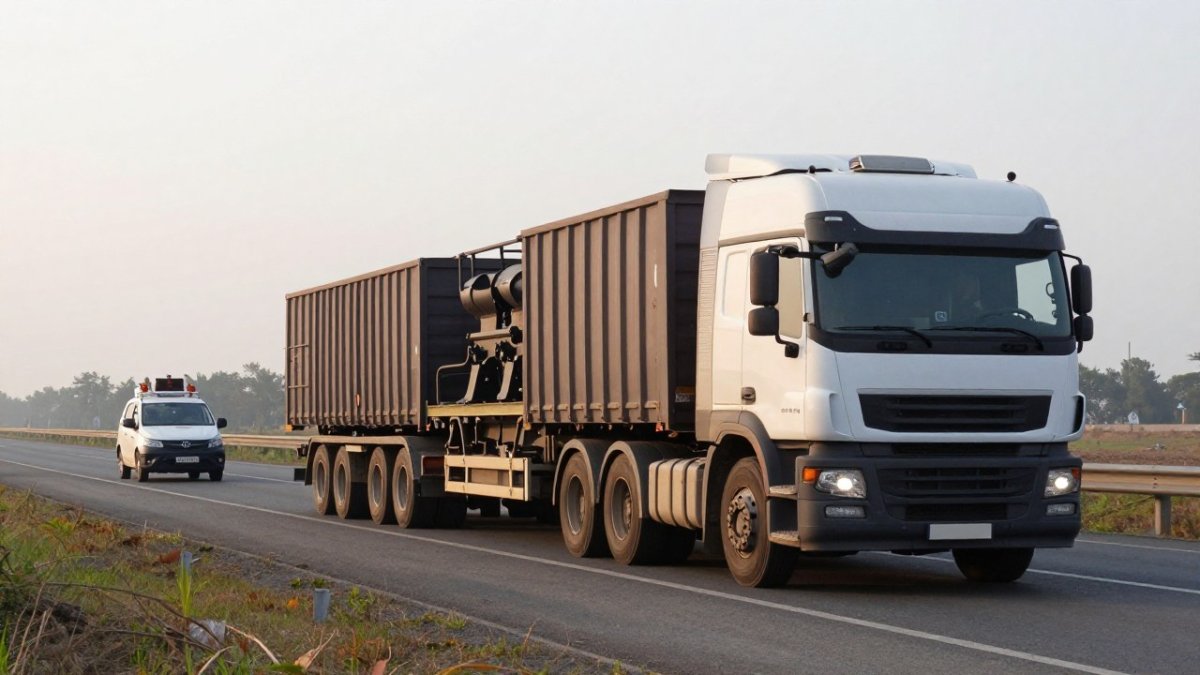
Permit conditions commonly set limits on travel times, escort vehicles, route approvals and load height, width or length. They may also impose curfews around school zones and peak traffic, and require pilot or escort vehicles for loads above certain dimensions. Because each jurisdiction sets its own thresholds, a load that travels freely in one state can require escorts and a night-only window in the next. Plan for the most restrictive jurisdiction on the journey, not the average.
Route planning should begin before the permit application, because the survey results are what the application is built on. Survey bridges, overpasses, roundabouts, overhead wires and tight urban turns along the proposed path, and record clearances rather than assuming them. A load that clears the port without trouble can still fail at a single low bridge three kilometres inland.
A practical sequence that most experienced operators follow:
- Confirm the cargo dimensions and the lifting and lashing plan, because these set the transport envelope.
- Identify candidate routes and survey the constraints on each.
- Apply for permits on the surveyed route, allowing for the most restrictive jurisdiction.
- Book escorts, pilot vehicles and traffic management to match the permit conditions.
- Confirm the receiving site can accept the load at the permitted arrival window, including crane availability.
Build a buffer into your timeline. Permit approval can take longer than expected, and changes to the route after approval usually mean starting the process again. Where a hard delivery date exists, consider whether a longer but less constrained route is worth the extra distance.
Watch out: a permit that is valid but does not match the actual escort configuration on the day can stop the load at the roadside, so confirm the escort arrangement against the permit conditions before the vehicle departs.
Mining Equipment Transport Logistics: Planning for Remote and Heavy Loads
Mining equipment is one of the most demanding categories of project cargo. Haul trucks, crushers and drive assemblies are heavy, costly and often needed on a fixed schedule to keep a site operating. Remote delivery adds another layer of difficulty, because access roads may be unsealed, weight-restricted or closed in wet weather.
The practical answer is to plan the final leg as carefully as the sea leg. Confirm road access conditions, the availability of suitable transport equipment at the destination, and whether unloading needs a crane or heavy-lift support on site. Remote sites also tend to have limited lead times for spare parts, so consider shipping critical components as a separate consignment.
Project Cargo Shipping Checklist
Use this checklist before you confirm a booking:
- Final dimensions, weight and centre of gravity confirmed for every piece
- Lifting points and lashing requirements documented
- Commercial invoice, packing list and bill of lading prepared and matched
- Customs classification checked and duties estimated
- Biosecurity requirements reviewed where relevant
- Route survey completed for the road leg
- Oversized load permits applied for and approved
- Escort and traffic management arrangements confirmed
- Insurance cover reviewed against the full value of the cargo
- Delivery window agreed with the receiving site
Booking Your Project Cargo Shipment with Seatram
Seatram handles project cargo across sea, air and land, offering both wharf-to-wharf and door-to-door services. Our team works with you on your shipment so that it reaches its destination safely, on time and on budget.
Pricing for project cargo depends on the size and weight of the load, the route, the timing and the level of handling required, so quotes are tailored to each shipment. If you are still deciding who to hire, you can compare project cargo shipping companies in Australia before booking. To start, request a quote from Seatram with your cargo details, or read our guide to what drives heavy-lift shipping costs before you do.
Frequently Asked Questions
What information is needed to plan a project cargo shipment?
Start with the exact dimensions, weight and centre of gravity of each piece, plus the origin, destination and required delivery window. Your forwarder also needs details on how the cargo is packed and lifted, any hazardous characteristics, and whether it must cross state borders or travel on public roads. Providing accurate figures early lets the team assess route feasibility, equipment needs and permit requirements before committing to a schedule. Pricing depends on quantity, dates and delivery, so request a quote through Seatram’s website once these details are ready.
What documents are required for project cargo shipping?
Most project cargo shipments require a commercial invoice, packing list, bill of lading or air waybill, and a detailed cargo specification with weights and dimensions. Export and import declarations, certificates of origin where relevant, and any permits for oversized road movements are also commonly needed. Customs clearance may require additional documents depending on the goods and destination. Your forwarder can confirm the exact set for your cargo type and route, which reduces delays at the port or on the road.
When are permits needed for oversized road transport?
Permits are generally required when a load exceeds the standard mass, height, width or length limits set for public roads. The relevant road authority in each state or territory issues these permits, and conditions often specify travel times, escort requirements and approved routes. Permit lead times vary, so arranging them early is important for on-time delivery. Your forwarder can coordinate route surveys and permit applications as part of the shipment plan.
How far in advance should project cargo shipping be arranged?
Lead times depend on cargo size, route complexity, permit approvals and vessel or aircraft availability. Complex or heavy loads that need engineering review, route surveys or multiple permits generally require more planning time than standard freight. Raising the shipment with your forwarder as early as possible gives time to confirm feasibility, book suitable equipment and build contingency into the schedule. Speak to Seatram about your timeline and request a quote on the Seatram website.
