
Table of Contents
- What is Airplane Cargo?
- Cargo Aircraft vs Passenger Aircraft
- Understanding the Air Cargo Shipping Process
- Air Freight Costs and Cost Drivers
- Air Freight vs Sea Freight: Choosing the Right Method
- Air Cargo Packaging Requirements and Restrictions
- Common Cargo Types and Special Handling
- Conclusion
- Frequently Asked Questions
Last Updated: October 16, 2026
What is Airplane Cargo?
Airplane cargo is freight transported by aircraft, from lightweight parcels to heavy industrial equipment, across domestic and international routes. At Seatram, we coordinate the logistics required to move goods safely and efficiently by air.
The term covers both dedicated cargo aircraft and passenger planes modified to carry freight. Unlike sea freight, which prioritises volume and cost, airplane cargo prioritises speed and reliability, reaching destinations in days rather than weeks.
Air cargo operates within strict regulatory frameworks: each shipment requires documentation, security screening, and dangerous goods compliance, involving freight forwarders, airlines, customs brokers, and ground handlers. Understanding how airplane cargo works helps businesses make informed supply chain decisions.
Cargo Aircraft vs Passenger Aircraft
Dedicated freighters are purpose-built for payload efficiency, with reinforced floors, wider doors, and optimised loading systems. Passenger-to-freighter conversions remove seats and reconfigure the interior, trading passenger capacity for cargo space.
Dedicated cargo aircraft offer superior economics for high-volume routes, accommodating larger, heavier loads and standardised containers.
Converted passenger aircraft serve regional routes and lower-volume lanes, offering flexibility where dedicated freighters aren’t economically viable. However, they carry less payload per flight and have dimensional restrictions that limit oversized cargo.
Seatram helps clients with their shipments based on size, weight, destination, and timeline.
Understanding the Air Cargo Shipping Process
The airplane cargo shipping process involves sequential steps, each critical to safe and timely delivery. Below is a practical walkthrough of how a shipment moves, with the Australian regulatory touchpoints that determine whether it departs on time.
Step 1: Quote and booking
Shippers contact a freight forwarder, like Seatram, with shipment details: origin, destination, weight, dimensions, commodity type, and required delivery date. The forwarder quotes rates based on aircraft availability, fuel surcharges, and demand, then the shipper arranges pickup or drops goods at a consolidation facility.
Two booking concepts matter here. Chargeable weight is the greater of actual weight and volumetric (dimensional) weight, so a light but bulky consignment can be priced on volume. Cut-off times are the deadlines by which cargo must be delivered to the forwarder or airline terminal to make a specific flight; missing them pushes the shipment to the next available service.
Step 2: Pre-shipment preparation and documentation
Cargo is weighed, measured, and inspected. Core documents:
- Commercial invoice, describes the goods, value, and terms of sale for customs.
- Packing list, itemises contents, weights, and dimensions per package.
- Air waybill (AWB), the contract of carriage and tracking reference issued by the airline or forwarder.
- Permits and certificates, required for restricted goods, food, plant and animal products, and dangerous goods.
For hazardous materials, shippers must provide a Shipper’s Declaration for Dangerous Goods and comply with the IATA Dangerous Goods Regulations (DGR), which Australia applies through the Civil Aviation Safety Regulations 1998 administered by CASA. The Australian Border Force (ABF) handles customs clearance, and the Department of Agriculture, Fisheries and Forestry issues import permits and phytosanitary certificates for biosecurity-controlled goods.
Step 3: Security screening and customs clearance
Cargo undergoes X-ray inspection and physical checks under the Office of Transport Security regime. The Regulated Air Cargo Agent (RACA) and Known Consignor programmes determine how and where screening occurs; goods from an approved Known Consignor may require less re-screening. Customs authorities verify documentation and assess duties, including Goods and Services Tax (GST) on imports where applicable. This step can take hours to days.
Step 4: Loading and weight and balance
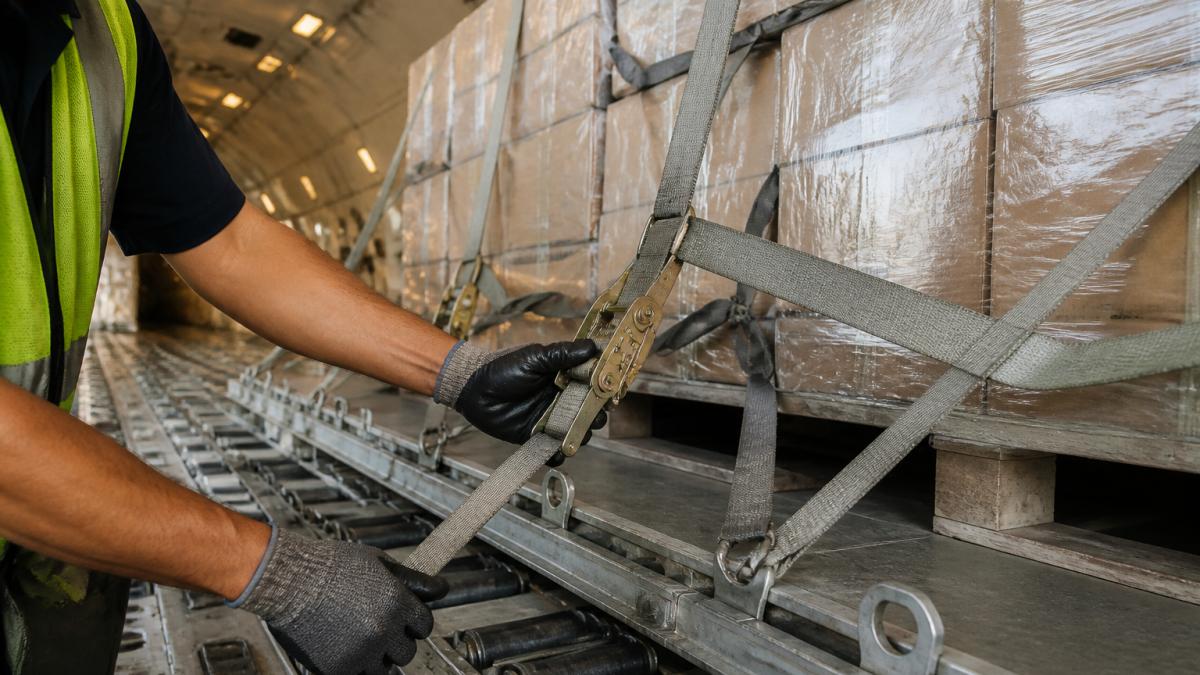
Ground handlers position cargo in the hold using pallets, unit load devices (ULDs), or loose stacking, secured with straps and restraint systems. Weight distribution is calculated to maintain balance within the centre-of-gravity envelope, and load planners issue a load sheet before departure. ULDs are standardised containers, common types include the LD3, LD6, and LD7 pallets, whose dimensions constrain what can be consolidated onto a flight.
Step 5: Flight and in-transit handling
After loading, the aircraft departs. A Sydney to Singapore flight takes roughly 6 hours, whilst Sydney to London requires approximately 17 hours with possible stops. Cargo remains secured in temperature and pressure-controlled holds, and perishable or pharmaceutical consignments may use temperature-controlled ULDs or active containers with data loggers.
Step 6: Arrival, clearance, and delivery
Upon arrival, cargo is offloaded and moved to customs for final clearance, where import duties and GST are assessed and paid. Once cleared, it moves to the consignee’s facility or a distribution centre. The AWB number is the primary reference for status enquiries.
Build a shipment checklist around the three deadlines that most often cause delays: documentation cut-off, cargo cut-off, and security screening cut-off. Confirm all three with your forwarder before booking.
Seatram coordinates each of these steps, from quote and booking through documentation, screening, clearance, and delivery, so shippers have a single point of accountability across the chain.
Air Freight Costs and Cost Drivers
Pricing for airplane cargo depends on multiple factors, and exact rates vary by route, season, and market conditions.
Airlines charge on whichever is greater: actual weight or dimensional weight, calculated by dividing cubic centimetres by 5,000.
Fuel surcharges fluctuate with crude oil prices, and currency fluctuations affect international pricing.
Remote destinations incur higher handling fees.
Express services guarantee specific delivery windows and cost more than standard air freight. Door-to-door service includes pickup and final delivery, adding labour costs compared to airport-to-airport arrangements.
Seatram provides transparent rate quotes. We recommend comparing total landed costs from multiple providers rather than focusing solely on base rates.
Air Freight vs Sea Freight: Choosing the Right Method
Choosing between airplane cargo and sea freight requires weighing cost, speed, volume, and shipment characteristics.
Sea freight moves larger volumes at significantly lower cost per unit, with fixed schedules and consolidation options for smaller shippers.
Airplane cargo prioritises speed, reaching international destinations within days.
Sea freight accommodates full container loads of 20 or 40 cubic metres; air cargo suits smaller, urgent shipments.
Fresh fruit, seafood, and pharmaceuticals deteriorate during a 2-4 week sea voyage; air’s shorter transit preserves quality and reduces spoilage.
Air Cargo Packaging Requirements and Restrictions
Packaging for airplane cargo must meet stringent standards to ensure safety, security, and product integrity during flight. These requirements differ from sea freight packaging due to air transport’s unique conditions, and they are governed by a specific regulatory framework that shippers need to understand before packing.
The governing framework
Dangerous goods by air are regulated internationally by the IATA Dangerous Goods Regulations (DGR), which Australia gives effect to through the Civil Aviation Safety Regulations 1998, administered by the Civil Aviation Safety Authority (CASA). The International Civil Aviation Organization (ICAO) Technical Instructions underpin the IATA DGR. Shippers, packers, and forwarders have defined responsibilities, and misdeclaration is an offence.
Dangerous goods classes and what they mean for packing
Dangerous goods are grouped into nine classes, and each has specific packaging, labelling, and documentation requirements:
- Class 1, explosives
- Class 2, gases (flammable, non-flammable, toxic)
- Class 3, flammable liquids
- Class 4, flammable solids, spontaneously combustible, and dangerous-when-wet substances
- Class 5, oxidisers and organic peroxides
- Class 6, toxic and infectious substances
- Class 7, radioactive material
- Class 8, corrosives
- Class 9, miscellaneous dangerous goods, including lithium batteries
Packaging must prevent leakage, rupture, or reaction during transport. Each class specifies UN packing instructions and performance-tested packaging; the shipper must use packaging that meets the applicable packing instruction and mark it accordingly. Lithium batteries are a common Class 9 example and attract particular scrutiny, standalone batteries, batteries packed with equipment, and batteries contained in equipment each have different requirements, and some are prohibited on passenger aircraft entirely.
The declaration and documentation chain
For any dangerous goods shipment, the shipper must complete a Shipper’s Declaration for Dangerous Goods, which states the UN number, proper shipping name, class, packing group, and quantity. This declaration accompanies the air waybill and is checked at acceptance. Training is mandatory for staff who prepare or sign dangerous goods documentation, and records must be retained.
Never assume a commodity is not dangerous goods because it seems ordinary. Aerosols, perfumes, paints, magnets, and many batteries fall within the regulations. Misdeclaration can result in rejection, fines, or prosecution.
General packaging standards
Non-dangerous cargo must still withstand handling, pressure changes, and temperature fluctuations. Materials must be sturdy enough to survive rough handling by ground equipment. Boxes, pallets, and containers must be properly secured and labelled with weight, dimensions, and handling instructions. Pressure changes at altitude can cause sealed containers to leak or burst, so packaging should allow for expansion.
Perishables and temperature control
Perishable goods require insulated packaging with temperature control. Goods must be packed in boxes with ice packs, dry ice, or gel packs to maintain required temperatures. Packaging must prevent condensation and contamination. Seafood, fresh produce, and pharmaceuticals all have specific temperature ranges and humidity requirements, and some perishables are subject to Department of Agriculture, Fisheries and Forestry biosecurity conditions on arrival.
Oversized and out-of-gauge cargo
Most aircraft cargo doors accommodate items up to approximately 2.4 metres wide, 2.7 metres tall, and 6 metres long. Larger items require special aircraft or may not be transportable by air. Weight distribution matters too, items must be balanced within the aircraft’s centre-of-gravity limits, and very heavy pieces may require spreader beams or custom cradles.
Prohibited items
Some items cannot be shipped by air at all. These include certain types of batteries, magnets, and materials deemed too hazardous for passenger or crew safety. Shippers must verify what is permitted before packing, and forwarders should confirm acceptance criteria with the airline in advance.
Proper packaging reduces damage claims, ensures regulatory compliance, and prevents delays. Seatram advises clients on packaging standards for their specific commodities, ensuring shipments meet all requirements before loading.
Common Cargo Types and Special Handling
Different commodities require tailored handling approaches. Understanding what makes each type special helps shippers prepare appropriately.
Electronics and high-value goods are frequent air cargo.
Perishables, fresh produce, seafood, meat, dairy, and flowers, demand temperature-controlled transport.
Pharmaceuticals and medical devices require temperature control and secure handling. Many medicines degrade if exposed to temperatures outside narrow ranges.
Automotive parts, engines, transmissions, electronics, move frequently by air, especially for urgent replacements.
Textiles and apparel move by air during peak seasons.
Machinery and industrial equipment occasionally moves by air for urgent repairs or time-sensitive projects.
Seatram understands the specific documentation, packaging, temperature control, and handling each requires.
Conclusion
Airplane cargo is essential for businesses requiring speed and reliability in global supply chains. Whether shipping perishables, electronics, or urgent replacements, air freight delivers results when time matters. The process is complex, from booking through security, loading, flight, and final clearance, but understanding each step helps you manage costs and timelines effectively.
Seatram specialises in end-to-end airplane cargo solutions, handling documentation, customs clearance, and secure loading so your shipments reach their destination safely, on time, and on budget. Our team manages the logistics complexity, allowing you to focus on your business. Request a quote today and discover how tailored air freight solutions can optimise your supply chain.
Frequently Asked Questions
What is airplane cargo?
Airplane cargo refers to goods transported by air freight on dedicated freighter aircraft or in the cargo compartments of passenger aircraft. It includes everything from perishables and hazardous materials to oversized items. Air cargo reaches destinations faster than sea freight, making it ideal for time-sensitive shipments. The cargo is loaded into standardised containers and pallets, secured with restraint systems, and tracked throughout the journey.
How does the air cargo shipping process work?
The process begins with shipment booking and documentation, including customs declarations and biosecurity requirements. Your freight forwarder collects goods, prepares them for air transport, and arranges pickup to the airport. Cargo is consolidated with other shipments, loaded into the aircraft hold using pallets or unit load devices, and secured. Upon arrival, cargo clears customs and biosecurity, then is delivered to your final destination.
What is the difference between air freight and sea freight?
Air freight is faster (3-7 days) but costs significantly more per kilogram. Sea freight takes 2-4 weeks but suits large-volume, non-urgent shipments at lower cost per unit. Air cargo is ideal for perishables, high-value goods, and time-critical deliveries. Sea freight works better for bulk goods, machinery, and cost-sensitive operations. Many businesses use both methods depending on shipment urgency, volume, and destination.
What packaging is required for air cargo?
Air cargo packaging must protect goods from pressure changes, temperature fluctuations, and handling during loading and unloading. Use sturdy boxes, pallets, or specialised containers. Fragile items require padding and shock-absorbing materials. Perishables need insulated packaging with temperature control. Hazardous goods follow strict regulations set by the International Air Transport Association (IATA). All packages must be clearly labelled with weight, dimensions, contents, and handling instructions. Your freight forwarder can advise on specific requirements for your cargo type.