
Last Updated: November 1, 2026
Quick Summary
To ship oversized equipment internationally, measure and document exact dimensions, weight and centre of gravity, then choose a transport mode such as flat-rack, open-top, breakbulk or RoRo. Secure the load with blocking and bracing, and line up permits, customs documents and cargo insurance before the cargo moves.
- Measure length, width and height at the widest point, including protruding parts.
- A flat-rack container suits cargo too wide or too tall for a standard box.
- Use both timber dunnage and straps, since straps hold but timber blocks.
- Reconcile the commercial invoice, packing list and bill of lading before cargo leaves.
- Insure the full replacement value, not the invoice value, for out-of-gauge freight.
Table of Contents
- Step 1: Measure and Document Your Oversized Equipment
- Step 2: Choose a Transport Mode for Out-of-Gauge Cargo Shipping
- Step 3: Prepare and Pack Heavy Machinery for International Transit
- Step 4: Prepare and Pack Heavy Machinery for International Transit
- Step 5: Arrange Oversized Cargo Permits and Documentation
- Step 6: Plan Oversized Cargo Shipping Costs and Cargo Insurance
- Step 7: Clear Customs and Coordinate Final Delivery
- Request a Quote for Your Oversized Equipment Shipment
- Frequently Asked Questions
Step 1: Measure and Document Your Oversized Equipment
Shipping oversized equipment internationally starts with one hard rule: the numbers you give your freight forwarder must be right.
Measure length, width and height at the widest point, including any protruding parts. Weigh the item, or have it weighed, rather than estimating from a spec sheet.
Here is what to record for every unit:
- Overall dimensions in metres, at the widest point
- Gross weight in kilograms, verified not estimated
- Centre of gravity and lifting lug positions
- Whether the item can be dismantled
- Any fragile, protruding or fluid-filled components
Doma Shipping’s 2026 guidance on shipment tracking and digital documentation notes that accurate pre-shipment data is what makes tracking and handling predictable later.
What Freight Forwarders Need From You
A forwarder needs a complete data pack before quoting. That means dimensioned drawings, weights, photos of all four sides, the pickup address and the delivery address. Send drawings, not descriptions. “About four metres long” is not a shipping instruction.
Step 2: Choose a Transport Mode for Out-of-Gauge Cargo Shipping
The right transport mode depends on three things: size, deadline and budget. Oversized cargo shipping rarely fits standard container shipping, so you are usually choosing between flat-rack, open-top, breakbulk or RoRo. For a deeper guide to managing over dimensional cargo logistics, review the options before committing to a mode.
Sea freight is commonly used for out-of-gauge freight, as it handles weight and volume well. Air freight can suit urgent, smaller heavy items but has tight size limits. Road and rail often handle the pickup and delivery legs.
| Mode | Best For | Watch Out For |
|---|---|---|
| Flat-rack container | Wide or tall machinery that fits a base | No roof or sides, so weather protection is on you |
| Open-top container | Tall cargo loaded from above | Height limits at some terminals |
| Breakbulk | Very heavy or very large single items | Slower scheduling, specialist port handling |
| RoRo | Self-propelled or wheeled machinery | Strict clearance limits on ramps |
Container Shipping, Flat-Rack and Open-Top Options
A flat-rack container is a container base with no sides or roof, built for cargo that is too wide or too tall for a standard box. An open-top container has a removable roof so tall cargo can be craned in from above. For anything beyond those limits, breakbulk shipping loads the item directly onto the vessel.
Step 3: Prepare and Pack Heavy Machinery for International Transit
Preparation is where cheap shipments become expensive ones. Heavy machinery for international transit needs protection from salt air, vibration and handling, plus a clean fuel and fluid state that satisfies biosecurity and dangerous goods rules. Our guide on importing heavy machinery to Australia covers preparation requirements in more detail.
Drain or isolate fuels and hydraulic fluids where required. Fit purpose-built wooden crates or cradles for smaller components. Seal openings against moisture, and use cushioning at every contact point.
- Crate loose parts and label every box
- Apply rust-preventative coating to machined surfaces
- Photograph the packed unit before it leaves your site
- Mark and label each item with weight and lifting points
Step 4: Prepare and Pack Heavy Machinery for International Transit
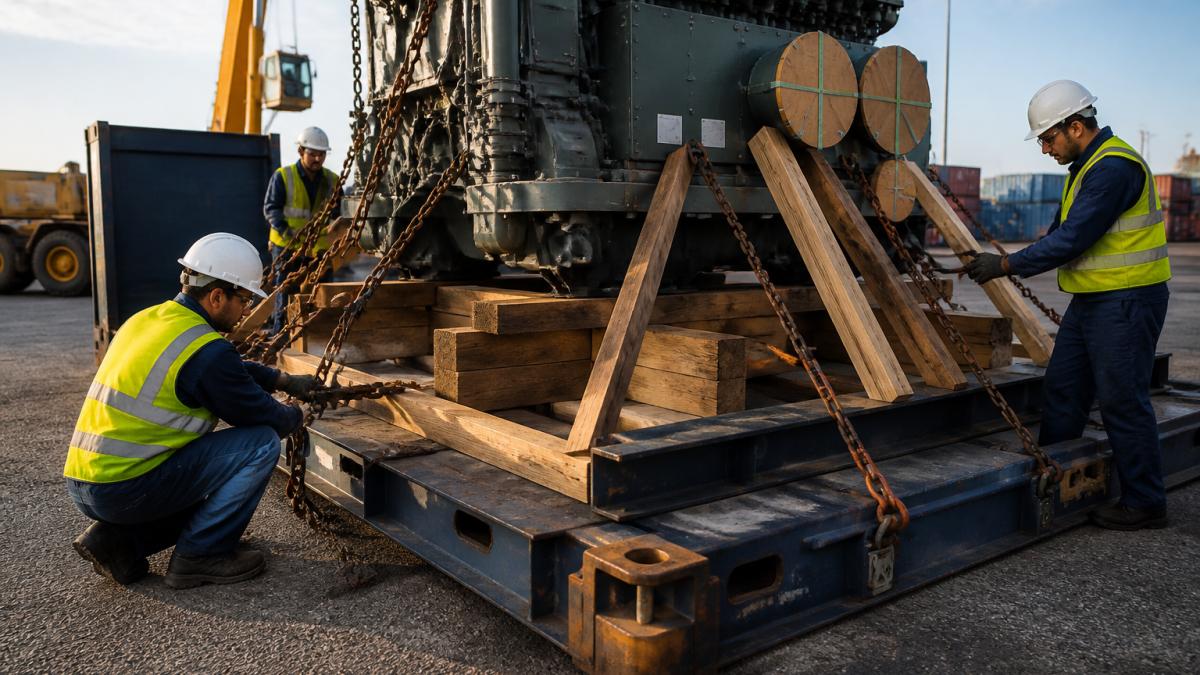
Blocking and bracing is what stops your cargo from moving, and movement is what causes damage and rejected loads. Securement must match the weight and the forces the load will meet at sea.
Use timber dunnage to block sideways movement. Chain or strap the item to the container base at rated points.
A common mistake is relying on straps alone for a heavy item. Straps hold; timber blocks. You need both.
Step 5: Arrange Oversized Cargo Permits and Documentation
Oversized cargo permits and documentation are not optional extras. Every leg of the journey, from road transport to port handling, needs the right paperwork in place before the cargo moves. Most guides stop at listing the documents. The practical work is sequencing them so customs, biosecurity and road authorities all see consistent data. Use an import customs clearance documentation checklist to assemble the correct paperwork for oversized import clearance.
Road Permits and Escorts
For the road legs, oversize loads generally need permits and pilot or escort arrangements under the applicable heavy vehicle rules. Requirements change with load width, height, length, mass and the specific route, so confirm them with the relevant road authority for each jurisdiction the cargo passes through rather than assuming a permit from one state covers another.
The Customs and Trade Compliance Workflow
This is the part most shipping guides leave out, and it is where oversized shipments most often stall. Treat customs as a sequence, not a pile of forms.
- Classify the goods. Assign an HS code to each item. The code drives duty rates, free trade agreement eligibility and any import restrictions. Get it wrong and the entry can be amended, delayed or penalised.
- Build the commercial invoice. It must show seller and buyer, a clear description matching the HS code, quantity, unit value, total value, currency, Incoterms and country of origin. The description on the invoice must match the packing list line for line.
- Build the packing list. List every package, crate and loose component with dimensions, gross weight and marks. For out-of-gauge cargo, note which pieces are the main unit and which are accessories.
- Lodge the export declaration. In Australia, exports are declared through the Integrated Cargo System administered by the Australian Border Force. The exporter or their broker typically lodges the declaration and receives an export clearance before the cargo is loaded.
- Clear import requirements at destination. The importer is responsible for the destination entry, duty and tax, and any import permits. Confirm who is the importer of record before the cargo sails, because oversized items are hard to re-route once loaded.
- Satisfy biosecurity. Timber crates, dunnage and any soil or plant risk can attract biosecurity requirements. Confirm current import conditions with the relevant biosecurity authority for both origin and destination, including any packaging treatment and marking standards that apply.
A mismatch between the commercial invoice, packing list and bill of lading is one of the most common causes of customs holds on oversized freight. Reconcile the three documents before the cargo leaves the site.
Core Shipping Documents
- Commercial invoice and packing list, reconciled against each other
- Bill of lading or airway bill, with the correct cargo description and Incoterms
- Export declaration and any export or import permits
- Certificate of origin, where a free trade agreement claim is being made
- Dangerous goods declaration, where relevant
Step 6: Plan Oversized Cargo Shipping Costs and Cargo Insurance
Freight cost for oversized cargo is driven by volume, weight, route and handling, not by a flat rate. The trap is comparing quotes on the headline freight number when the real difference sits in the charges around it. Build a total landed cost model and compare every quote on the same basis.
Build a Total Landed Cost Model
Ask each forwarder to break the quote into the same line items so you can compare like with like:
- Origin charges: pickup, crane lift at origin, export clearance, terminal handling at origin
- Main freight: ocean or air freight, including any out-of-gauge surcharge
- Destination charges: terminal handling, wharfage, crane lift, customs clearance, biosecurity inspection
- Road legs: permits, escorts, pilot vehicles, low-loader or multi-axle trailer hire
- Documentation and compliance: broker fees, certificate of origin, dangerous goods handling
- Insurance: premium based on cargo value and route
Chargeable weight matters. Sea freight is usually charged on volume or weight, whichever is greater, using a conversion factor, while air freight uses volumetric weight against actual weight. For dense machinery, actual weight often governs; for bulky but light items, volume does. Confirm which basis each quote uses, because a quote built on the wrong basis is not comparable.
Ask each forwarder to state what is excluded as clearly as what is included, as surcharges, terminal fees and inspection costs are common areas where quotes diverge.
Compare Quotes on the Same Basis
A practical method is to put every quote into a single spreadsheet with identical rows for each line item, then compare the total landed cost rather than the freight line. A quote that looks cheaper on freight can be more expensive once destination handling and road permits are added. Also confirm the Incoterms behind each quote, because a delivered quote and a port-to-port quote are not the same product.
Cargo Insurance and Risk Management
Out-of-gauge freight carries higher handling risk, and standard carrier liability is limited, so cargo insurance deserves its own line. Insure the full replacement value, not the invoice value, because replacement cost includes freight, duty and reinstallation.
Check the policy for:
- Coverage limits and any per-item sub-limits
- Exclusions, particularly for inadequate packing or securing
- The valuation basis, whether replacement cost or invoice value
- The claims evidence required, including photos and survey reports
- Whether the policy covers the full door-to-door journey, not just the sea leg
Document the pre-shipment condition thoroughly. Photograph all four sides, any existing damage, and the packed and secured load before it leaves the site. If a claim arises, that evidence is what supports it.
Step 7: Clear Customs and Coordinate Final Delivery
Customs clearance and delivery coordination decide whether the shipment arrives on time or sits at the wharf.
Then plan the last leg. Oversized items need cranes, escorts and delivery windows booked in advance, often outside peak traffic hours.
Green Worldwide Shipping’s 2026 case study on multi-origin breakbulk for drilling equipment shows why specialist handling and early planning matter for oversized rig components. Our guide on how to avoid customs clearance delays covers the checks that prevent costly holds.
Request a Quote for Your Oversized Equipment Shipment
Oversized freight rewards preparation. Get the measurements right, choose the right transport mode, secure the load properly and line up permits and paperwork before anything moves.
At Seatram, we offer tailored end-to-end supply chain solutions, with wharf-to-wharf or door-to-door options. Our team works to the specific requirements of each shipment.
Get started with Seatram and move your oversized equipment safely, on time and on budget. Request a quote today.
Frequently Asked Questions
What documents and permits are needed to ship heavy equipment overseas?
You will typically need a commercial invoice, packing list, bill of lading, and an export declaration lodged through the Australian Border Force system. Oversized cargo permits and documentation may also include import permits for the destination country, biosecurity treatment certificates for timber packaging under ISPM 15, and road transport permits for the final leg. Dangerous goods declarations apply if the equipment contains fuel, batteries or hydraulic fluids. Confirm destination-specific requirements early, because missing paperwork is the most common cause of port delays.
What transport options are available for oversized machinery?
Out-of-gauge cargo shipping commonly uses flat-rack or open-top containers for equipment that fits within those frames, and breakbulk or RoRo shipping for very large or self-propelled machinery. The right choice depends on dimensions, weight, whether the equipment can be driven, and how much dismantling is acceptable. Ask your forwarder to compare at least two modes before committing.
How long does international shipping take for oversized equipment?
Transit time depends on the mode and route. Transit time varies by mode and route. Breakbulk and heavy-lift vessels can take longer than container shipping because sailings are less frequent and port handling is slower. Add time for inland pre-carriage, permits, customs clearance and final delivery. Route planning should account for port congestion and vessel schedules, which change often. Ask for a door-to-door estimate rather than a port-to-port figure so you can plan installation or project timelines realistically.
How do you prepare oversized equipment for international shipping?
Start by draining fuels and fluids where required, disconnecting batteries, and cleaning the equipment to meet biosecurity rules. Measure and record exact dimensions and weight, then build a wooden crate or protective frame with cushioning for exposed parts. Mark and label each piece clearly. Secure everything with blocking and bracing suited to sea motion, and photograph the load before it leaves. Good preparation reduces damage claims and helps customs clearance run smoothly.
