
Quick Summary
Oversized equipment shipping by sea means moving machinery that exceeds standard container dimensions or cannot pass through a container door. Planning starts by measuring length, width, height, gross weight and centre of gravity, then choosing between flat rack, open-top container or breakbulk.
- Measure the unit as it will ship, including crate, protruding parts and lashing material.
- Check standard container dimensions first; if the unit fits, it ships as standard containerised freight.
- Flat racks suit loads that sit above container walls but need an adjacent vessel slot.
- Breakbulk is the choice when cargo exceeds flat rack or open-top limits or cannot be safely stowed.
- Ask for an itemised quote, since destination handling, lashing and inland permits are often left out.
Table of Contents
- What Counts as Oversized Equipment for Sea Freight
- Choosing a Sea Freight Method: Breakbulk, Flat Rack or Out-of-Gauge Container
- Step-by-Step Sea Shipping Workflow From Measurement to Delivery
- Heavy Equipment Shipping Checklist: Preparing, Lashing and Documenting the Load
- What Drives Oversized Freight Shipping Cost
- Port, Vessel and Route Constraints, Plus Insurance and Damage Claims
- Requesting a Quote for Your Oversized Cargo
- Frequently Asked Questions
What Counts as Oversized Equipment for Sea Freight
Oversized equipment is any machinery or cargo that exceeds standard container dimensions or cannot be loaded through a standard container door, so planning is needed before the booking is made. Most shipping lines treat a unit as out-of-gauge once it is taller, wider or longer than a standard 20 or 40 foot container allows.
Shipping teams usually measure three things before anything else:
- Overall length, width and height, including any protruding parts such as booms, mirrors, tracks or handles
- Gross weight, including crating, pallets and lashing material
- Centre of gravity, which decides how the load sits on a deck or in a container
Each affects which vessel, port and handling method will work for oversized equipment shipping on a given route. A machine that fits container dimensions but has an off-centre weight distribution can still be refused by a carrier, so getting these numbers accurate early helps avoid rework later.
Watch out: Measurements taken from a brochure or a photo are often wrong. Measure the unit as it will actually ship, with its crate or transport fittings on.
Choosing a Sea Freight Method: Breakbulk, Flat Rack or Out-of-Gauge Container
Sea freight gives you three main routes for oversized loads, and the right one depends on size, weight and how the cargo can be secured. The useful question is which method your unit actually qualifies for; the thresholds below are the practical decision points most freight forwarders and shipping lines apply when assessing a booking.
Standard container limits (for reference). Standard container dimensions are published by container manufacturers and shipping lines and vary slightly by type, so check the current specification with your carrier.
Flat rack thresholds. Flat racks suit long, tall or wide loads that sit above the container walls, but they need a vessel slot with adjacent space, because the load cannot be stacked under or over other containers.
Open-top container thresholds. An open-top container allows the load to be lifted in from above and to protrude through the roof, which can suit units too tall for a standard container.
Breakbulk thresholds. Breakbulk becomes the practical choice when cargo exceeds flat rack or open-top limits, such as units that are too heavy for the container’s rated payload or have a centre of gravity that cannot be safely stowed in a container.
Here is how the three methods compare on the dimensions that matter:
| Method | Typical size envelope | Weight ceiling | Handling implications | Port availability |
|---|---|---|---|---|
| Flat rack | Up to ~12 m long, ~2.4 m wide, no height limit | Container payload, often ~28-30 t | Needs adjacent vessel slot; lashing to platform | Most container ports |
| Open-top container | Standard footprint, load protrudes through roof | Container payload | Crane lift in/out; tarpaulin required | Most container ports |
| Breakbulk | No fixed envelope; limited by vessel and crane | Limited by ship’s gear and stowage plan | Direct lift; heavy lashing; load plan critical | Fewer ports; specialist berths |
A simple decision sequence. First, measure the unit as it will ship. Second, check whether it fits a standard container, if yes, ship standard. Third, check flat rack and open-top envelopes, if yes, compare rates and vessel schedules. Fourth, if it exceeds both, price breakbulk and confirm the origin and destination ports have the crane capacity and berth access to handle it.
When Out-of-Gauge Container Shipping Makes Sense
Out-of-gauge container shipping works best when a unit is slightly too tall or too long for a standard box but still fits within the largest available container frame. It is often cheaper and simpler than breakbulk because the cargo is handled as a container through most of the journey, and container ports generally offer more frequent sailings than breakbulk services.
It stops making sense when the load is so large that no container can take it, when the weight pushes the unit beyond container and port lifting limits, or when the centre of gravity cannot be safely stowed within the container’s load plan. At that point, breakbulk or a specialist heavy-lift vessel is the only compliant option.
Step-by-Step Sea Shipping Workflow From Measurement to Delivery
A smooth oversized shipment follows a clear sequence; working through the steps in order prevents most costly surprises.
- Measure and weigh the unit. Record length, width, height, gross weight and centre of gravity, including crating.
- Choose the shipping method. Match the dimensions to breakbulk, flat rack or out-of-gauge container.
- Request a quote with full specifications. Send accurate measurements, weights, photos and the lifting points.
- Confirm the port and vessel. Check that origin and destination ports can handle the lift and the cargo size.
- Prepare the cargo. Crate, brace and protect the unit, and fit lifting and lashing points.
- Complete documentation. Prepare the commercial invoice, packing list, bill of lading and any dangerous goods or permit paperwork.
- Load and secure. Lash the cargo to the platform or deck according to the load plan.
- Track the shipment in transit. Watch for vessel changes and port delays.
- Clear customs and take delivery. Arrange discharge, customs clearance and inland transport to the final site.
Plan for the transit time to vary, especially on routes with limited vessel slots for oversized cargo.
Heavy Equipment Shipping Checklist: Preparing, Lashing and Documenting the Load
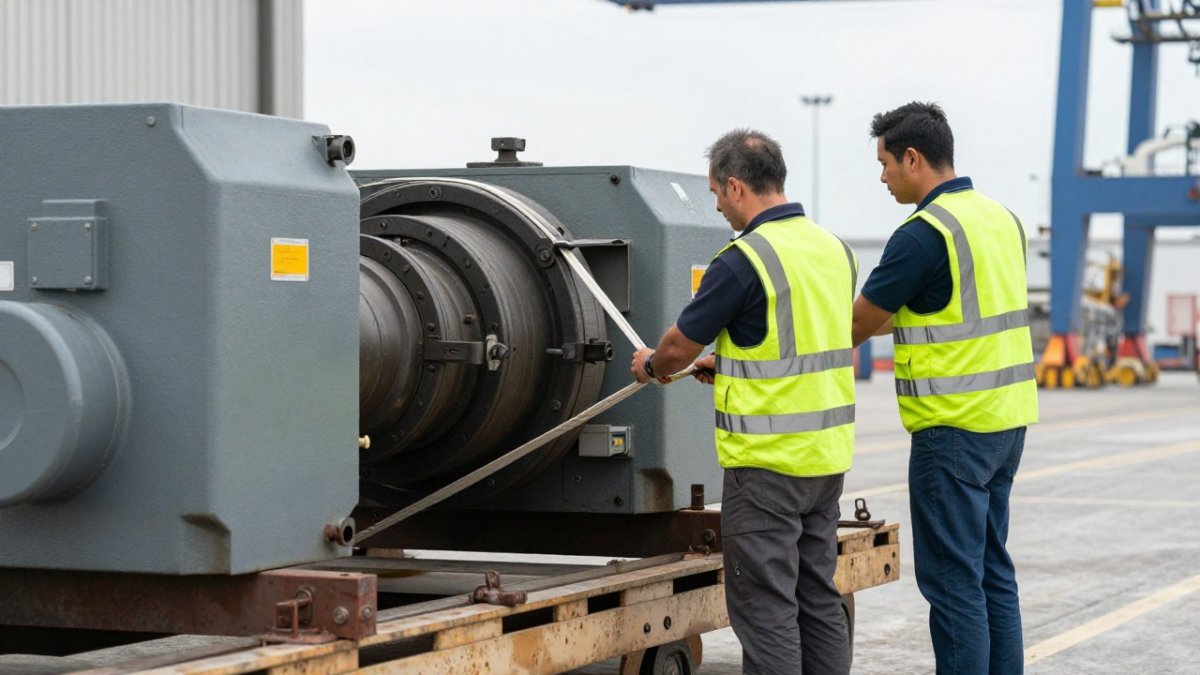
Good preparation at origin protects the equipment and keeps the shipment moving. Use this checklist before the cargo leaves your site:
- Drain fluids, remove loose parts and secure moving components
- Mark the centre of gravity and lifting points clearly on the unit
- Build or check the crate or frame so it carries the full weight
- Confirm lashing points are rated for the load and the sea conditions
- Prepare a load plan showing how the cargo sits and is secured
- Gather the commercial invoice, packing list and certificate of origin
- Check whether any part of the cargo is classed as dangerous goods, such as batteries or fuel residues
- Arrange any export or import permits the destination country requires
Lashing and securing errors cause a large share of cargo damage at sea. Ask your forwarder to review the load plan before the unit is loaded.
For handling hazardous-classified equipment, the costs and rules are covered in our guide on dangerous goods shipping costs.
What Drives Oversized Freight Shipping Cost
Oversized freight is priced on more than weight. Dimensions, the lifting method, the vessel slot, port handling and special lashing all add to the bill.
The main cost components in an oversized sea freight quote are:
- Ocean freight, priced per unit or per cubic metre for breakbulk, and per container or per flat rack for containerised out-of-gauge cargo. Out-of-gauge surcharges apply when the cargo exceeds the container’s standard envelope.
- Origin handling, including crane lift, terminal receival, wharfage and any stevedoring charges at the load port.
- Destination handling, which often mirrors origin but can be higher at ports with limited heavy-lift capacity.
- Lashing and securing, including materials, labour and any third-party surveyor sign-off on the load plan.
- Inland transport at both ends, which may require low-loader trailers, pilot vehicles, road permits or escorts depending on the unit’s dimensions and the route.
- Documentation and compliance, including customs brokerage, export declarations, and any permits or certificates required by the destination country.
- Insurance, which for oversized or project cargo is usually priced separately from standard cargo cover.
- Port and vessel surcharges, such as bunker adjustment, peak season, and out-of-gauge or heavy-lift surcharges levied by the shipping line.
How the mechanics work in practice. Ocean carriers price out-of-gauge cargo by comparing the space it occupies against the container slot it displaces; a flat rack carrying a load that overhangs its ends may be charged for two slots rather than one. Breakbulk is usually quoted per unit or per revenue tonne, whichever is greater, with heavy-lift surcharges above a threshold that varies by carrier and route. Inland haulage is often the largest variable cost for domestic legs, because oversize road movements usually require permits and may need pilot or escort vehicles.
A worked example (illustrative only). Consider an excavator that is too wide and tall for a flat rack. It would typically be quoted as breakbulk or heavy-lift.
Timeline drivers. Transit time for oversized cargo is longer than for standard containers because vessel slots for out-of-gauge and breakbulk cargo are less frequent.
Watch out: Quotes that exclude destination handling, lashing or inland permits are common. Ask for an itemised quote so you can see what is included, because hidden extras often sit in port handling, inland transport and document fees.
Pricing depends on quantity, dates, origin, destination and the delivery terms you agree. For a closer look at the cost drivers, see our page on heavy-lift cargo shipping cost.
Port, Vessel and Route Constraints, Plus Insurance and Damage Claims
Not every port can handle every oversized load. Check crane capacity, berth depth and yard space at both ends of the route. Vessel constraints matter too, since deck space and stability limits decide what can be carried on a given sailing.
Insurance is often overlooked until something goes wrong. Ask whether your cover includes oversized or project cargo, and what the liability terms say about lifting and handling damage. Keep photos and records of the unit before shipment; if a claim is needed, these make the process much faster.
Watch out: Standard cargo insurance may not cover damage caused during lifting or lashing on oversized loads. Check the exclusions before you ship.
Requesting a Quote for Your Oversized Cargo
A complete quote request gets you a faster and more accurate price. Include the length, width, height and gross weight, plus photos, lifting points, the origin and destination ports, and your required delivery date.
If you want help choosing between breakbulk, flat rack and out-of-gauge container for your specific unit, our team can review the details with you. You can also read our guide to requesting a freight forwarding quote to see what a complete request should contain, or explore our logistics solutions for oversized cargo to see how we handle these shipments.
To get started, request a quote with your unit’s measurements and weight, and we will come back with a clear plan for the route.
Frequently Asked Questions
How is oversized equipment shipped by sea?
Oversized equipment is usually shipped as breakbulk, on a flat rack, or in an open-top or out-of-gauge container, depending on its dimensions and weight. The freight forwarder first confirms the overall length, width, height and gross weight, along with the centre of gravity. Those figures determine the vessel, the lifting equipment at both ports and how the load is lashed. Seatram can advise which method suits your cargo and provide a quote once the dimensions are confirmed.
What information is needed to get a sea freight quote for oversized equipment?
A quote needs the overall length, width and height, the gross weight, and the centre of gravity or lift points. You should also provide the origin and destination ports, the required delivery window, any inland transport needs at either end, and whether the cargo is new or used. Photos and the manufacturer’s specification sheet help avoid surprises. Pricing depends on quantity, dates and delivery, so contact Seatram for a current quote.
What documents are required to ship machinery internationally?
Most shipments need a commercial invoice, packing list, bill of lading or sea waybill, and a certificate of origin where relevant. Machinery may also need a detailed packing or weight declaration and, for some goods, import permits or inspection certificates. Customs clearance requirements depend on the goods and the destination country. Seatram can help prepare and check the shipping documents before the cargo sails.
How long does oversized equipment sea freight take?
Transit time depends on the route, vessel schedules, port handling and whether the cargo needs a dedicated sailing. Planning should include time for permits, customs clearance and inland transport at both ends, which often takes longer than the ocean leg. Seatram can give a realistic timeline for your specific route once it has the cargo dimensions and required delivery date.
