
Quick Summary
Improving cold chain visibility means seeing where temperature-sensitive cargo is and what condition it is in at every point of its journey. Start by mapping your handovers and gaps, then add real-time tracking, IoT sensors, a tiered excursion response, shared data standards and KPIs to measure progress.
- Map every handover and note where cargo sits unmonitored, since those gaps are where problems hide.
- Use at least three threshold bands per product: in-range, warning and excursion.
- Assign named people to three response tiers, each with a deputy for nights and leave.
- Calibrate sensors before each shipment and check them against a reference thermometer.
- Display time since last transmission alongside temperature so silent sensors are not mistaken for healthy shipments.
Table of Contents
- Why Cold Chain Visibility Breaks Down and What It Costs You
- 1. Define Visibility Goals and Map Your Cold Chain Gaps
- 2. Set Up Real-Time Shipment Tracking Across Every Leg
- 3. Deploy IoT Sensors for Cold Chain Monitoring
- 4. Place and Calibrate Sensors to Protect Data Quality
- 5. Build Temperature Excursion Management Workflows
- 6. Standardise Data Sharing With Suppliers, Carriers and Customs Partners
- 7. Track Cold Chain KPIs and Plan for Connectivity Failures
- Frequently Asked Questions
Why Cold Chain Visibility Breaks Down and What It Costs You
Last Updated: November 18, 2026
Cold chain visibility is the ability to see where temperature-sensitive cargo is, and what condition it is in, at every point of its journey. Without it, a shipment can spoil in transit and nobody knows until the container is opened. Freight forwarders and logistics providers working with businesses moving perishable and temperature-sensitive goods see the same problems come up again and again.
Cold chain visibility breaks down when data lives in too many places. The carrier has one system, the port has another, and the importer checks a third. Each party sees a fragment of the picture. When a reefer container drifts out of range, the alert may reach one party hours later, or not at all.
The costs add up quickly. Spoiled product means lost stock, returns, and sometimes disputes over who is liable. Late discovery also means no chance to reroute, reschedule or recover the load.
Many food and pharmaceutical businesses find that a single bad shipment can cost more than the tracking tools would have. Cold chains are widely recognised as helping to maintain food quality and reduce food losses, especially in long-distance international trade. That is the core reason visibility matters.
The seven steps below show how to close those gaps. Each one builds on the last, so start at the top if you are new to this.
1. Define Visibility Goals and Map Your Cold Chain Gaps
Start by writing down what you need to know, and when. A food importer may need core product temperature every few minutes. A pharmaceutical shipper may need proof that a load stayed in range from pickup to delivery.
Next, map every handover in your chain. List each leg, each party, and each point where the cargo sits unmonitored. Those gaps are where problems hide.
Quick check: For each leg, ask who sees the temperature data, how often, and who acts when it goes out of range.
2. Set Up Real-Time Shipment Tracking Across Every Leg
Real-time tracking shows where cargo is now, not where it was at the last scan. Connected reefer containers can report location and status during transit, which can help you spot a delay before it becomes a loss.
For a deeper look at how this works in freight, read our guide to Real Time Tracking for Freight: A 2026 Guide. It covers what to expect from tracking across different transport modes.
Make sure your tracking covers the whole route, not just the ocean leg. Trucks, rail, and port dwell time are where many shipments quietly drift off track.
3. Deploy IoT Sensors for Cold Chain Monitoring
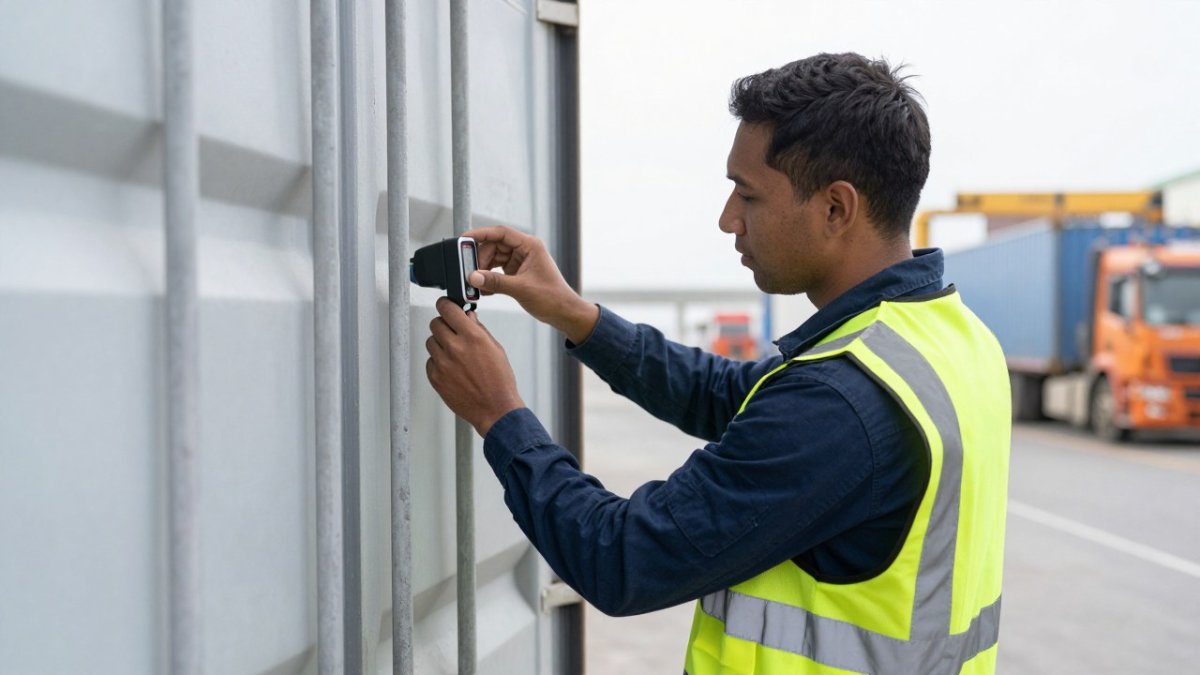
IoT sensors record temperature, humidity and sometimes shock, then send that data to a dashboard. They turn the cold chain from a guessing game into a set of measurable facts.
Choose sensors that match your cargo. Some products need core temperature readings, while others only need air temperature inside the container. Battery life and connectivity matter too, especially on long routes with no signal.
4. Place and Calibrate Sensors to Protect Data Quality
A sensor in the wrong spot gives the wrong reading. Place sensors where product temperature is most likely to rise, such as near the door or in the warmest pallet position, rather than in a cold corner of the box.
Calibrate sensors before each shipment and check them against a reference thermometer. Drift is common, and a faulty sensor can make a spoiled load look fine.
Watch out: a sensor that reads normally but sits in the wrong position can hide a real excursion. Test placement on a trial run before relying on it for live cargo.
5. Build Temperature Excursion Management Workflows
Monitoring only tells you that something went wrong. A response workflow decides what happens in the next fifteen minutes, and that is where product loss is actually prevented or limited. Alerts are only the start; the practical work is in thresholds, ownership, escalation and documentation.
Start with the thresholds themselves. A single upper and lower limit is rarely enough. Set at least three bands for each product and lane:
- In-range: normal operation, no action, data logged.
- Warning band: a short drift beyond the acceptable range, for example a brief rise while a trailer door is open at a dock. The alert goes to the carrier and the shipper’s operations desk, and the expectation is a reading check within a defined window rather than an immediate intervention.
- Excursion band: a sustained breach beyond the warning band. This triggers the full response, including a decision on whether the load can be saved.
Thresholds should be product-specific. A chilled ready-meal, a frozen consignment and a pharmaceutical load all tolerate different durations and magnitudes of drift, and a mean kinetic temperature approach can account for both time and temperature rather than a single spike.
Next, assign ownership in tiers so an alert never lands in a shared inbox and stalls:
- First responder: the party closest to the cargo, often the carrier’s driver, the warehouse supervisor or the reefer technician. Their job is to confirm the reading is real, not a sensor fault, and report back.
- Second tier: the shipper’s operations or quality contact, who decides whether to redirect, re-cool, inspect or quarantine the load.
- Third tier: commercial and quality management, who handle customer notification, claims and any product release decision.
Name a person for each tier, not a department, and include a deputy for leave and night shifts. Response times can fall off outside business hours when nobody owns the overnight alert.
Corrective actions need to be pre-agreed so the first responder is not improvising.
Documentation is the part most operators under-invest in, and it is the part that decides claims.
Run the workflow once as a desktop exercise and once on a live low-value shipment before relying on it. Time each step. If confirmation takes four hours because the carrier’s contact is unreachable, that is the gap to fix, not the sensor.
Watch out: a workflow that only fires on the excursion band will miss slow, cumulative drift that never trips a single threshold but still degrades the product, add a cumulative exposure check, not just a point-in-time limit.
The article sets out the three-tier response structure and the points that most often go wrong, which can be summarised as follows.
| Element | What the article says | Key detail |
|---|---|---|
| Warning band | Short drift beyond range | Reading check within a defined window |
| Excursion band | Sustained breach | Triggers the full response |
| First responder | Party closest to the cargo | Confirms the reading is real |
| Second tier | Shipper operations or quality | Decides redirect, re-cool or quarantine |
| Third tier | Commercial and quality management | Handles customer notice and claims |
| Documentation | Logs each excursion | Keep raw sensor data for claims |
6. Standardise Data Sharing With Suppliers, Carriers and Customs Partners
Visibility fails when each partner uses a different format. Agree on one data standard before shipping, covering temperature units, time zones, shipment IDs and alert thresholds.
Customs clearance also depends on accurate data flow. Integrated supply chain software can help pass shipment information between your team and the parties who need it. Our guide on Integrated Supply Chain Management Software: A 2026 Guide explains how that works in practice.
Managing this exchange well is also a core part of managing freight tracking visibility across partners. Put the data rules in writing so they survive staff changes.
7. Track Cold Chain KPIs and Plan for Connectivity Failures
Visibility only pays back if you can show what changed. That means a small set of cold-chain-specific measures, a baseline taken before you improve anything, and a review rhythm that turns the numbers into decisions.
Choose KPIs that map to the losses you identified in step one. A workable set for most operators includes:
- Excursion rate: the share of shipments with at least one reading outside the agreed range, expressed per hundred or per thousand shipments so it is comparable across volumes.
- Time to detect: the gap between the first out-of-range reading and the moment someone acts on it. This is the measure that separates monitoring from visibility.
- Time to resolve: from detection to a documented disposition, released, re-cooled, diverted or written off.
- Spoilage and write-off rate: the value or volume of product lost to temperature causes, as a share of shipped value.
- On-time in-full (OTIF): delivery performance for temperature-sensitive lanes, since a late load is often also a warm load.
- Record completeness: the share of shipments with a full, unbroken temperature record from pickup to delivery. Gaps here undermine every other number.
- Cost per shipment of monitoring: sensor, connectivity, platform and labour cost divided by shipments, so the programme can be compared with the losses it prevents.
Take a baseline before you change anything. Pull twelve months of data if you have it, or run a four-to-eight-week measurement period on your highest-risk lanes. Record the current excursion rate, spoilage value, OTIF and record completeness.
Then set targets that are tied to money, not just to operations. If spoilage on a lane is running at a known share of shipped value, a realistic reduction translates into a recoverable amount per year.
Review the KPIs monthly with the parties who can act on them, carriers, warehouses and the quality team, and quarterly with commercial management. Keep the definitions fixed so trends are real rather than artefacts of a changed formula.
Connectivity failures belong in the same review, because they corrupt the data the KPIs depend on. Sensors should buffer readings locally and upload when signal returns, and the platform should flag a shipment that has gone silent rather than simply showing the last known reading as if it were current.
Watch out: a dashboard that shows only the latest reading will make a silent sensor look like a healthy shipment, always display time since last transmission alongside the temperature.
If you want help building a cold chain visibility plan for your freight, contact Seatram to request a quote. Pricing depends on cargo type, volume, route and delivery dates, so we will work through the details with you.
Frequently Asked Questions
What is cold chain visibility?
Cold chain visibility is the ability to see where temperature-sensitive cargo is and what condition it is in at every stage of its journey, from supplier to final delivery. It combines location tracking with temperature data from sensors or reefer controls, so problems can be spotted while there is still time to act. Good visibility lets a business confirm that a shipment stayed within its required range, not just that it arrived. It also gives supply chain teams the evidence they need to resolve disputes and improve handling over time.
Why is visibility important in cold chain logistics?
Cold chain cargo such as food, pharmaceuticals and some chemicals can lose value quickly if temperatures drift outside the required range. Without visibility, a temperature excursion may only be discovered at the point of delivery, when there is no chance to recover the goods. Visibility also supports on-time delivery, because delays and route deviations can be seen and addressed early. For businesses handling perishables, it reduces the risk of spoilage losses and gives clearer grounds for insurance and customer claims.
How does real-time shipment tracking help protect temperature-sensitive cargo?
Real-time shipment tracking shows the current location and status of a consignment, so the team can see early arrivals, unplanned stops or route changes as they happen. Combined with temperature data, it helps identify whether a problem is occurring during transit, at a port or during a handover. Teams can then reroute, contact the carrier or arrange receiving staff before the cargo reaches its destination. The result is faster decisions and fewer surprises at delivery.
