
Table of Contents
- Understanding Cold Chain Logistics
- Cold Chain Logistics Best Practices
- Cold Chain Temperature Monitoring Systems
- Temperature Excursion Management and Response
- Cold Chain Management Checklist
- Regulatory Compliance and Documentation
- Building Resilience and Contingency Planning
- Measuring Cold Chain Performance
- Frequently Asked Questions
Last Updated: October 17, 2026
Understanding Cold Chain Logistics
Cold chain logistics is the management of temperature-sensitive products from origin through storage, transportation, and delivery, maintaining strict temperature control at every step to preserve product integrity and safety.
A single temperature excursion can spoil an entire shipment, meaning lost revenue and potential harm to customers. At Seatram, proper planning prevents costly failures.
Cold chain logistics covers several key areas:
- Storage: Maintaining consistent temperatures in warehouses and distribution centres
- Transportation: Using refrigerated vehicles and containers during transit
- Handling: Minimising exposure during loading, unloading, and transfers
Food exporters ship fresh produce and frozen goods, pharmaceutical companies transport medicines and life-science products, and chemical manufacturers move temperature-sensitive compounds, each requiring different temperature ranges and handling protocols.
Cold Chain Logistics Best Practices
Effective cold chain logistics requires discipline at every stage. Core practices that prevent spoilage and ensure compliance:
Start with proper packaging. Insulated containers with phase-change materials or gel packs buffer temperature fluctuations, your first line of defence against external heat or cold.
Plan your routes carefully. Shorter transit times reduce exposure.
Maintain equipment consistently. A failing compressor mid-transit destroys the entire shipment, so service refrigerated trucks and storage units before problems occur.
Train your team. Every minute a door stays open raises internal temperature, so loading staff must understand why speed matters.
Use redundancy in monitoring. A single data logger can fail.
Common mistakes to avoid:
- Opening containers unnecessarily during transit
- Stacking cargo in ways that block airflow
- Using damaged or worn insulation materials
Cold Chain Temperature Monitoring Systems
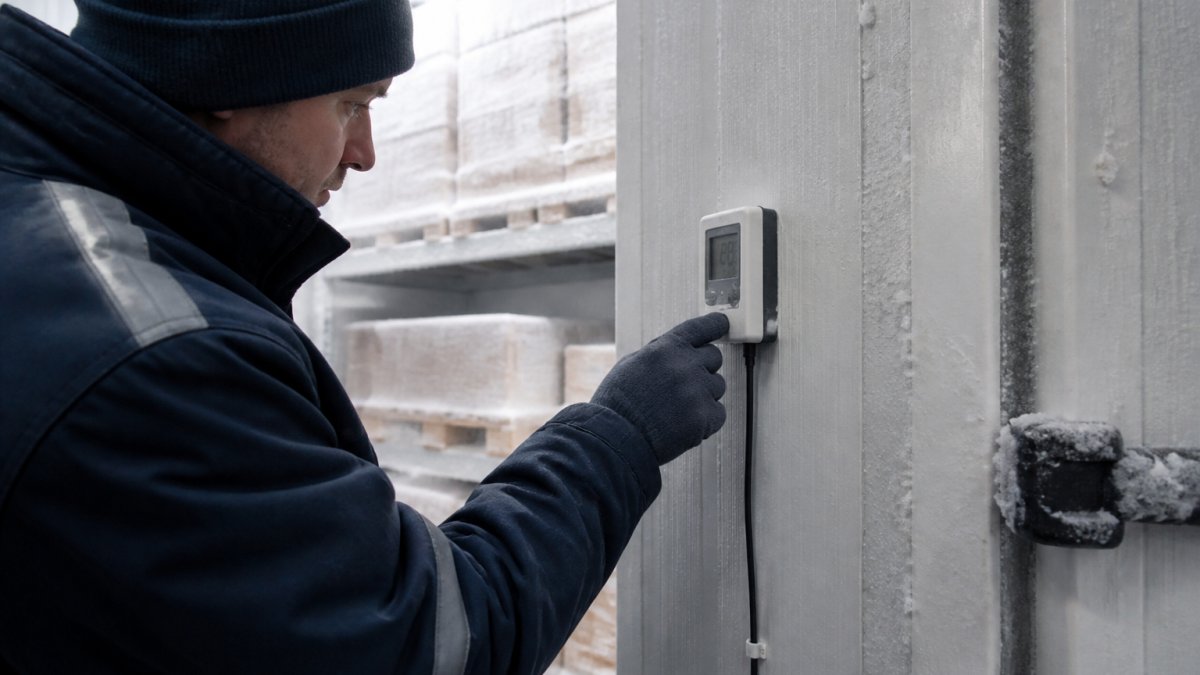
Temperature monitoring is non-negotiable in cold chain logistics. Without real-time data, you won’t know a problem exists until the shipment arrives spoiled.
Selecting the Right Monitoring Equipment
Your monitoring system must provide accurate readings across the entire journey. Data loggers, the industry standard, record temperature at regular intervals for later review.
Choose equipment that fits your specific needs:
- Standalone data loggers: Record temperature only. Cost-effective for basic tracking. Best for shipments where you retrieve data at delivery.
- Cloud-connected sensors: Send real-time alerts if temperature drifts. Higher upfront cost but allow intervention during transit.
- Multi-sensor systems: Track temperature, humidity, and sometimes location simultaneously. Essential for sensitive pharmaceuticals.
Key features to prioritise:
- Accuracy within ±0.5°C
- Battery life matching your shipment duration
- Data storage capacity for entire journey
Real-Time Tracking and Data Logging
Real-time tracking makes cold chain management proactive rather than reactive, catching problems mid-transit instead of after delivery.
IoT-enabled systems transmit data continuously and alert you immediately if temperature breaches your threshold, allowing corrective action such as rerouting, adding ice packs, or adjusting vehicle settings.
Data logging creates a timestamped audit trail that proves compliance during inspections and protects you in product-quality disputes.
Implement these practices with your monitoring system:
- Set alert thresholds 2-3°C above or below your target range (early warning system)
- Check data feeds at least twice daily during transit
- Document any alerts and your response immediately
Temperature Excursion Management and Response
A temperature excursion is any deviation outside a product’s validated range. The response is not simply “discard” or “deliver anyway” but a documented, risk-based decision, most cold-chain failures are recoverable if goods are quarantined quickly and the excursion properly characterised.
Step 1: Detect and characterise the excursion
Record four things before you move anything:
- Magnitude: how far outside the range (for example, 2°C above a 2-8°C target).
- Duration: how long the product was out of range, not just when the alarm fired.
- Product temperature at the time of detection, not the ambient or container temperature.
A single logger reading is not enough. Cross-check against a second sensor, vehicle telemetry, and carrier door-open events; if readings disagree, treat the higher-risk reading as authoritative until proven otherwise.
Step 2: Quarantine immediately
Move the consignment to a controlled environment at the correct temperature and apply a physical hold, a quarantine label, segregated bay, or system status flag. Do not deliver, return to saleable stock, or open the packaging to “check” unless stability data permits a brief ambient check; opening a validated shipper can cause a second excursion.
A quarantined consignment must be visibly and systemically separated from saleable stock. A label alone is not sufficient if warehouse staff can pick the pallet by mistake.
Step 3: Assess product impact
The decision to release or dispose depends on the product, not the size of the deviation alone. Use this hierarchy:
- Manufacturer stability data. Most pharmaceutical and vaccine products have documented permitted excursions (often expressed as a time-temperature budget, for example “up to 24 hours at 25°C”). If the excursion sits inside that budget, the product is generally releasable.
- Product-specific guidance. If no stability data is available, contact the manufacturer or the marketing authorisation holder before making a decision. Do not rely on general rules of thumb.
- Food safety criteria. For perishable food, the relevant test is whether the product stayed within the temperature control requirements of the Food Standards Code (Standard 3.2.2 for food safety practices and general requirements, and Standard 4.2.2 for seafood, for example). Some foods tolerate brief deviations; high-risk ready-to-eat products generally do not.
- Sensory and physical checks. Appearance, texture, and smell are supporting evidence, never the sole basis for release.
A common pattern is a three-tier outcome: release (inside validated limits), conditional release (outside limits but supported by stability data and a documented risk assessment), or dispose (outside limits with no supporting data, or product visibly compromised).
Step 4: Document the decision
Every excursion needs a record that would survive an audit. At minimum:
- Consignment identifiers (batch, lot, product code, quantity).
- The temperature data, including the raw logger file, not just a summary.
- The characterisation from Step 1.
For therapeutic goods, this record forms part of the evidence the Therapeutic Goods Administration expects under the current Good Manufacturing Practice requirements set out in the PIC/S Guide to GMP (PE 009), which Australia adopts. For food, it supports the traceability and recall obligations under the Food Standards Code.
Step 5: Notify the right people, in the right order
Notify internally first (quality, operations, account owner), then the customer, then the carrier. Regulators are notified only where product has been released to market or mandatory reporting applies; telling the customer before characterising the excursion usually creates more confusion than it resolves.
Step 6: Close the loop with corrective action
An excursion is a symptom; corrective action should address the cause, not the shipment. Common root causes and the controls that prevent recurrence:
| Cause | Preventive control |
|---|---|
| Equipment failure | Scheduled servicing, pre-trip checks, redundant cooling units on high-value lanes |
| Door left open | Loading discipline, door alarms, curtain-sided loading docks |
| Ambient extremes | Route and time-of-day planning, validated shipper duration, seasonal packaging changeover |
| Incorrect set point | Two-person pre-shipment verification against the product specification |
| Overloaded vehicle | Load planning against the unit’s rated capacity, not the trailer’s volume |
| Customs or border delay | Pre-clearance, broker briefing, contingency hold capacity at the border |
Review excursion trends monthly. A rising excursion rate on a single lane or carrier is an early warning that a control has failed, long before it shows up as spoilage.
The goal is not zero excursions, it is fast detection, disciplined quarantine, a documented risk-based decision, and a corrective action that stops the same failure recurring.
Cold Chain Management Checklist
Use this checklist before every shipment:
Pre-shipment (48 hours before departure):
- Verify product storage temperature requirements
- Inspect refrigerated vehicle or container for damage
- Test all temperature monitoring equipment
At loading:
- Record initial temperature of vehicle/container
- Place temperature sensors in cargo
- Minimise time between loading and departure
During transit:
- Monitor temperature data at least twice daily
- Document any alerts or deviations
- Confirm vehicle is operating normally
At delivery:
- Record final temperature readings
- Inspect packaging for damage
- Verify product appearance and condition
Regulatory Compliance and Documentation
Cold-chain compliance depends on what you are moving, where it is going, and who is receiving it. Map each product to its regulator, then build one documentation system that satisfies all of them.
Who regulates what
- Food Standards Australia New Zealand (FSANZ) sets the Food Standards Code. For cold chain, the relevant chapters are the food safety standards (Chapter 3), including temperature control requirements for potentially hazardous food, and the traceability and recall provisions. Enforcement sits with state and territory food authorities and, for imported food, with the Department of Agriculture, Fisheries and Forestry.
- Therapeutic Goods Administration (TGA) regulates medicines, vaccines, biologicals, and medical devices. Cold-chain requirements flow from the Good Manufacturing Practice standard (the PIC/S Guide to GMP, PE 009, which Australia adopts) and from the product’s conditions of registration. Wholesaling is licensed under state and territory medicines and poisons legislation, and the TGA’s GDP guidance sets expectations for storage and transport.
- Department of Agriculture, Fisheries and Forestry manages export certification for meat, dairy, seafood, eggs, and live animals, and import conditions for plant and animal products. Export consignments often need a health certificate that depends on documented cold-chain control.
What each regulator actually expects to see
Across all regulators, the evidence base is similar. An auditor will typically ask for:
- A validated storage and transport process, written procedures, temperature ranges by product, and evidence the equipment performs to specification (mapping studies for warehouses and chambers, qualification for shippers and vehicles).
- Contemporaneous temperature records for every consignment, with the raw data available, not just a pass/fail summary.
- Deviation and CAPA records, every excursion, its assessment, the decision, and the corrective action.
Retention periods
Retention is set by the applicable regime, not by preference. As a working rule:
- Therapeutic goods: retain distribution and temperature records for the period required by the GMP and licensing framework, commonly the product shelf life plus one year, and never less than five years for batch-related records.
- Food: retain traceability records for the period needed to support a recall, commonly at least the shelf life of the product, and longer for products with extended shelf life.
- Export certification: retain the records supporting each certificate for the period the certifying body specifies, and at minimum for the life of the certificate plus the relevant audit cycle.
Where regimes overlap, apply the longest applicable period. A single retention schedule that satisfies the strictest regime is simpler to defend than three separate ones.
Building audit readiness
Audit readiness is a system, not a scramble before inspection. The practices that matter most:
- One record, one location. Temperature data, deviation reports, and training records should live in a single system with role-based access, not across email, spreadsheets, and carrier portals.
- Write the procedure you actually follow. Auditors test the procedure against practice. A procedure that describes an ideal process nobody follows is worse than a simpler one that matches reality.
- Qualify your carriers in writing. Keep their cold-chain capability evidence, their temperature data access arrangements, and their incident notification obligations on file and current.
- Run internal audits on a schedule, and record the findings and closures. A documented internal audit programme is strong evidence of a functioning quality system.
- Rehearse a recall. A mock recall that traces a batch from receipt to delivery in a defined time window exposes gaps before a regulator does.
If you ship both food and therapeutic goods, build the documentation system to the therapeutic goods standard. It is more demanding, and a system that satisfies it will generally satisfy food traceability requirements as well.
Documentation checklist by shipment
- Product specification and validated temperature range.
- Shipper or vehicle qualification record.
- Pre-shipment equipment check.
Keep the checklist with the consignment record, not in a separate file. The value of documentation is that it can be produced quickly and completely when someone asks for it.
Building Resilience and Contingency Planning
Cold chain disruptions happen. Your contingency plan determines how quickly you recover.
Develop backup routes. Have alternative carriers, ports, and timing options ready if your primary route faces delays.
Maintain supplier relationships. Strong relationships mean suppliers and carriers prioritise your shipment when issues arise.
Create communication protocols. Define who contacts whom if a problem occurs.
Seatram helps businesses build resilience through proactive planning and real-time visibility.
Measuring Cold Chain Performance
On-time delivery rate: Percentage of shipments arriving within the scheduled window.
Temperature compliance rate: Percentage of shipments with zero temperature excursions.
Excursion frequency and severity: How often deviations occur and how large they are.
Product spoilage rate: Percentage of cargo arriving in acceptable condition.
Cost per shipment: Track transportation, monitoring, and packaging costs.
Carrier performance: Rate each carrier on reliability, communication, and temperature control.
Frequently Asked Questions
What are the three main components of a cold chain?
A cold chain consists of temperature-controlled storage, temperature-controlled transportation, and handling procedures that maintain product integrity. Storage includes refrigerated warehouses and cold rooms that maintain specific temperature ranges. Transportation uses insulated vehicles and refrigerated containers to prevent temperature fluctuations during transit. Handling procedures ensure staff follow protocols for loading, unloading, and monitoring to prevent temperature excursions. Together, these components create a continuous chain of custody that protects perishable goods, pharmaceuticals, and temperature-sensitive products from spoilage and degradation.
How do you maintain temperature control during cold chain logistics transport?
Maintain temperature control by using properly insulated packaging, pre-cooling vehicles before loading, and selecting refrigerated transport appropriate for your product type. Install temperature sensors and data loggers to monitor conditions throughout transit. Plan routes to minimise travel time and avoid unnecessary delays. Train drivers on proper loading techniques to maintain airflow within refrigerated containers. Use thermal packaging materials such as gel packs or dry ice for shorter shipments. Monitor real-time temperature data and establish protocols to respond immediately if excursions occur, including rerouting or emergency cooling measures.
What should a cold chain management checklist include?
A comprehensive cold chain management checklist covers equipment maintenance (regular servicing of refrigeration units), temperature calibration (sensors and thermometers), staff training (proper handling and emergency procedures), packaging standards (insulation and protective materials), monitoring protocols (daily temperature checks and data review), documentation (records of all shipments and excursions), contingency plans (backup equipment and alternative routes), and regulatory compliance (adherence to food safety and pharmaceutical standards). The checklist should also include supplier audits, customer communication procedures, and quarterly reviews of cold chain performance metrics to identify improvement opportunities.
How should temperature excursions be handled in cold chain logistics?
Handle temperature excursions by implementing a rapid response protocol: immediately investigate the cause, assess product impact, and document findings. Isolate affected shipments to prevent further exposure. Contact your logistics provider and customer within one hour of detection. Conduct a risk assessment to determine whether the product remains safe or must be rejected. Document the excursion duration, temperature range, product type, and corrective actions taken. Review root causes (equipment failure, loading delays, route issues) and implement preventive measures. Maintain detailed records for traceability and regulatory compliance. For pharmaceuticals and food products, consult relevant standards to determine if the shipment can proceed or must be destroyed.