
Quick Summary
Shipping chemicals internationally starts with classifying the product as dangerous goods or not, using its Safety Data Sheet, especially Sections 2 and 14. Dangerous goods follow different packaging, documentation and carrier rules for each transport mode, so check every requirement before booking.
- Check Section 2 and Section 14 of the Safety Data Sheet first to classify the chemical.
- Do not book the shipment if you cannot classify the product confidently; ask a specialist or forwarder.
- Air, sea and road each follow different rulebooks, so a product accepted by one mode may be refused by another.
- Confirm the UN certification code on packaging matches the packing instruction for the UN number and packing group.
- Check destination-country restrictions and permit processing times before booking, as these can stop a compliant shipment.
Table of Contents
- Classifying Your Chemical Before You Ship
- International Dangerous Goods Shipping Requirements by Transport Mode
- Chemical Shipping Documentation and Safety Data Sheets
- Dangerous Goods Packaging and Labelling Requirements
- Chemical Import Permits and Destination-Country Restrictions
- Costs, Lead Times and Common Compliance Mistakes
- Booking Your Chemical Shipment with Seatram
- Frequently Asked Questions
Classifying Your Chemical Before You Ship
Shipping chemicals internationally starts with one question: is it dangerous goods? If the answer is yes, the rules for packaging, documents and carriers change completely. Many exporters skip this step and discover the problem only when a freight booking is rejected at the wharf.
Dangerous goods are classified by their hazard properties, such as flammability, toxicity, corrosiveness and reactivity. The Safety Data Sheet (SDS) supplied by the manufacturer is the main reference for this classification. Check Section 2 (hazard identification) and Section 14 (transport information) first.
A decision tree for shipping status
Work through these questions in order:
- Does the product have a UN number listed on its SDS or label? If yes, it is likely regulated dangerous goods.
- Does the SDS list a hazard class from 1 to 9? If yes, it must be declared and packed to the relevant code.
- Is the product a mixture or a solution? If yes, classify the mixture as a whole, not only its active ingredient.
- Does it fall under a limited or excepted quantity rule? Small inner packaging may reduce some requirements, but documentation still applies.
- If you cannot classify it confidently, do not book the shipment. Ask a dangerous goods specialist or your freight forwarder to review the SDS first.
A common mistake is relying on a product name or a marketing brochure. Only the SDS and the regulatory classification decide the shipping status.
Watch out: an incorrect hazard class declared on a booking can lead to cargo being offloaded, storage fees and penalties, even when the goods themselves are safe.
International Dangerous Goods Shipping Requirements by Transport Mode
Each transport mode has its own rulebook, and a product accepted by one mode may be refused by another. Review these hazardous goods transport best practices to handle each mode correctly. The frameworks are not interchangeable: a packing instruction that satisfies air freight may not satisfy sea freight, and a quantity that is routine by sea may be prohibited by air.
Air freight generally follows the IATA Dangerous Goods Regulations (DGR), which are aligned with the ICAO Technical Instructions. Ocean freight follows the IMO International Maritime Dangerous Goods (IMDG) Code. Road and rail movements within Australia fall under the Australian Dangerous Goods Code (ADG Code), while international road legs follow the relevant national or regional rules. Australian exporters should confirm current requirements with Australian Government guidance on dangerous goods transport.
Key differences to plan for:
- Air: tighter quantity limits and stricter packaging rules for many hazard classes. Passenger aircraft carry far less than cargo aircraft, and some classes are forbidden by air entirely. Packing instructions are specific to the UN number and packing group, so the same chemical may need a different pack for air than for sea.
- Sea: larger quantities are often possible, but segregation rules apply inside the container and on deck. The IMDG Code sets stowage categories and separation requirements that depend on the hazard class of every item in the consignment, not just the chemical you are shipping.
- Road: the ADG Code governs domestic movements, including vehicle placarding, driver training and route restrictions. Rules differ by country on international legs, so check each leg of the journey rather than assuming the origin rules apply throughout.
A practical way to compare modes is to work from the SDS Section 14 entry. It lists the UN number, proper shipping name, class and packing group, and often notes whether the substance is forbidden by air or subject to special provisions. From there, check the packing instruction for each mode you are considering and confirm the carrier accepts that class on the route and equipment offered.
Watch out: a booking accepted on the basis of a sea classification can be rejected at the air cargo terminal if the packing instruction or quantity limit for air is different, and the rebooking delay often exceeds the freight saving.
The rules differ by transport mode, so a product accepted by one may be refused by another. The main rulebooks and their key differences are summarised below.
|
Mode |
Governing rules |
Key difference |
|---|---|---|
|
Air |
IATA DGR, aligned with ICAO Technical Instructions |
Tighter quantity limits; some classes forbidden |
|
Sea |
IMO IMDG Code |
Larger quantities possible; segregation rules apply |
|
Road (domestic) |
Australian Dangerous Goods Code (ADG Code) |
Vehicle placarding, driver training, route restrictions |
|
Road (international legs) |
National or regional rules |
Rules differ by country; check each leg |
Chemical Shipping Documentation and Safety Data Sheets
Documentation is where most shipments succeed or fail. The core documents for dangerous goods are the Dangerous Goods Declaration, the SDS and the commercial invoice, and getting them right is essential when shipping chemicals internationally.
Here is a practical document checklist:
- Current Safety Data Sheet, dated within the supplier’s review period
- Dangerous Goods Declaration completed for the correct mode
- Commercial invoice with accurate product descriptions
- Packing list showing UN number, proper shipping name and packing group
- Emergency contact details, available 24 hours
- Any import permits or licences required by the destination country
The SDS fields that matter most for shipping include Section 2 (hazards), Section 9 (physical properties), Section 14 (transport information) and Section 15 (regulatory information). Make sure the proper shipping name in your declaration matches Section 14 exactly.
Dangerous Goods Packaging and Labelling Requirements
Packaging must be approved for the hazard class and packing group of the product, and the approval is shown by a UN certification code. The code is not decorative: it records the packaging type, the performance level tested, and the specific design that passed. Using uncertified packaging where the regulations require certification is one of the most common reasons a consignment is refused at the freight terminal.
Reading the UN certification code
A UN code typically shows the packaging type (for example, a drum or a box), the material, the packing group performance level (X for high hazard, Y for medium, Z for low), and the year of manufacture. The code must match the packing instruction for the UN number and packing group in the relevant mode rulebook. A package certified for a lower performance level cannot be used for a higher hazard product, even if it looks identical.
Selecting the packing instruction
Each mode publishes packing instructions tied to the UN number and packing group. The instruction sets the permitted packaging types, the maximum quantity per package, and any special requirements such as venting or absorbent material. Because the instruction differs between air and sea, confirm it for the mode you are actually booking rather than reusing a previous shipment’s paperwork.
Marking and labelling
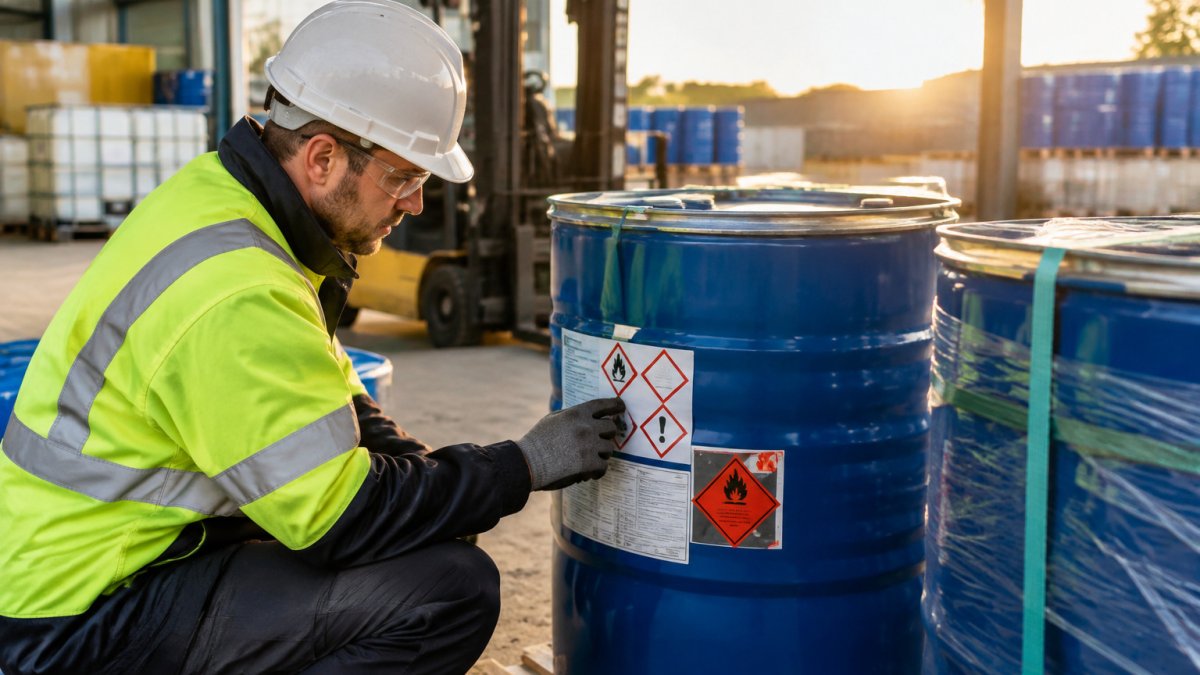
Labelling must show the correct hazard diamond or label for each class, along with the UN number. Outer packages need the correct marks as well, including the proper shipping name and, where required, the shipper and consignee details. Missing or incorrect labels are among the most frequent reasons for shipment refusal.
Pay attention to these points:
- Inner containers must be leak-proof and compatible with the product, and closures must be secured against loosening in transit
- Outer packaging must meet the drop and stacking tests for the mode used, and the certification code must be legible on the package
- Absorbent material may be required for liquids, and the quantity of absorbent must suit the volume of the inner containers
- Labels must be legible, durable and placed on the correct faces, and old labels from previous shipments must be removed or completely obscured
- The UN number must appear adjacent to the proper shipping name on the outer package where the regulations require it
Watch out: a package that passes a visual check can still fail because the certification code does not match the packing instruction for the declared UN number, so verify the code against the rulebook before the courier collects.
Chemical Import Permits and Destination-Country Restrictions
Even a fully compliant shipment can be stopped at the destination. Many countries restrict or prohibit certain chemicals, and some require import permits before the goods can clear customs.
Before booking, check:
- Whether the chemical appears on the destination country’s restricted or prohibited list
- Whether an import permit, registration or licence is required, and how long it takes to obtain
- Whether the importer must hold a specific licence to receive dangerous goods
- Local labelling or language requirements
Permit processing times vary widely. Build them into your timeline, because a shipment that arrives without approval can face storage costs and possible return or disposal.
Costs, Lead Times and Common Compliance Mistakes
Pricing depends on quantity, dates, mode, packaging and delivery terms, so Seatram does not publish fixed rates for dangerous goods. Request a quote from Seatram for current pricing, which depends on quantity, dates, mode and delivery terms. Surcharges for dangerous goods handling, documentation and extended lead times are common and should be confirmed in writing.
Lead times also increase when classification is unclear or permits are pending. Allow extra time for approvals and for carriers that accept dangerous goods on fixed days only.
The most frequent compliance mistakes include:
- Using an outdated SDS
- Declaring the wrong proper shipping name
- Choosing packaging not rated for the hazard class
- Missing or incorrect labels on outer packs
- Failing to check destination-country restrictions
If a shipment is rejected or an incident occurs, stop further movement, notify your forwarder and the carrier, and review the classification and documentation before resubmitting.
Booking Your Chemical Shipment with Seatram
Seatram is a specialist provider of freight forwarding and logistics services, offering sea, air and land options with tailored end-to-end solutions.
Whether you ship by wharf-to-wharf or door-to-door, our team can discuss your shipping requirements with you. Compare the international shipping options for businesses like yours before you book. You can read more about how to ship dangerous goods internationally and see what dangerous goods shipping costs in Australia before you request a quote.
Request a quote to discuss the requirements for your chemical shipment.
Frequently Asked Questions
What documents are required to ship chemicals internationally?
Most international chemical shipments need a dangerous goods declaration where the goods are classified as dangerous, a commercial invoice, a packing list and the Safety Data Sheet for the substance. Carriers typically ask for the UN number, proper shipping name, hazard class and packing group before accepting cargo. Requirements differ by transport mode and destination, so confirm the full document set with your freight forwarder before booking.
Do I need a Safety Data Sheet to ship chemicals overseas?
In most cases, yes. The Safety Data Sheet provides the physical hazards, health hazards and transport information needed to classify the substance and prepare compliant packaging and labels. Carriers and destination authorities may request it during acceptance or customs clearance. Check that the SDS is current and matches the exact product and concentration you are shipping, as an outdated or mismatched sheet is a common cause of delayed or rejected cargo.
Can chemicals be shipped internationally by air or sea?
Yes, but the rules differ. Air transport generally applies stricter limits on quantities and packaging, and some substances are prohibited on passenger aircraft entirely. Sea transport follows the IMDG Code and allows larger quantities, though segregation requirements apply when different hazard classes are stowed together. Ground transport across borders follows its own regional rules. Tell your forwarder the mode and route early so the classification and packaging match the relevant regulations.
How do I check whether a destination country permits a chemical import?
Start by checking the import rules of the destination country with its customs authority and relevant chemical regulator, and confirm whether the substance needs a permit, registration or prior notification. Some countries restrict or ban specific chemicals regardless of how they are packaged. The consignee should confirm the requirements in writing before the goods leave Australia. Pricing and timeframes for permits vary, so request a quote from Seatram for current pricing.
