
Quick Summary
To ship temperature sensitive products safely, first confirm the exact temperature range and shelf life from the supplier’s data sheet. Then match temperature controlled packaging to the route, add a monitoring device inside the package, prepare a complete compliance file, and plan routing to limit handoffs and port dwell time.
- Approximately 20% of temperature-sensitive products are damaged in transport due to temperature fluctuations and logistics failures.
- Confirm minimum and maximum temperatures in writing, plus the maximum time the product can stay outside its range.
- Packaging should match route length, so a short domestic trip needs less protection than a multi-week ocean voyage.
- Place the temperature logger close to the product, not the coolant, and test it before every shipment.
- Get carrier acceptance criteria for dry ice weight and labelling before designing the package.
Table of Contents
- What Makes Temperature Sensitive Shipping Different
- Step 1: Confirm Your Product’s Temperature Range and Shelf Life
- Step 2: Choose Temperature Controlled Packaging Requirements That Fit Your Route
- Step 3: Add Temperature Monitoring Devices for Shipping
- Step 4: Meet Compliance Standards for Perishable Goods Transport
- Step 5: Plan Routing, Transit Times and Port Dwell
- Booking Your Temperature Sensitive Shipment With Seatram
- Frequently Asked Questions
What Makes Temperature Sensitive Shipping Different
Last Updated: November 10, 2026
Products that are ship temperature sensitive can lose value long before they reach the customer. A pharmaceutical batch, a food ingredient or a biological sample may fail if it drifts above or below its safe range for even a short time. That is what makes how to ship temperature sensitive products a different job from standard freight. Readers who want to see how another high-risk cargo category is handled under strict rules can read dangerous goods shipping guide for comparison.
Seatram handles this kind of cargo as part of its freight forwarding work.
Research published in 2026 puts the risk in plain numbers. Approximately 20% of temperature-sensitive products are damaged during transportation due to temperature fluctuations and logistics failures (FleetRabbit, 2026) FleetRabbit cold chain logistics 2026 report.
Temperature-sensitive cargo also faces more handoffs than most freight. Each handoff, whether at a port, an airport or a warehouse, is a point where the cold chain can break. Extended dwell times at ports are a known problem. Industry guidance for 2026 notes that long port waits create compliance and cargo integrity risks, particularly under US FDA and FSMA rules for shippers operating across those markets (Integrated GL, 2026) Integrated GL temperature-controlled freight compliance guide.
Three things set this work apart from ordinary shipping:
- Narrow tolerances: Many products only tolerate a few degrees of variation.
- Longer exposure risk: Delays, customs holds and transfers all add time at the wrong temperature.
- Documented proof: You often need records showing the temperature held the whole way.
Watch out: A cooler that works in the warehouse can still fail on the tarmac or at the port. Check the full route, not just the packing step.
Step 1: Confirm Your Product’s Temperature Range and Shelf Life
Start by confirming the exact temperature range your product needs before you ship temperature sensitive goods of any kind. The supplier’s data sheet or product specification is the right source, not a rough guess. Write down the minimum and maximum allowed temperatures, and how long the product can stay outside that range before it fails.
Shelf life matters just as much. A product with a long shelf life can absorb a delay that would ruin a short-dated one. Ask the supplier whether the product can tolerate brief excursions, and in what conditions.
Use this checklist before moving on:
- Confirmed minimum and maximum temperatures in writing
- Noted the maximum time outside the range
- Recorded the remaining shelf life at dispatch
- Checked whether the product is also sensitive to humidity or light
Clear answers here drive every decision that follows, from packaging to the choice of carrier.
The checks below summarise what to confirm before you ship, so you can review them at a glance.
| Check | What to confirm | Why it matters |
|---|---|---|
| Temperature range | Minimum and maximum allowed temperatures, in writing | Sets the band the whole shipment must hold |
| Time outside range | Maximum time the product can stay outside its range | Shows how much delay the product can absorb |
| Shelf life | Remaining shelf life at dispatch | A short-dated product tolerates less delay |
| Other sensitivities | Humidity or light sensitivity | Affects packaging choices beyond temperature |
Step 2: Choose Temperature Controlled Packaging Requirements That Fit Your Route
Packaging has to match the route and the length of the journey. A short domestic trip in mild weather needs far less protection than a multi-week ocean voyage through hot ports. For deeper process detail, see the cold chain logistics step-by-step guide.
For most small and medium businesses, the packaging decision is really a cost-per-shipment decision. A useful way to compare options is to work out the total cost of a failed shipment, which is the product value plus re-shipment, handling and customer goodwill, and then ask how much extra packaging spend would have prevented that failure at an acceptable rate.
Sustainability now shapes this choice as well. Expanded polystyrene (Styrofoam) insulation is widely used but is hard to recycle in most Australian kerbside systems. Alternatives include molded pulp and mushroom-based insulators, cellulose or wool-based liners, and reusable insulated shippers with a return loop.
The packaging also has to meet the cargo’s own rules. Dry ice is a regulated dangerous good for air and many road and sea movements, and its quantity limits and labelling requirements differ by carrier and mode. Confirm these with your forwarder before booking, because a package that is compliant for one carrier can be refused by another.
Common mistake: Choosing packaging based on the product alone and ignoring the route. Two identical shipments can need different packaging if one goes by air and one goes by sea.
Active Versus Passive Cooling: Which Suits Your Cargo
Passive cooling uses insulation and coolants that work without power. It is simpler and cheaper, but protection lasts only as long as the coolant does. Once it runs out, the package warms or cools toward ambient.
Active cooling uses a powered unit that holds a set temperature. It suits longer journeys and tighter tolerances, but costs more and needs power, monitoring and a plan for what happens if the unit fails in transit.
As a working rule, use passive cooling for shorter, predictable routes with generous tolerances. Move to active cooling when the journey is long, the window is narrow, or the route carries a real chance of unplanned delay. Costs and availability vary by route and season, so request current quotes rather than relying on rough figures.
Watch out: A package that passes its test in a temperature-controlled room can still fail on a hot tarmac or in a port holding area, so test under conditions closer to the real route.
Step 3: Add Temperature Monitoring Devices for Shipping
A temperature monitoring device, often called a data logger, records the temperature inside the package at set intervals. It gives you proof that the cargo stayed within range, and it shows exactly when and where any excursion happened.
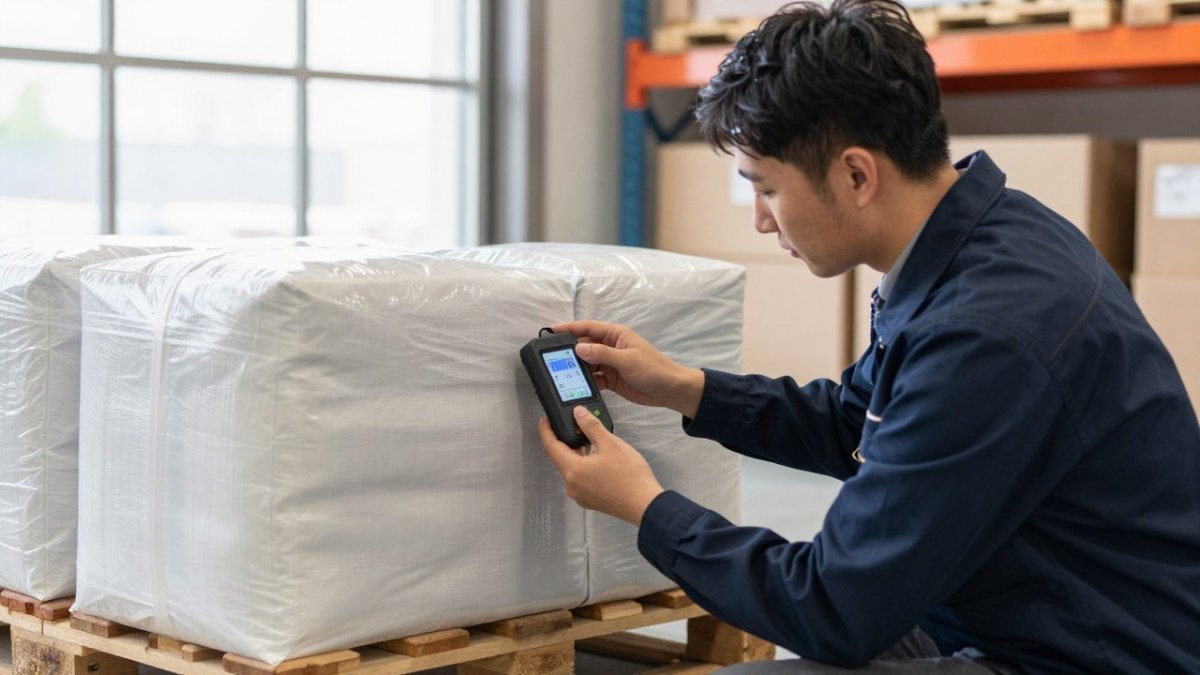
Place the logger inside the packaging, close to the product rather than against the outer wall. Check that it is calibrated and that it starts recording before the package is sealed.
Some monitoring devices send live alerts during transit. Others only store data until the package is opened at its destination. Live tracking helps when a delay can still be fixed, such as re-routing a container or moving cargo to a cooler facility.
A logistics coordinator in a warehouse checking a small data logger attached to an insulated pallet of packaged goods would look something like this in practice.
Watch out: A logger that is not switched on, or is placed where it reads the coolant instead of the product, gives false comfort. Test it before every shipment.
Step 4: Meet Compliance Standards for Perishable Goods Transport
Compliance depends on what you ship and where it is going. Food, medicine, biological samples and dangerous goods each carry their own rules, and those rules often cover labelling, documentation, handling and record keeping. They can also differ between origin and destination, so a file that satisfies the exporting country may still be refused on arrival.
For Australian importers and exporters, the Department of Agriculture, Fisheries and Forestry sets biosecurity and import conditions for many perishable goods, and the Therapeutic Goods Administration regulates medicines and certain medical products. Check the current conditions on each agency’s official website before booking, because requirements change and a conditions sheet from a previous shipment can be out of date.
Carrier rules are the layer most guides leave out. Airlines and shipping lines each set their own limits on dry ice quantities per package and per aircraft or vessel, their own acceptance conditions for dangerous goods declarations, and their own labelling formats.
Build the compliance file before the cargo is packed. A typical file includes:
- Certificates of analysis or health certificates where required
- Temperature records from the monitoring device
- Labelling that meets both origin and destination rules
- Dangerous goods declarations and carrier acceptance confirmation, if applicable
When something does go wrong, the file also determines how quickly you can respond. If a shipment arrives outside its range, the first steps are to secure the package without opening it further, pull the data logger record, photograph the packaging and temperature indicator, and notify the consignee and forwarder in writing with timestamps.
Missing paperwork is one of the most common causes of customs holds, and holds are one of the biggest sources of temperature breaks, so the time spent on this file is usually recovered many times over.
Step 5: Plan Routing, Transit Times and Port Dwell
Route planning is where most cold chain failures are prevented or caused, and it matters most when you ship temperature sensitive cargo across several handoffs. Map every leg of the journey, including trucking to the port or airport, the main transport, and the final delivery. Each leg is a potential failure point.
Ask your forwarder for realistic transit times, not best-case estimates. If you are concerned about damage or loss during long transit and port dwell, review freight forwarder liability for damaged cargo. Build in buffer time for customs, port congestion and weather. Find out how long cargo will sit at each transfer point, because port dwell is often the longest and least predictable stage.
Consider these routing questions:
- How many handoffs does the route involve?
- Which ports or airports have a record of long waits?
- Is there a cooler facility close to each transfer point?
- What is the backup route if the main one is disrupted?
Good routing is not the cheapest route on paper. It is the route with the fewest unplanned stops and the clearest record at each one.
Booking Your Temperature Sensitive Shipment With Seatram
Once you have your temperature range, packaging, monitoring plan, compliance file and route, you are ready to book. Seatram is a specialist freight forwarder for sea, air and land freight, and we tailor logistics solutions to each client’s requirements.
Seatram can help you think through packaging, monitoring and compliance steps for your shipment. For a quote, pricing depends on quantity, dates and delivery location, so contact us with your product details and route.
Before you contact us, it can help to read the project cargo comparison guide, which covers what to check when choosing a forwarder for specialised freight.
Frequently Asked Questions
What are the main challenges in cold chain logistics?
The main challenges are holding a steady temperature across handovers, managing delays at ports and airports, and protecting cargo from excursions that go unnoticed until delivery. Shipping experts also point to compliance gaps and the cost of spoiled stock. Temperature fluctuations and logistics failures can damage sensitive products in transit, which is why planning packaging, monitoring and routing together matters.
How do I maintain temperature control during long-haul freight?
Start with packaging rated for your full transit time, including buffer for delays. Pair it with a temperature monitoring device that logs readings throughout the journey, and confirm how your carrier handles reefer or ambient legs. Plan for dwell time at transhipment points, since extended port waits are one of the most common causes of excursions on long routes.
What packaging materials are best for temperature sensitive shipping?
The right material depends on your product’s required range and how long it will be in transit. Insulated shippers, phase change materials and gel packs each suit different temperature windows, and dry ice is used where sub-zero conditions are needed. Pricing depends on quantity, dates and delivery, so request a quote from Seatram for current costs rather than relying on estimates.
How can I monitor temperature during transit?
Use data loggers or real-time sensors placed inside the packaging, not just on the pallet exterior. Choose devices that record at short intervals and can share alerts during transit. Review the logged data at delivery and keep the records with your shipping documents, as they are valuable evidence if a claim needs to be made.
